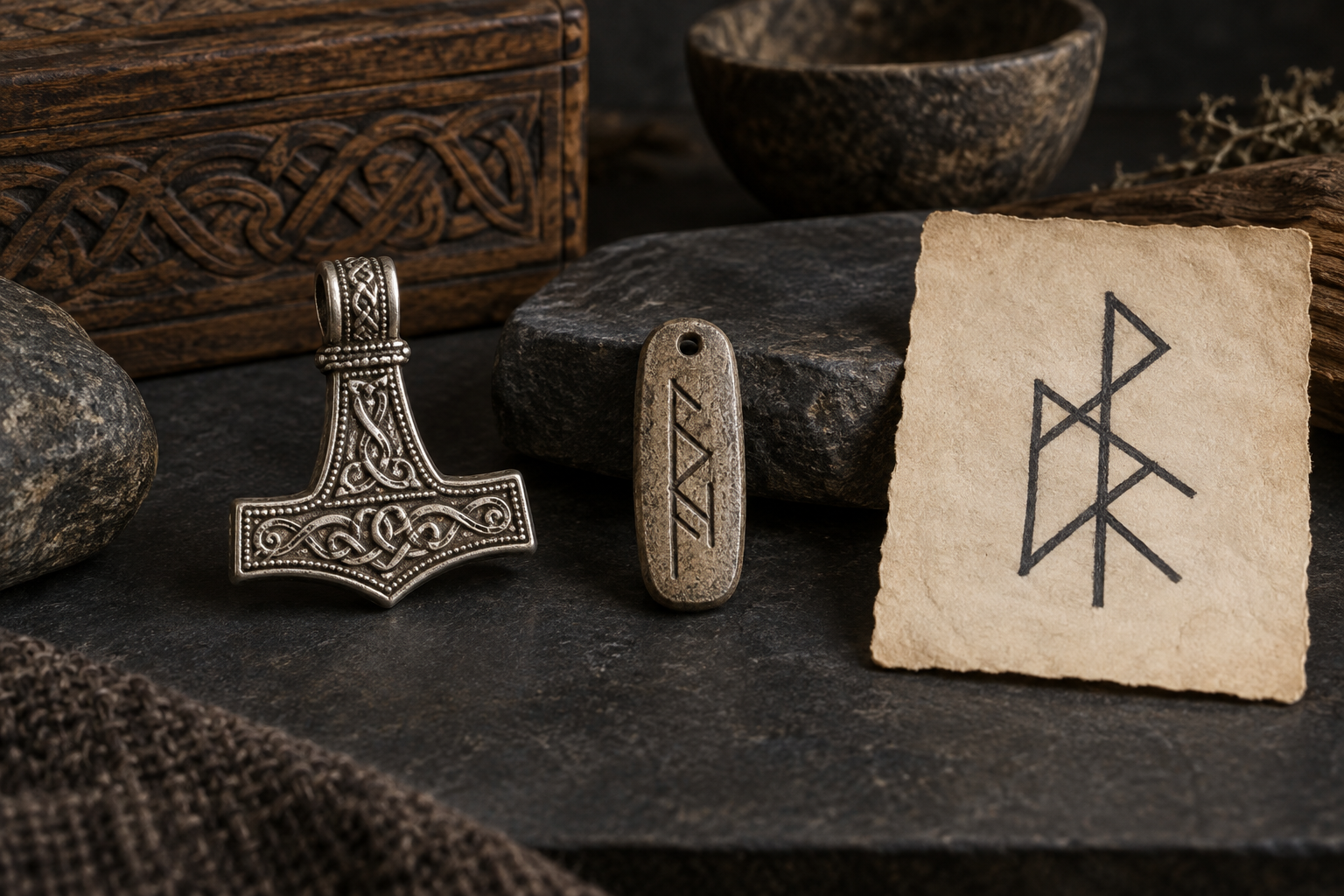
Meaning at a glance
Documentary evidence from Scandinavian museums shows Viking Age protection objects primarily as Thor's-hammer amulets and isolated runic inscriptions; many contemporary 'protection charts' and fixed bindrune recipes are modern creations that reinterpret or extend that material.
What the archaeological and museum evidence shows
The best-documented protective objects from the Viking Age that relate to what we now call 'Norse protection symbols' are Thor's-hammer amulets and certain runic inscriptions used in inscriptions on small objects. The National Museum of Denmark discusses clothing and jewellery from the Viking Age and records that pendants and amulets bearing hammer motifs appear in the archaeological record, often interpreted as expressions of devotion to Thor or as protective talismans. These are physical objects recovered from Scandinavian contexts and curated in museum collections.
Runic inscriptions are another verified category of evidence, but their use and meaning vary. The Swedish History Museum provides an overview of runes and emphasizes that runic writing is a real, documented practice across many centuries in Scandinavia. Some runic inscriptions include short formulaic phrases, names, or marks that may have been intended to identify ownership, commemorate a person, or carry simple wishes. A small number of inscriptions have been interpreted by specialists as having protective intent, but these are isolated instances rather than evidence of a single, standardized system of protective symbols used uniformly across Viking Age communities.
Both museums highlight that the archaeological record is fragmentary. Objects survive unevenly in graves and hoards, and surviving inscriptions are often short and context-dependent. The Swedish History Museum notes that runes and objects must be read in context, and the National Museum of Denmark stresses careful interpretation of jewellery finds in relation to clothing, status, and belief. Taken together, the museum evidence supports the thesis that some tangible items served protective or devotional roles, but it does not support the idea of a comprehensive, codified protection chart widely used in the Viking Age.
Precise cultures and periods
When we talk about 'Norse' protection symbols in a historical sense, we are primarily referring to material culture from the Viking Age in Scandinavia. The Viking Age is the period most commonly associated with the archaeological finds discussed by the National Museum of Denmark and the Swedish History Museum, and that is the context in which Thor's-hammer pendants and runic inscriptions appear most frequently in surviving material. The term 'Norse' can also be used more broadly to refer to related Germanic-speaking communities in earlier and later centuries, but the specific objects most often invoked in modern jewellery—hammer amulets and short runic inscriptions—are mainly Viking Age artifacts recorded in Scandinavian museum collections.
It is important not to generalize these findings beyond the regions and periods where they were used. Practices and meanings could differ between communities in what are now Denmark, Sweden, and Norway, and chronological changes occurred over centuries. The museum sources caution against assuming uniform meaning or ritual use across time and place.
Documented historical meanings vs modern interpretations
The archaeological record provides limited but concrete clues about what specific objects meant in their original contexts. Thor's-hammer amulets, for example, have a clear material presence in the record and are often interpreted by historians and archaeologists as symbols associated with Thor and possibly with protection, fertility, or identity. The National Museum of Denmark presents these finds within the broader fabric of Viking Age clothing and jewellery, suggesting their role in personal display and religious expression rather than as evidence of a formalized talismanic system.
By contrast, many popular modern interpretations—such as elaborate protection charts, standardized lists of protective runes, or ritualised 'intention bindrunes' sold as if they replicate a Viking Age practice—are contemporary reconstructions. The Swedish History Museum emphasizes that runes were used in many ways, but does not support the existence of a single ancient manual prescribing how to combine runes into fixed protective formulas. Modern bindrunes, where multiple runic characters are graphically overlapped to form a single symbol for a stated purpose, are often creative designs inspired by historic runes rather than direct survivals of Viking Age practice.
Distinguishing the two matters for accuracy and respect for historical cultures. Use the documented evidence—Thor's-hammer amulets, isolated runic texts, and context notes from museum collections—when claiming a direct link to the past. Treat constructed systems, charts, and modern ritual uses as contemporary responses to that past, valuable for personal meaning but not equivalent to archaeological fact.
How these motifs and traditions appear in jewelry today
In contemporary jewellery, motifs inspired by Viking Age finds are common. The Thor's-hammer motif is used widely as pendants, brooches, or engraved charms, drawing directly on the shape and image of archaeological hammer amulets recorded by museums. Runic characters are engraved on rings, necklaces, and cuffs as single letters, names, or short words. Designers may also create stylized 'bindrunes' by merging runic shapes for aesthetic or symbolic purposes.
Materials and manufacturing techniques differ from the Viking Age: modern reproductions are commonly made in silver, bronze, or steel using contemporary casting and finishing methods rather than the original smithing techniques. Some makers aim for archaeological fidelity and explicitly model their items after museum examples, while others produce inspired designs that blend historical elements with modern fashion. The Swedish History Museum and the National Museum of Denmark both advise clear labeling: objects inspired by historical finds should be described as modern reproductions or contemporary designs rather than original artifacts.
Practical and respectful guidance for selecting or gifting Norse-protection jewelry
If you want a piece that connects to documented Viking Age practice, choose designs that have a clear archaeological reference and that are presented with transparent provenance. Museums and reputable makers will note when a design is taken from a specific find or inscription and will explain what is known and what is inferred. This transparency respects the historical record and helps the wearer understand the difference between an artifact and an artistic reinterpretation.
If you are drawn to modern bindrunes or protective charts, treat them as contemporary symbolic jewellery rather than as exact restorations of Viking Age rituals. Many people find personal meaning in creating or wearing a bindrune; that is a valid modern spiritual or aesthetic choice. When gifting, consider the recipient's cultural background and beliefs. Some recipients will appreciate a historically grounded piece; others will welcome a modern symbol created for a personal intention. Avoid presenting modern inventions as 'authentic Viking magic' if you know the recipient cares about historical accuracy.
Practical considerations also matter: ask about metal allergies and preferred wear styles, check the maker's return policy, and look for clear craftsmanship information. If buying from a seller who references museum objects, prefer items that explicitly state whether they are reproductions, inspired designs, or direct casts of museum-held finds. This approach supports ethical collecting practices and shows respect for the cultures whose material heritage informs modern designs.
Concluding note
In short, there is verified Viking Age evidence for several kinds of objects now associated with protection—most notably Thor's-hammer amulets and some runic inscriptions—recorded in Scandinavian museum collections. At the same time, many of the fixed protection systems and standardized bindrunes common in modern jewellery are creative reconstructions or new symbolic systems inspired by that past. Using historically documented forms can be meaningful and respectful when clearly labeled, and contemporary reinterpretations can also carry sincere personal value if presented honestly.
Frequently asked questions
Were Thor's-hammer amulets actually used for protection in the Viking Age?
Thor's-hammer pendants are well-documented in Viking Age finds and are often interpreted as expressions of devotion to Thor or as personal talismans, but museum sources like the National Museum of Denmark treat such interpretations cautiously and place them in context rather than asserting a single fixed meaning.
Do runes have specific protective meanings?
Runes were used for many purposes—inscriptional, commemorative, and sometimes apotropaic—according to the Swedish History Museum, but the archaeological record shows only occasional inscriptions that specialists read as protective; there is no single standardized set of runes universally used for protection in the Viking Age.
What are bindrunes, and are they historical?
Bindrunes—composite symbols formed by merging runic characters—do appear in various contexts but the widespread modern practice of creating fixed 'protection bindrunes' as a standardized system is largely a contemporary design and spiritual innovation rather than a documented Viking Age technique, per museum guidance.
How can I choose a respectful Norse-inspired piece?
Choose items that are clearly labeled as museum-inspired reproductions if they are modeled on a specific find, prefer makers who disclose sources, consider the recipient's cultural perspective, and avoid claiming that modern-designed protection charts are direct historical continuations.
Are modern Norse-style protection pieces offensive?
Not inherently; many people create and wear Norse-inspired jewellery respectfully. Concern arises when modern items are marketed as 'authentic Viking magic' or when cultural heritage is misrepresented. Transparency about whether a piece is a reproduction or a modern design helps avoid misuse.
Sources and further reading
- Runes — Swedish History Museum
- Clothes and jewellery — National Museum of Denmark
- The sources for what we know — Swedish History Museum