Meaning at a glance
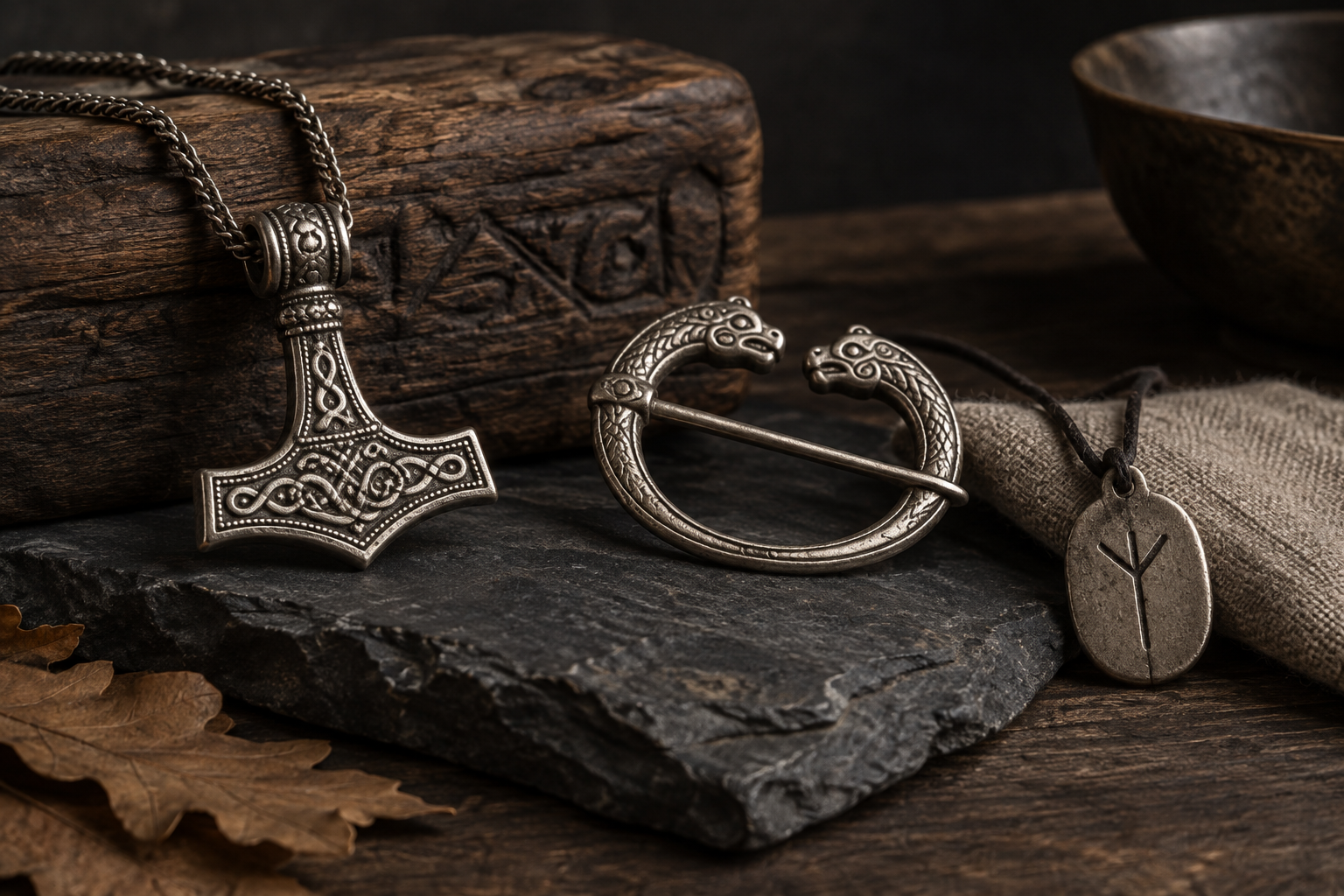
Norse-themed strength and courage jewelry often uses Mjölnir, animal and heroic motifs, and rune motifs; archaeological and museum evidence supports some traditional associations but does not justify claiming every motif had a single, universal meaning.
What the historical evidence shows (and which cultures and periods it covers)
Archaeological finds from the Viking Age (roughly late 8th to mid-11th centuries) and related early medieval contexts in Scandinavia show that people wore metal amulets, brooches, and pendants that carried images and symbols. The National Museum of Denmark documents the presence of god-figures and amuletic jewellery in Viking Age contexts and treats such finds within the history of Viking religion and personal adornment, making clear that these objects appear in archaeological and historical records rather than in modern marketing alone.
Similarly, the Swedish History Museum explains the rune alphabet as a historical writing system used across Scandinavia and beyond, with runes appearing on stones, wood, metal and other objects from the early centuries CE through the Viking Age. Runes were used for names, messages, memorial inscriptions and occasionally short inscriptions whose purpose may have been personal, commemorative or practical.
Taken together, the museum evidence establishes two facts relevant to strength-themed jewelry: first, certain motifs—most famously Thor’s hammer—are attested on archaeological pendants and other personal objects; and second, runic inscriptions and other iconography are historical elements that have been repurposed in modern designs. The museums’ materials caution readers that modern interpretations and commercial uses often layer new meanings onto these older objects.
Documented historical meanings versus modern personal interpretations
Where museums and archaeology provide relatively direct evidence, the context is usually specific and limited: a small metal pendant shaped like a hammer is archaeologically associated with Thor in the literary record and with amuletic use in material culture, but that evidence does not automatically mean every hammer-shaped object in later media, or every depiction of a hammer in modern jewelry, carried an identical, fixed meaning for all Viking Age wearers. The National Museum of Denmark presents Thor and related god-figures within the religious and ritual landscape of the Viking Age, but it does not offer a single, exhaustive list of symbolic meanings that applied consistently to all communities or individuals.
Runes are historically attested as a writing system. The Swedish History Museum emphasizes their role as an alphabet used for communication. Modern ‘rune meanings’ frequently used in jewelry—where individual runes are assigned particular powers such as protection, strength, or luck—are largely contemporary reconstructions or modern spiritual readings rather than straightforward continuations of a single, uniform Viking practice.
Animal motifs and heroic scenes appear in Norse art and artefacts, but their meanings varied by context, region, and time. Museum documentation shows motifs were used in clothing and jewellery, yet assigning a single symbolic reading such as ‘this animal equals courage’ across all Viking Age contexts is not supported by the archaeological record cited by those museums.
Common motifs associated with strength and how they appear in historical records
Mjölnir (Thor’s hammer). Pendants shaped like a short-handled hammer are among the best-known Viking Age finds and are often discussed in museum treatments of Norse religion and personal ornament. These pendants are commonly interpreted as markers of devotion to Thor, and in archaeological publication and museum displays they are frequently linked to concepts of protection and the god’s power. Museum accounts make clear that such associations are part of a broader religious and cultural context rather than a universal formula.
Heroic and martial imagery. Scenes and figures drawn from heroic poetry and saga traditions later recorded in medieval manuscripts sometimes have antecedents in earlier decorative art. Jewellery showing warriors, weapon motifs, or battle-related iconography can be linked in broad terms to martial identity or prestige in the Viking Age, but specific symbolic readings are contextual and not uniform across time or place, according to museum sources.
Animals and animal-style ornament. Animal motifs—interlaced beasts, serpents and other zoomorphic designs—are widespread in Viking Age metalwork and clothing accessories. Museums treat these motifs as decorative styles that could also carry narrative or symbolic resonance depending on the object and its find context. They are not, however, a simple, universal shorthand for courage or strength in the way modern marketing sometimes portrays them.
Runes, bind runes, and modern readings
Historically, runes were a script. The Swedish History Museum provides an overview showing runes used to record names, memorials, messages and short inscriptions across centuries. While some historical inscriptions may have had apotropaic or comparable uses, the primary evidence is of runes functioning as writing rather than as a fixed catalogue of magical properties.
Bind runes and single-rune ‘strength’ talismans are predominantly modern practices in contemporary jewellery design. Designers combine historical rune forms with contemporary symbolism, and many consumers wear runes today for personal meanings such as courage or resilience. Museums note that these contemporary attributions should be presented as modern interpretations and not as direct, unchanged continuations of Viking Age beliefs.
How motifs, materials and traditions appear in contemporary jewellery
Contemporary Norse-style jewellery draws on archaeological motifs, medieval literature and modern symbolism. Typical items include Mjölnir pendants reproduced from archaeological examples, rings and bracelets engraved with runes, and pieces that incorporate animal-style ornament inspired by Viking art. Modern makers use a range of metals—silver, bronze and alloys—and often include contemporary materials such as gemstones, leather cords, or synthetic beads to meet current tastes.
Where museums provide reproductions or encourage historically informed designs, the emphasis is typically on accuracy in form and honest labeling. The National Museum of Denmark’s discussions about clothes and jewellery underline the importance of distinguishing between historical artefacts and modern reproductions or reinterpretations. This is important both for consumer transparency and for respectful engagement with the past.
Respectful and practical guidance for selecting or gifting Norse strength-symbol jewellery
Choose pieces with accurate labeling. Prefer makers or sellers who clearly state whether a piece is an archaeological reproduction, a modern design inspired by Viking art, or a contemporary symbolic piece. Museums recommend clarity so wearers and recipients understand whether they are buying history or a modern reinterpretation.
Consider provenance and context. If the buyer seeks a historically grounded item, look for references to archaeological finds, museum reproductions, or collaboration with historians or craftspeople who follow archaeological models. If you prefer modern symbolism—such as a rune chosen for personal meaning—look for creators who explain the modern interpretation rather than claiming it as an unbroken Viking tradition.
Be mindful of cultural sensitivity. Avoid marketing or gifting that reduces Norse heritage to caricatures, or that blurs historical material with political messaging. Respectful engagement means recognizing that symbols and motifs have complex histories and that not every modern assignment of ‘strength’ or ‘courage’ reflects an ancient, uniform belief.
Ask about materials and care. Contemporary Norse-style pieces use many materials; if the recipient has metal sensitivities or prefers period-accurate techniques, inquire about metals and construction. For heirloom-quality gifts, prioritize reputable makers, hallmarks, or museum-reproduction quality descriptions.
Explain your intention. When giving a piece as a token of strength or courage, a short note explaining whether the meaning is personal, modern, or drawn from historical sources helps the recipient appreciate the context and avoids accidental misrepresentation.
Final note
If your interest in Norse strength symbols is aesthetic, commemorative, or spiritual, you can find richly evocative designs inspired by Viking Age art. If your interest is historical, consult museum resources and favour labeled reproductions or pieces made with scholarly input. The museums cited here underline that while many motifs have historical roots, modern meanings are layered on top of those roots; accurate labeling and respectful interpretation help keep history and contemporary use distinct.
Frequently asked questions
Are Mjölnir pendants authentic Viking symbols of strength?
Pendants shaped like Thor’s hammer appear in Viking Age archaeology and museum displays and are commonly linked to Thor and protective use. Museums such as the National Museum of Denmark present these finds within the religious context of the Viking Age, but this archaeological evidence does not mean every modern hammer-shaped piece automatically has the same historical meaning for all ancient wearers.
Do runes on jewelry historically represent magical protections for courage?
Runes were historically a writing system used for names, messages and memorial inscriptions, as explained by the Swedish History Museum. While some historical inscriptions may have had personal or protective purposes, assigning fixed magical properties to individual runes is largely a modern interpretive practice rather than a uniformly documented Viking Age usage.
Is it offensive to wear Norse symbols as modern jewelry?
Wearing Norse symbols is not inherently offensive, but it becomes problematic when symbols are used in ways that misrepresent history or promote exclusionary ideologies. Choose items with accurate labeling, avoid political appropriations, and respect the cultural complexity behind these motifs.
How can I tell if a piece is a historical reproduction or a modern design?
Look for accurate descriptions from the seller or maker. Reputable sellers will state whether a piece is a reproduction of an archaeological object, inspired by historical motifs, or a contemporary symbolic design. Museum-led reproductions and items made with scholarly input are the best options if you want historical fidelity.
What should I consider when gifting Norse-themed strength jewelry?
Consider the recipient’s interest in history, spirituality or style. Include a note explaining whether the meaning is personal or historically grounded, choose makers who label their work clearly, and avoid pieces that use Norse imagery to promote harmful ideologies.
Sources and further reading
- The Viking gods — National Museum of Denmark
- Clothes and jewellery — National Museum of Denmark
- Runes — Swedish History Museum