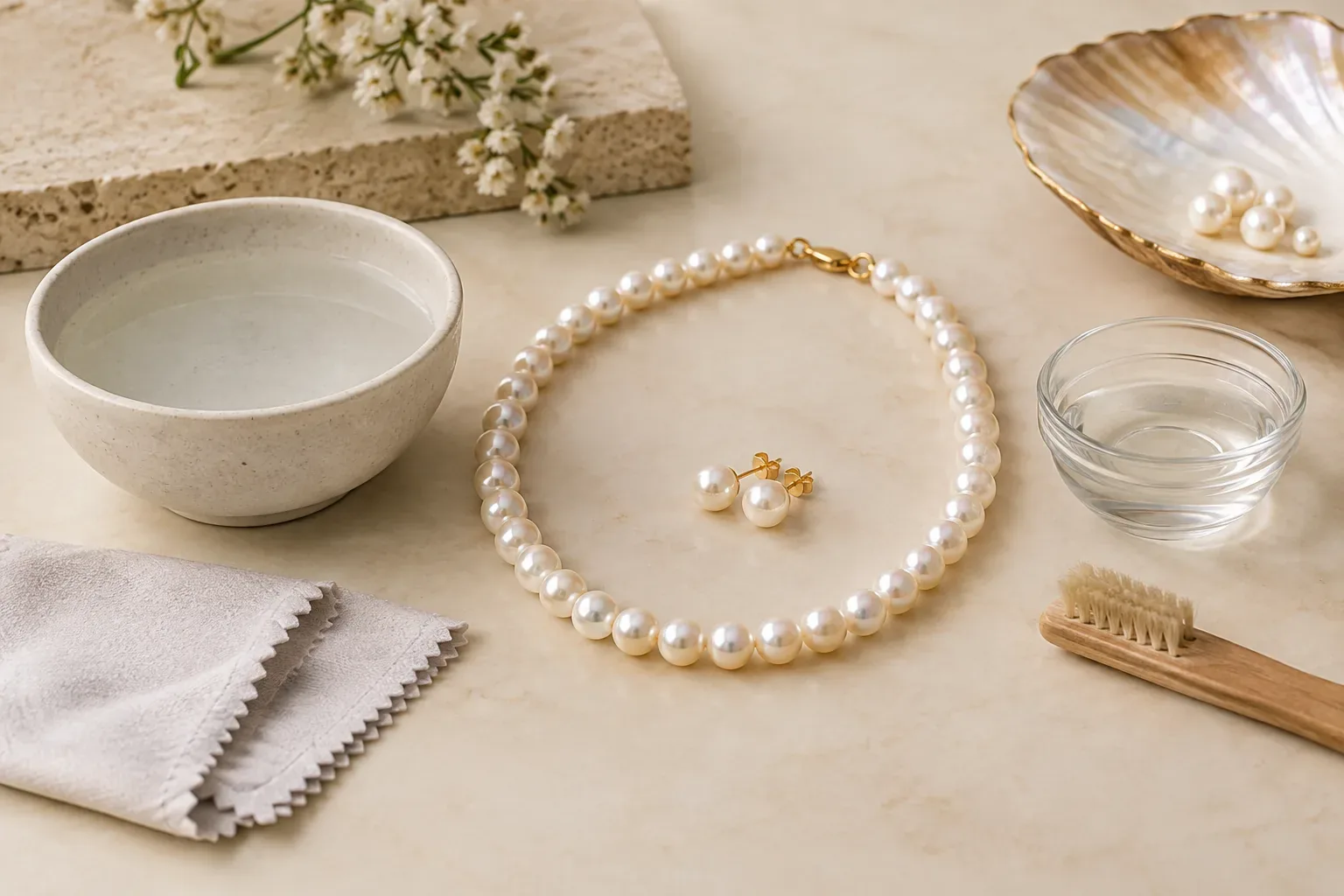
Meaning at a glance
This pearl cleaning guide gives decision criteria and step-by-step safe care for pearls, explains trade-offs between at-home cleaning and professional service, and clarifies what requires verification by a qualified jeweler or gemological laboratory.
Direct answer — the short, practical thesis
Clean pearls gently with a soft, slightly damp cloth and mild soap when needed; avoid ultrasonic cleaners, steam, strong chemicals, and high heat. For valuable, antique, or unknown pearls, or if the strand’s silk or settings look fragile, stop and consult a qualified jeweler or gemological laboratory because only specialists can confirm treatments, natural vs. imitation materials, or unstable stringing.
Why a focused pearl cleaning guide matters
Pearls are organic or biogenic gems with a delicate surface layer (nacre) and commonly come strung on silk or thread and set in soft settings. Their surface and mounting materials make them sensitive to abrasion, acids, and solvents, so cleaning methods used for hard gemstones often damage pearls. The Gemological Institute of America (GIA) emphasises that treatments, durability and special care create distinct consumer questions for different gemstones, which is why pearls need tailored guidance.
Historical evidence — what the approved sources do and don’t cover
Readers often ask for cultural and historical background for pearls alongside care advice. The four approved sources provided for this article do not offer a comprehensive catalog of historical beliefs about pearls. The Gemological Institute of America focuses on gem treatment, detectability, and durability; the Federal Trade Commission provides guidance on disclosure and market distinctions; and the trade publications describe modern consumer demand and trends. These sources therefore support care, treatment and consumer-verification topics but do not substitute for specialist historical or museum scholarship on how pearls were used or interpreted in specific ancient cultures.
Because the approved evidence base is limited on historical meanings, the rest of this article separates practical, documented care instructions (supported by GIA and consumer disclosure guidance in the FTC material) from commonly reported cultural associations that are modern interpretations or general summaries. If you need primary historical documentation for a specific culture or period, consult museum catalogues or academic texts dedicated to that region and era.
Documented historical meanings vs modern personal interpretations
Documented historical meanings require primary or scholarly sources. The sources used for this guide do not provide those primary historical citations, so any cultural associations listed here are presented as modern summaries or common interpretations rather than proof from the approved source list.
Modern personal interpretations are the meanings people attribute to pearls today: symbols of purity, brides’ jewelry, or heirloom status. Those interpretations influence how people care for, display, and gift pearls today, and are reflected in contemporary jewellery trends and buying behaviors reported by trade publications.
How pearls appear in jewelry today
Pearls commonly appear as single studs, strands, cluster necklaces, drop earrings, and as accents in multi-gem compositions. Trade reports indicate consumer demand shifts can influence how pearls are styled; Professional Jeweller and trend reports show growth in sculptural and cluster approaches that can include pearls alongside gemstones. Imaginaire Digital’s search data likewise demonstrates sustained interest in classic categories such as necklaces and earrings that often include pearl pieces.
Because pearls are softer than many gemstones, jewelers often mount them in bezel-like cups or as suspended drops to reduce abrasion. Strung pearls typically use silk or specially treated threads and are sometimes knotted between beads to reduce friction and prevent loss if a break occurs. These construction choices are relevant to cleaning decisions because cleaning can affect the thread, knots, and glue used in settings.
Safe at-home cleaning: step-by-step
Prepare a very mild cleaning solution. Use lukewarm water with a drop or two of mild, pH-neutral soap (no ammonia, no bleach, no acetone). The solution should be just soapy, not concentrated.
Gently wipe pearls with a soft, lint-free cloth slightly dampened with the solution. Move the cloth across the surface without applying pressure or rubbing vigorously. For strung pearls, do not submerge the strand for long periods; brief surface wiping is safer because prolonged soaking can weaken silk and knots.
Rinse the cloth in clean water and wipe the pearls again with a cloth dampened only with water to remove soap residue. Then lay the pearls flat on a soft towel to air-dry naturally. Ensure the string or necklace dries completely before storage to avoid mildew or weakened thread.
For single pearls set in metal, clean around the setting with the same damp cloth and use a dry cotton swab to reach under surfaces, taking care not to force water into crevices where glue may be present. If metal settings look soldered or contain fragile adhesives, pause and seek professional help.
What to avoid — clear limits and what causes common damage
Do not use ultrasonic or steam cleaners on pearls. Ultrasonic vibrations can shatter nacre layers and loosen settings, and steam can change or damage natural surface coatings. The GIA’s guidance on treatments and durability highlights that different gem materials require special care, and pearls are among materials for which standard machine-based cleaning methods are inappropriate.
Avoid household chemicals, acids, solvents, and abrasive cleaners. Chlorine, perfume, hair spray and cosmetics contain chemicals that erode nacre and dissolve adhesives. Never use silver dip, baking soda scrubs, or toothpaste on pearls because abrasives will dull the surface.
Do not forcibly soak vintage or knotted pearl strands. Prolonged immersion can weaken silk, dissolve old adhesives used in knotting or settings, and cause dyes to bleed. If a necklace appears fragile, do not attempt to restring it at home.
Trade-offs: DIY cleaning vs. professional service
At-home cleaning is appropriate for routine maintenance of modern, well-constructed pearl jewelry and for quick removal of body oils from recently worn pieces. The trade-off is that DIY cleaning cannot detect or address hidden problems such as internal fractures, non-original restorations, or undisclosed treatments.
Professional cleaning and inspection are recommended for antique pearls, high-value pieces, or any item with questionable stringing or attachments. The Federal Trade Commission stresses that consumers need clear distinctions among natural, lab-created, treated, cultured and imitation materials and written seller disclosures. Only a qualified jeweler or a gemological laboratory can confirm treatment history, natural vs. imitation material identity, and whether a restoration is advisable.
Practical selection and respectful gifting guidance
When selecting a pearl gift, evaluate how the recipient will use the piece. For everyday wear choose pearls that are well-set, with robust mountings and synthetic or metal backs that protect the nacre; for occasional or heirloom gifts, vintage pieces can be meaningful but may need conservation.
Ask the seller for written disclosure about type (natural, cultured, or imitation), treatments, and how the pearls were strung. The Federal Trade Commission requires clear distinctions in marketplace claims, so request documentation when buying higher-value items. If buying online, retain photographs and the seller’s description.
Wrap and present pearls with care. Use soft packaging and avoid knots that compress the string. If gifting a strand, consider including a short card with care instructions: wipe with a soft cloth after wear, avoid sprays and perfumes, and have the piece restrung every few years if worn often.
Limits of what you can verify at home
Without instruments or professional training you cannot reliably determine whether a pearl is natural, cultured, dyed, treated, or imitation. The GIA explains that treatments, detectability and disclosure are technical matters; likewise the FTC advises that consumers require clear seller disclosures for these distinctions. A qualified jeweler with gem-testing equipment or a gemological laboratory can run tests to identify material and detect treatments.
Do not rely on visual inspection alone to assess surface integrity or internal flaws. If you suspect a pearl has been repaired, reglued, dyed, or otherwise altered, stop at-home cleaning and take it to a professional for assessment.
Routine care checklist and storage
Wear pearls often; body oils can keep nacre lustrous, but always protect them from sprays and heavy cosmetics. After wearing, wipe them with a soft, dry or slightly damp cloth to remove residues. Store pearls flat when strung, in a soft pouch or fabric-lined box separated from abrasive jewelry. Do not store pearls in airtight plastic for long periods because they benefit from some humidity.
Have wearable pearl strands restrung periodically by a professional, especially if worn frequently. Knots between pearls reduce loss risk if a strand breaks but can deteriorate over time, and only a professional should assess and replace fragile knotting or silk.
When to consult a professional
Bring the piece to a qualified jeweler or send it to a gemological laboratory when the pearls are antique, high-value, show surface separation or flaking, have loose settings, or when you need authoritative identification (natural vs. cultured or treated). The FTC’s guidance on consumer protections and the GIA’s emphasis on detectability of treatments justify seeking professionals for verification and conservation.
Ask the jeweler or laboratory for a written report that describes material identity, any treatments found, and recommended conservation steps. Keep this documentation with the piece; it is useful for insurance, resale, and provenance records.
Frequently asked questions
Can I use jewelry cleaner on pearls?
No. Most commercial jewelry cleaners contain ammonia, solvents or abrasives that can dull or damage pearl nacre and dissolve adhesives. Use a soft damp cloth and mild soap if necessary, and avoid machine-based cleaners such as ultrasonic or steam.
How often should a pearl necklace be restrung?
If worn regularly, consider professional restringing every one to three years. Less frequent use may extend the interval, but have a jeweler inspect the knots and silk periodically because only a professional can assess internal wear and adhesive condition.
Are cultured pearls less delicate than natural pearls?
Cultured and natural pearls can both have delicate nacre and similar care needs. The Gemological Institute of America notes that treatments and material differences create varying durability questions, so request seller disclosure and professional assessment for valuable items.
Can I remove stains or discoloration from pearls at home?
Light surface residue is best removed with a soft damp cloth and mild soap. Deep staining, dye bleed, or surface flaking should be evaluated by a professional conservator or jeweler because aggressive cleaning risks further damage.
How can I verify whether a pearl is real or imitation?
You cannot reliably verify material identity at home. The Federal Trade Commission advises consumers to request clear seller disclosures, and definitive identification should be performed by a qualified jeweler or gemological laboratory with appropriate instruments.
Sources and further reading
- Imaginaire Digital — Imaginaire Digital
- Professional Jeweller / PRYA Jewellery Search Insights — Professional Jeweller / PRYA Jewellery Search Insights
- Gemological Institute of America — Gemological Institute of America
- Federal Trade Commission — Federal Trade Commission