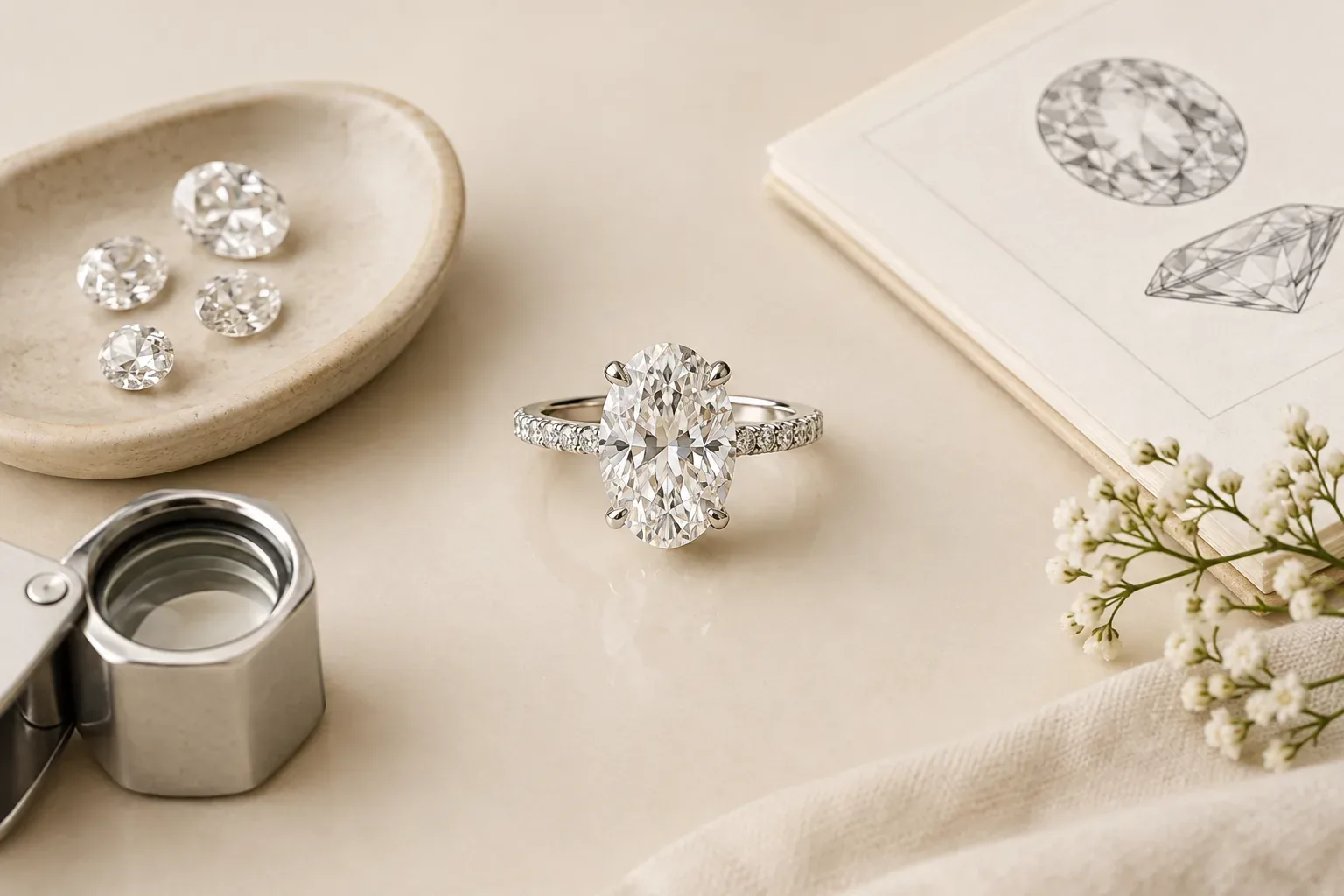
Meaning at a glance
An oval cut engagement ring is a versatile, contemporary choice that often reads as elegant and elongating on the finger; shoppers should weigh its visual advantages against trade-offs such as the 'bow-tie' effect and cut-dependent brilliance, insist on written disclosures and a gemological report for diamonds or treated stones, and verify color, clarity and cut quality only with a qualified jeweler or laboratory.
Quick answer
An oval cut engagement ring is a modern, versatile option that typically emphasizes an elongated gemstone silhouette; it suits people who want a blend of sparkle and elegance and who accept trade-offs such as potential dark zones (the so-called "bow-tie") and a dependence on cut proportions. For a confident purchase, combine visual evaluation, clear seller disclosures, and a gemological report from a qualified laboratory; consumers should not assume provenance, treatments, or exact grading without written documentation and professional inspection.
What the evidence shows about historical meaning and cultural use
There is little in the supplied evidence that ties a specific, long-standing cultural or religious symbolism uniquely to the modern oval cut. Contemporary market data and trend commentary document demand and stylistic preferences more clearly than historical symbolism.
Imaginaire Digital's 2026 UK search estimates indicate strong consumer interest in oval engagement rings as part of broader search demand for engagement rings and other classic categories, which shows modern popularity rather than an ancient symbolic lineage. Jewelers Mutual's 2026 trends reporting describes current tastes—fluid forms, modern stacking, colored gemstones, craftsmanship, versatility and gender-neutral styling—helping explain why oval shapes fit into contemporary wardrobes but not providing historic symbolic attributions.
Because the available evidence focuses on present-day demand and retail trends rather than premodern cultural meanings, any claim that an oval cut carried a particular symbolic meaning in a specific ancient culture would require other historical sources not presented here. Treat documented historical meaning and modern personal interpretation as separate: the supplied sources document today’s market and disclosure requirements but do not substantiate long-running cultural symbolism for the oval cut.
Documented meanings versus modern personal interpretation
Documented meanings in the supplied sources relate to marketplace signaling and contemporary style rather than ancient ritual. Imaginaire Digital and Jewelers Mutual provide evidence that oval cuts are currently in demand for their style and versatility, but they do not record a fixed, universal symbolic meaning for the shape.
Modern personal interpretation is where most meaning attached to an oval cut arises: wearers and gifters may choose it for an elongating look, perceived elegance, vintage references, or simply because it resonates with personal taste. Those personal meanings are valid, but they differ from documented historical symbolism and should be presented as individual preference rather than an established cultural fact.
How the oval motif and cut appear in engagement jewelry
In rings, the oval shape appears as a faceted gemstone with an elongated outline, and jewelers commonly pair it with settings such as solitaire, halo, three-stone, or pavé bands to alter perceived size and emphasis. Designers also set oval stones with side stones or in low-profile settings for daily wearability.
Ovals are used with diamonds and colored gemstones; choice of setting and metal influences the overall look—halos can increase apparent size and brightness, while bezel or low-profile settings emphasize durability for active wearers. These are stylistic descriptions of how the cut is used in modern jewelry design rather than claims about historical ritual or symbolism.
Pros of choosing an oval cut engagement ring
Visual elongation: Many wearers and jewelers note that an oval's elongated silhouette can make the finger appear longer and slimmer, a desirable visual effect for some styles and body types.
Perceived size and brilliance: Because of its surface area, an oval can appear larger than a round of the same carat weight; depending on cut proportions, it can also present strong sparkle and fire when well-cut.
Versatility: The oval shape adapts to a range of settings and aesthetics—from minimal solitaires to ornate vintage-inspired halos—making it suitable for people who value adaptability and contemporary styling, consistent with Jewelers Mutual’s 2026 observation of demand for versatility and gender-neutral styling.
Cons and practical trade-offs to evaluate
Bow-tie effect and light distribution: Ovals can display a darker band across the centre known as a "bow-tie." The degree varies by stone and cut quality. This is a cut-dependent trait; buyers should view the actual stone in hand or on high-quality images or video to judge how noticeable it is.
Cut sensitivity: Because an oval’s appearance depends heavily on the cutter’s choices of length-to-width ratio and facet arrangement, two stones with the same carat weight can look quite different. Cut quality matters more in some respects than carat weight alone.
Color and clarity visibility: Elongated shapes can make color shifts and inclusions appear differently than in round stones. Depending on setting and metal color, buyers may want to prioritize slightly higher color or clarity grades to get the look they expect.
How to evaluate an oval cut stone before you buy
See the stone in person whenever possible, or request calibrated, high-resolution images and a video showing the stone from multiple angles under natural light. Look specifically for even light return across the table and for whether a bow-tie is distracting.
Ask for documentation. For diamonds, request a gemological report from a recognized laboratory that specifies cut-related metrics and confirms the 4Cs. For colored gemstones, ask for any available treatment reports or origin information. The Federal Trade Commission emphasizes the need for written seller disclosures distinguishing natural, lab-created, treated, or imitation materials.
Confirm treatment and durability details with reference to the Gemological Institute of America's resources on treatments. Treated or enhanced stones may require special care and may affect long-term value; GIA's guidance notes that treatments, their disclosure and detectability are important consumer questions.
Practical and respectful advice for selecting or gifting an oval cut ring
Start with style preferences: choose an oval if your recipient or you prefer an elongated silhouette and a look that can be both classic and modern. Consider whether the intended wearer values daily durability, minimal maintenance, or dramatic sparkle.
Match setting to lifestyle: select a low-profile or bezel setting for active wearers to protect the stone, or choose a halo for added flash and apparent size. Respect personal taste over trends—Jewelers Mutual’s 2026 trend guidance shows that individual expression and craftsmanship matter to many buyers today.
Be candid about budget and documentation: ask sellers for written disclosures about whether the stone is natural, lab-created, or treated, and request any available laboratory reports. The FTC recommends consumers get clear, written descriptions of gemstone origin and treatment so that gift recipients are not surprised by later information.
Care, maintenance, and what to verify after purchase
Routine care: clean an oval cut stone gently with a soft brush, warm water and mild soap unless the seller or treatment report advises otherwise; avoid harsh chemicals and ultrasonic cleaners for some treated gemstones. GIA's resources on treatments and durability explain that certain treatments change how a gem should be cared for.
Regular inspections: have prongs and settings checked by a qualified jeweler annually, more often if the wearer is active. A secure setting reduces the risk of chipping or loss.
Keep documentation: save invoices, warranties and lab reports. Written records help with insurance, resale and any future grading or verification needs.
What you can and cannot verify without a qualified jeweler or a gemological laboratory
You can verify visual appearance, color as it appears to the eye, and whether the stone has obvious inclusions or a pronounced bow-tie by inspection or high-quality photos and video. You can also confirm a seller’s written claims and request certificates.
You cannot reliably verify a diamond’s precise grading, origin, the presence of some treatments, or the authenticity of certain claims (for example, natural vs. lab-created or specific heat treatments) without a qualified jeweler’s loupe, specialized equipment, or a laboratory report. Both GIA and the FTC stress that detectability of treatments and the need for disclosure make laboratory reporting and professional inspection important for definitive verification.
Final considerations
An oval cut engagement ring can be an excellent, contemporary choice when chosen with attention to cut quality, setting, documentation and wearer lifestyle. Use present-day trend data and seller disclosures as evidence of popularity and styling context, and rely on gemological reports and professional inspection for technical claims and provenance.
If you want one practical next step: view candidate stones in person or request live video, insist on written disclosures and a lab report, and consult a trusted jeweler for an independent inspection before final purchase.
Frequently asked questions
How does an oval cut compare to a round brilliant?
An oval cut typically presents an elongated silhouette and can appear larger than a round of the same carat weight; it also relies more on cut proportions to manage light return and a possible "bow-tie" effect. For definitive comparisons of brilliance and precise grading, ask for a laboratory report and a side-by-side inspection by a qualified jeweler.
What is the "bow-tie" and should I avoid it?
The "bow-tie" is a darker area across the center of some elongated cuts that results from how light exits the stone. It varies by individual stone: some show only a faint effect, others a pronounced band. You should view the exact stone—by high-quality images, video or in person—before deciding whether its bow-tie is acceptable.
Do I need a lab report for an oval diamond?
Yes—if you want authoritative grading on color, clarity and confirmation of whether the diamond is natural or lab-grown you should request a report from a recognized gemological laboratory. The FTC also advises getting written disclosures about treatments and origin.
Are oval cuts suitable for everyday wear?
Oval cuts can be suitable for everyday wear if set appropriately and cared for. Choose protective settings like bezels or secure prong work for active lifestyles and arrange regular inspections to keep the stone secure.
How should I care for an oval cut stone that has been treated?
Care depends on the specific treatment. The Gemological Institute of America explains that some treatments affect durability and cleaning methods; always follow the seller’s and laboratory’s guidance and avoid aggressive cleaning methods if the stone has known treatments.
What can I verify myself before taking a ring to a jeweler?
You can verify the stone’s visual appearance, overall condition of the setting, and whether seller documentation exists. However, you cannot reliably verify precise grading, certain treatments, or origin without professional equipment or a laboratory report.
Sources and further reading
- Imaginaire Digital — Imaginaire Digital
- Jewelers Mutual — Jewelers Mutual
- Gemological Institute of America — Gemological Institute of America
- Federal Trade Commission — Federal Trade Commission