Meaning at a glance
No single Viking Age sign served as a universal luck or prosperity symbol; modern jewelry commonly repurposes runes, hammers, ships, and later staves, so historical evidence and personal interpretation should be labeled separately.
Direct answer — the short thesis
No single Viking Age sign served as a universal luck or prosperity symbol; modern jewelry commonly repurposes runes, hammers, ships, and later staves, so historical evidence and personal interpretation should be labeled separately. This distinction between what is securely attested in the archaeological and textual record and what is a later or contemporary reinterpretation matters for collectors, designers, and gifters alike.
What the historical evidence actually shows
Archaeology and contemporary medieval documentation are the primary bases for understanding Norse-era symbols. The Swedish History Museum points out that our knowledge of runes, objects, and motifs comes from material finds—such as carved stones, metalwork, and inscriptions—and from later written sources, and that these different kinds of evidence must be weighed carefully.
The National Museum of Denmark records how people in the Viking Age wore and used jewelry: metal brooches, arm rings, bead strings and pendants are common finds in graves and hoards. These objects provide secure evidence that certain shapes and decorations were popular, and that personal ornament carried social and perhaps ritual meanings in the societies of Scandinavia and the North Atlantic.
Documented Viking Age motifs and what we can say about them
Runic inscriptions are well attested on stone monuments, bone, wood, and some metal objects. Museums such as the Swedish History Museum treat runes as a writing system used across centuries and regions, and they document inscriptions that convey names, memorial formulas, ownership marks, or short messages. While runes were sometimes used in ways that could be described as personal or private, the archaeological record does not show a single, universal rune that functioned solely as a general good-luck charm across the Viking world.
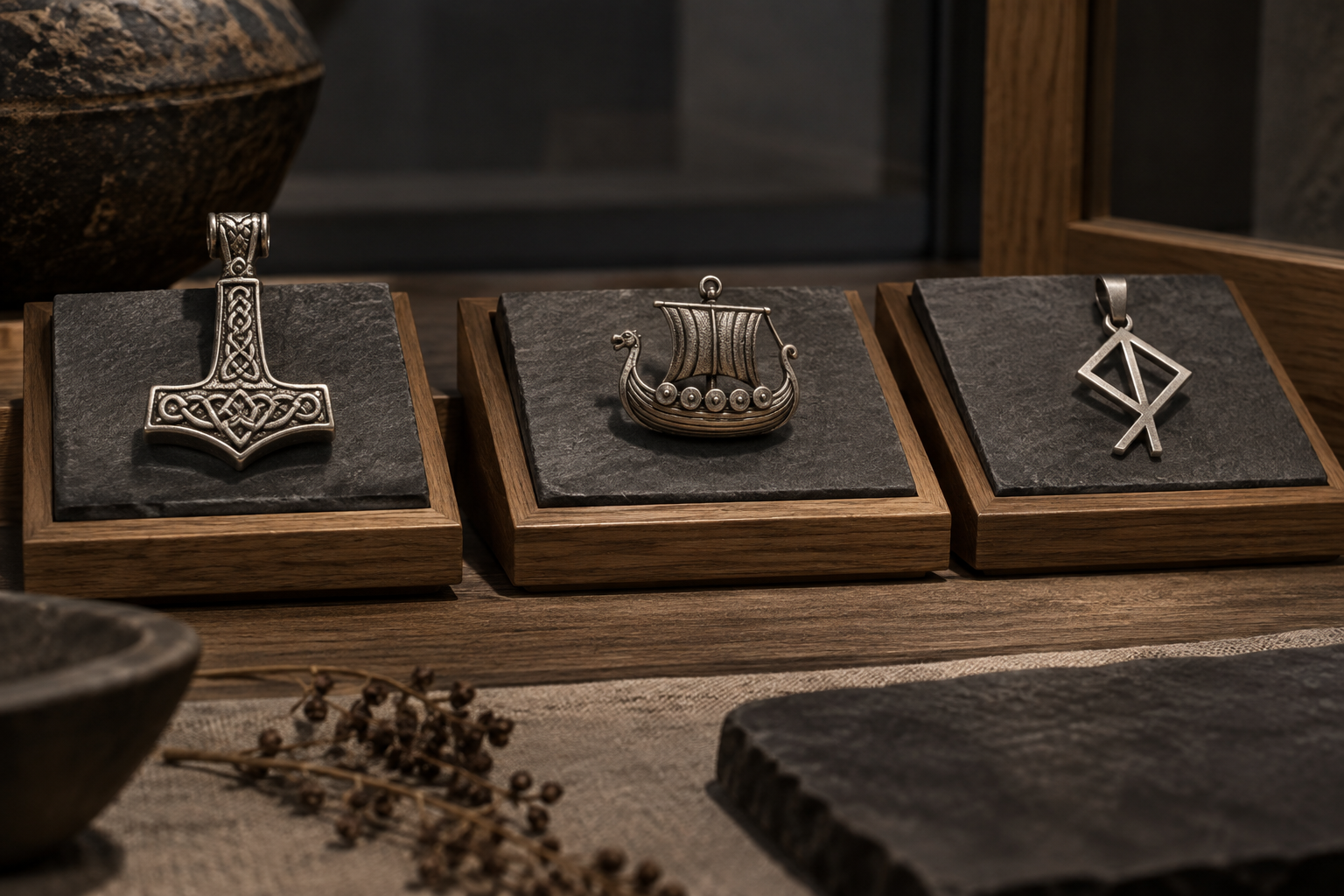
Hammer-shaped pendants and small amuletic forms appear in Viking Age contexts. The National Museum of Denmark and other collections display hammer-shaped objects among grave goods and personal ornaments, so the form was part of contemporary material culture. Interpreting such pendants as invoking Thor, protection, or luck is plausible but must be treated cautiously: archaeological presence confirms the form’s popularity, while literary and religious meanings are often inferred from later texts and comparative evidence.
Ship motifs, animal interlace, and interlocking knotwork are frequent in metalwork and wood carving. These motifs appear on functional objects and high-status items, and their use in jewelry reflects stylistic and symbolic choices in a variety of contexts. The museums’ object records show such motifs were widespread, but the precise meanings—whether commemorative, identity-marking, talismanic, or purely decorative—are not universally recorded for every object.
Later staves, bind-runes, and the boundary between historic practice and later or modern magic
Many of the motifs commonly sold today as 'Norse luck symbols'—especially complex magical staves—are best documented in later manuscripts and folk traditions rather than in Viking Age contexts. The Swedish History Museum and its guides on our sources emphasize that some popular ‘magic signs’ have more secure attestation in medieval or early modern Icelandic and Scandinavian manuscript traditions than in the archaeological record of the Viking Age.
Bind-runes, where two or more runes are merged into a single graphic form, are attested historically in inscriptions and sometimes used for names or compact messages. However, modern usage often expands bind-runes into bespoke talismans claiming specific protections or fortunes. The museums’ accounts recommend labeling such modern interpretations clearly so buyers understand which claims are historically documented and which are contemporary attributions.
How these motifs, gemstones, and traditions appear in contemporary jewelry
Contemporary jewelers reuse Viking Age forms and motifs in a wide range of pieces: pendants shaped like hammers, rings stamped or engraved with runes, brooches inspired by archaeological examples, and modern interpretations of knotwork and animal ornament. The Swedish History Museum’s materials advise that many of these adaptations are artistic reworkings rather than direct continuations of historic practice.
Materials also matter. The National Museum of Denmark documents that people in the Viking Age used gold, silver, bronze, glass beads, and amber in personal ornament. Modern makers echo that palette—sterling silver and amber remain popular—but they also introduce contemporary gemstones and manufacturing techniques that were not available historically. When a piece uses historic motifs with modern metals, manufacturing marks, or contemporary gems, it is a modern object with a historic reference rather than an archaeological continuity.
Separating documented history from modern personal meanings
If you are selecting or wearing a piece because you like a motif, that preference is perfectly valid but it is different from claiming a historically documented talismanic function. Museums like the Swedish History Museum and the National Museum of Denmark advise labeling when selling or describing items: say whether a symbol is attested in Viking Age archaeology, first appears in later manuscripts, or is a contemporary artistic invention.
For example, a silver pendant engraved with a runic name is directly comparable to inscribed objects in museum collections and can be described as 'runic inscription, echoing historic practice.' A complex magical stave printed on a modern pendant may be better described as 'inspired by later Scandinavian folk magic' if its earliest attestations are medieval or post-medieval rather than Viking Age. Clear language prevents conflation between historic evidence and modern belief.
Practical and respectful guidance for choosing or gifting Norse-inspired jewelry
Decide what you want the piece to say. If your priority is historical connection, look for makers who cite archaeological finds and provide provenance or references. The National Museum of Denmark’s descriptions of Viking Age clothing and jewelry offer useful comparators: accept that authenticated replicas will differ from mass-produced fashion pieces in materials and technique.
If your priority is personal meaning, pick a motif that you understand and can explain without presenting it as a universal historical truth. If you buy runes, know whether the inscription is an attested formula, a reconstructed name, or a modern creation. If you choose a hammer, understand that its cultural resonance comes from a mix of archaeological finds and later literary associations.
Respect contemporary cultural sensitivities. Some symbols are meaningful or sacred in modern communities and using them as mere decoration can feel disrespectful. Ask sellers about their research, request clear labeling, and consider commissioning a thoughtful piece from a maker who understands both the historical record and the ethical considerations of cultural reuse.
Practical checks: examine materials and hallmarks for quality and durability, ask for clear descriptions of whether a design is a reproduction, interpretation, or modern creation, and prefer copies or designs that acknowledge their inspirations rather than claim unwarranted historic authority. For gifts, include a short note that explains whether the symbolism is historical, folkloric, or personal—this adds respect and context to the gesture.
Closing thoughts
The interest in 'Norse luck symbols' reflects a longstanding fascination with the Viking Age and the artistic power of its imagery. Museums such as the Swedish History Museum and the National Museum of Denmark show that many motifs are authentic to the period in form but that meanings are rarely universal or monolithic.
Labeling matters. Whether you are a designer, seller, or buyer, distinguishing documented historical evidence from modern interpretation helps preserve scholarly integrity, honors the societies that produced these objects, and gives future wearers a richer, more accurate relationship to the jewelry they choose.
Frequently asked questions
Were there Viking 'good luck' symbols used universally across the Norse world?
No. The archaeological record and contemporary object records show popular forms—runes, hammer-shaped pendants, ship motifs—but there is no single sign attested as a universal Viking Age luck symbol. Museums emphasize that meanings varied by context and that later literary or folk sources often shaped modern attributions.
Is it historically accurate to wear runes as protective talismans?
Runes were used historically for names, ownership marks, and short messages, and bind-runes do appear in the record. However, treating runes as universally protective talismans is a modern interpretation unless the inscription itself is an attested protective formula. Sellers and buyers should distinguish historic inscriptions from contemporary attributions.
Do hammer pendants mean the wearer worshipped Thor or sought protection?
Hammer-shaped pendants are documented in Viking Age contexts, but interpreting them as expressions of worship or as protective amulets is not universally provable from objects alone. Museums document the form and suggest caution: material evidence confirms the motif’s use, while exact belief-related meanings often rely on later textual or comparative interpretation.
What gemstones did Norse people use in their jewelry?
Museum collections show that people in the Viking Age used metals such as silver and gold, bronze, glass beads, and organic materials such as amber. Modern jewelry frequently reinterprets those materials and also incorporates gems that were uncommon or unavailable in the Viking Age.
How can I respectfully buy or give Norse-inspired jewelry?
Choose makers who explain whether their designs are historical reproductions, inspired interpretations, or modern creations. Include a note with a gift explaining whether the symbol is documented in Viking Age archaeology or is a later or personal interpretation. Avoid claiming universal historic meanings for motifs that are better understood on a case-by-case basis.
Sources and further reading
- Runes — Swedish History Museum
- Clothes and jewellery — National Museum of Denmark
- The sources for what we know — Swedish History Museum