Meaning at a glance
Norse-themed love and family jewelry can use historically grounded inscriptions, rings, or mythic references, but most fixed love runes and family bindrunes are modern compositions rather than standard Viking Age emblems.
What the historical record actually shows
When evaluating symbols linked to love and family in a Norse context, it helps to separate artifacts and inscriptions from later romanticized trends. The material record from Scandinavia and areas influenced by Norse culture contains runic inscriptions on stones, metalwork, and personal items, and archaeological finds show that jewellery and clothing were important markers of identity and social relationships. The Swedish History Museum documents the use of runes across Scandinavia and explains how runic inscriptions appear on a variety of objects, while the National Museum of Denmark describes the role of jewellery in Viking Age dress and personal display.
Runes themselves are a writing system rather than a fixed set of symbolic emblems for specific emotions, and their appearance on objects can have many functions: memorializing a person, noting ownership, invoking protection, or conveying a message that the inscriber chose to write. The Swedish National Heritage Board provides guidance on transliteration and cautions that interpreting runic texts requires careful reading of language, context, and archaeological provenance. These institutional sources make it clear that there is evidence for runic writing on rings and pendants, but there is no single historic catalogue of standardized 'love runes' used across the Viking Age.
Which cultures and periods are relevant
When people say 'Norse' in this context they usually refer to the Scandinavian Iron Age and the Viking Age, roughly the first millennium AD into the 11th century. The Swedish History Museum and the National Museum of Denmark describe finds and traditions from that broad timeframe, and those institutions are the appropriate references for material culture and runic practice from those periods.
Later medieval and modern Scandinavian folklore, as well as 19th–20th century revival movements, also shaped how people read and re-use older motifs. Much of what is marketed today as 'Viking' or 'Norse' symbolism mixes genuine archaeological forms with later inventions or modern aesthetic reinterpretations. Museums caution that modern jewellery designers often adapt or invent runic bindrunes and motifs to express contemporary meanings rather than reflecting a single, historically attested Viking-Age emblem.
Documented historical meanings versus modern personal interpretations
Documented historical meanings are those that can be tied to archaeological context, inscriptions that can be read and translated, or contemporary medieval texts. For example, some runestones contain memorial inscriptions that name a person and often note family relationships or commemoration. Museums and heritage boards emphasize that these inscriptions are statements, not a pre-made symbolic shorthand for concepts such as love.
Modern personal interpretations include using specific runes or combined 'bindrunes' to represent love, commitment, or family cohesion in jewellery. Designers and wearers often create bindrunes by overlaying the shapes of several runes into a single motif and assign them meanings like 'love', 'home', or 'fidelity.' Both the Swedish History Museum and the Swedish National Heritage Board note that such compositions are contemporary practices and should be presented as modern adaptations rather than direct Viking-Age emblems.
How motifs, gemstones, and traditions appear in modern jewellery
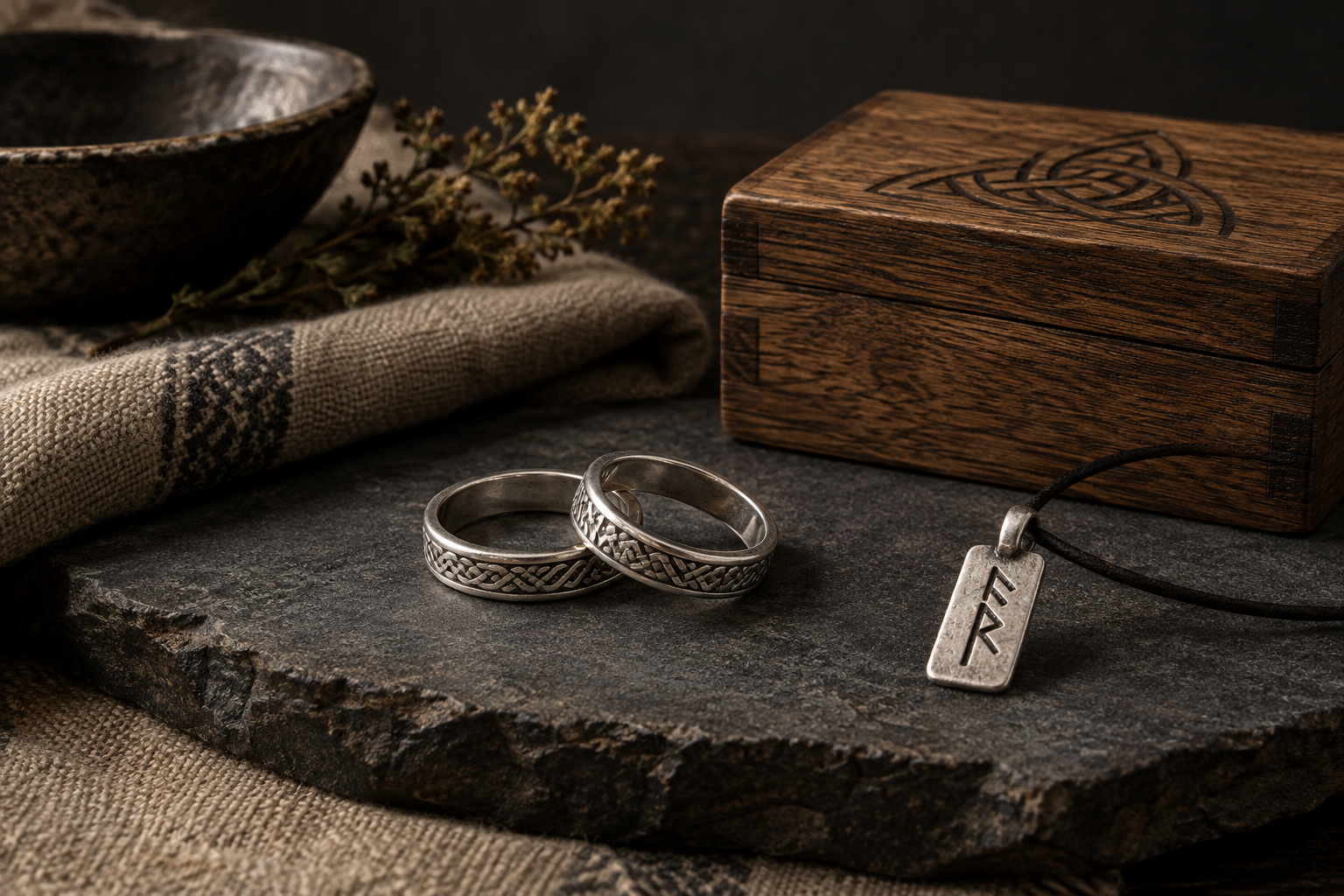
Runic letters appear on rings, pendants, bracelets, and engraved bands in two main ways: as directly transliterated characters from Old Norse or related languages, or as stylized decorative strokes inspired by runic shapes. When inscriptions are authentic quotations or faithful transliterations, responsible makers label them as such and, where possible, provide transliteration and translation. The Swedish National Heritage Board’s guidance on transliteration is a useful reference for anyone who wants an accurate rendering of runes.
Bindrunes and stylized symbols inspired by mythic motifs—such as simplified versions of Thor’s hammer, valknut-like interlacings, or knotwork—are common in contemporary pieces. The National Museum of Denmark documents Viking-Age jewellery types, from simple penannular brooches to richly decorated necklaces, and contemporary designers borrow forms like rings and pendants while using modern materials and stones to convey personal meaning.
Gemstones and materials carry modern associations that influence how a piece communicates love or family ties. For example, rose quartz or garnet may be chosen for color and cultural resonance rather than any specifically documented Norse association. In contrast, plain silver and bronze reproductions echo the metals most commonly used in Viking-Age personal adornment, a link the National Museum of Denmark highlights when discussing archaeological finds.
Design choices and inscription practice that link to history
If you want a piece that is historically grounded, choose inscriptions that are real, translatable texts or select ornament styles attested in museum collections. A short, clearly documented Old Norse phrase or a name inscribed using a carefully transliterated Younger Futhark alphabet can be a responsible way to reference the past. The Swedish National Heritage Board’s transliteration principles are the appropriate guide for rendering runic letters accurately.
Rings were a practical and symbolic object in the Viking Age, used for commerce, status, and personal exchange, so a ring with a historically styled inscription can be fitting for commitments. The National Museum of Denmark’s overview of clothes and jewellery shows the ubiquity of rings, brooches, and beads as forms of personal expression, which is why modern makers often choose those shapes for love and family pieces.
Practical and respectful selection and gifting guidance
Be clear about what you are buying and why. If you want an item with a historical connection, ask the maker or seller whether the runes are a documented inscription, a transliteration, or a modern composition. Museums and heritage boards recommend transparency about what is original and what is newly invented, and responsible sellers will provide that information.
If the piece uses runic text, request a transliteration and translation and, if possible, an explanation of the runic alphabet used. This is important because runic alphabets changed over time and region, and the Swedish National Heritage Board cautions that transliteration demands care. A meaningful gift will be more respectful and durable if the giver understands and can explain the inscription’s origin and meaning.
Choose metals and stones thoughtfully. Silver and bronze finishes resonate with Viking-Age material culture, while modern gemstones may add personal symbolism. Consider the recipient’s cultural background and comfort with revivalist symbols; avoid presenting a symbol as an 'authentic Viking amulet' unless the inscription or motif is truly documented. Prioritize makers who provide provenance, accurate runic rendering, and clear labeling of any modern compositions.
Responsible customization and communication
If you commission a custom bindrune or motif to represent love or family, treat it as a modern personal symbol rather than a historical fact. Ask the jeweller to document the design and to present it as a contemporary creation inspired by runic letterforms or Viking-Age motifs. That straightforward labeling follows the Museums’ guidance about modern interpretation and helps the recipient understand the piece’s status as meaningful today rather than an archaeological reproduction.
When gifting, include a written note that explains whether the runes are a historical inscription, a transliteration of a known phrase, or a new composition. This small act of transparency honors the historical record and communicates respect for the cultures that produced the original artifacts.
Frequently asked questions
Are there authentic Viking 'love runes'?
No single set of 'love runes' is attested across the Viking Age. Runic inscriptions in the archaeological record served many purposes and sometimes record names or memorials, but the idea of a fixed collection of runes specifically for love is a modern interpretation rather than a documented historical practice.
What is a bindrune and is it historical?
A bindrune is a modern or historical practice of combining runic characters into a single symbol. While some rune-carving traditions did join strokes for economy or style, most decorative 'bindrunes' sold today as representing love or family are contemporary compositions and should be labeled as such.
Can I have a ring engraved with a real Old Norse phrase?
Yes. If you want historical authenticity, ask a specialist to transliterate and translate a phrase using the appropriate runic alphabet. The Swedish National Heritage Board’s transliteration guidance is the right model to follow for accuracy.
Which metals and stones are most historically appropriate?
Silver and bronze are historically common in Viking-Age jewellery and are appropriate if you want a materially resonant piece. Modern gemstones can be used for contemporary symbolism but are not necessarily tied to documented Norse meanings.
How should I describe a modern bindrune gift to be respectful?
Describe it as a contemporary design inspired by runic forms or Viking-Age motifs and include a note explaining the designer’s intended meaning. Transparency about what is historical and what is newly created is respectful and informative.
Where can I verify the meaning of a runic inscription?
Consult museum publications or heritage board materials such as those from the Swedish History Museum and the Swedish National Heritage Board, or seek an expert in runology who can provide transliteration and contextual interpretation.
Sources and further reading
- Runes — Swedish History Museum
- Begrepp och principer for translitterering — Swedish National Heritage Board
- Clothes and jewellery — National Museum of Denmark