Meaning at a glance
Loki appears in medieval Norse literature as a multifaceted trickster, but archaeological and manuscript evidence offers no single, verifiable Viking Age symbol for him; contemporary jewelry that claims to be a 'Loki symbol' usually reflects modern design choices and interpretation rather than an authenticated emblem.
What the historical evidence shows
The medieval textual evidence describing Loki is multifaceted and originates in later medieval Icelandic manuscripts. The Uppsala Edda (preserved and published by the Viking Society for Northern Research) is part of that manuscript tradition and records stories in which Loki appears as a shape-shifting, trickster, and liminal figure in the Norse mythic corpus. These narrative sources reveal Loki’s character and role in myth, but they do not include or describe a standardized icon, badge, or widely recognized visual emblem used in the Viking Age specifically to denote Loki.
Archaeological and material studies summarized by the National Museum of Denmark emphasize that Viking Age symbolism is complex and locally variable. Surviving metalwork, carving, and ornament show recurring motifs—animals, interlace, and stylized human faces—but museum-level surveys caution against assuming that every motif represents a named mythic figure. The museum’s work on sources of the Viking Age highlights how later literary identification and modern imagination can overlay meaning onto objects without clear, contemporary evidence.
Distinct cultures and periods: what is documented and what is not
It is important to separate the medieval Icelandic literary period (when the Eddic and saga texts were written down) from the Viking Age archaeological record. The stories that describe Loki were committed to manuscripts in medieval Iceland, and those manuscripts are our primary literary witness to Loki’s character. The Uppsala Edda represents that manuscript tradition, not a contemporaneous Viking Age catalog of symbols.
By contrast, artifacts recovered from the Viking Age and summarized by institutions such as the National Museum of Denmark reflect regional artistic styles and motif repertoires. Those visual repertoires do not include a single emblem that conservators and scholars universally identify as 'Loki’s symbol.' Where a motif reappears—such as serpents or masks—its meaning varies by object type, context, and period, and cannot be automatically equated with a single mythic figure across the whole Viking world.
Historical motifs often linked to Loki in modern marketing
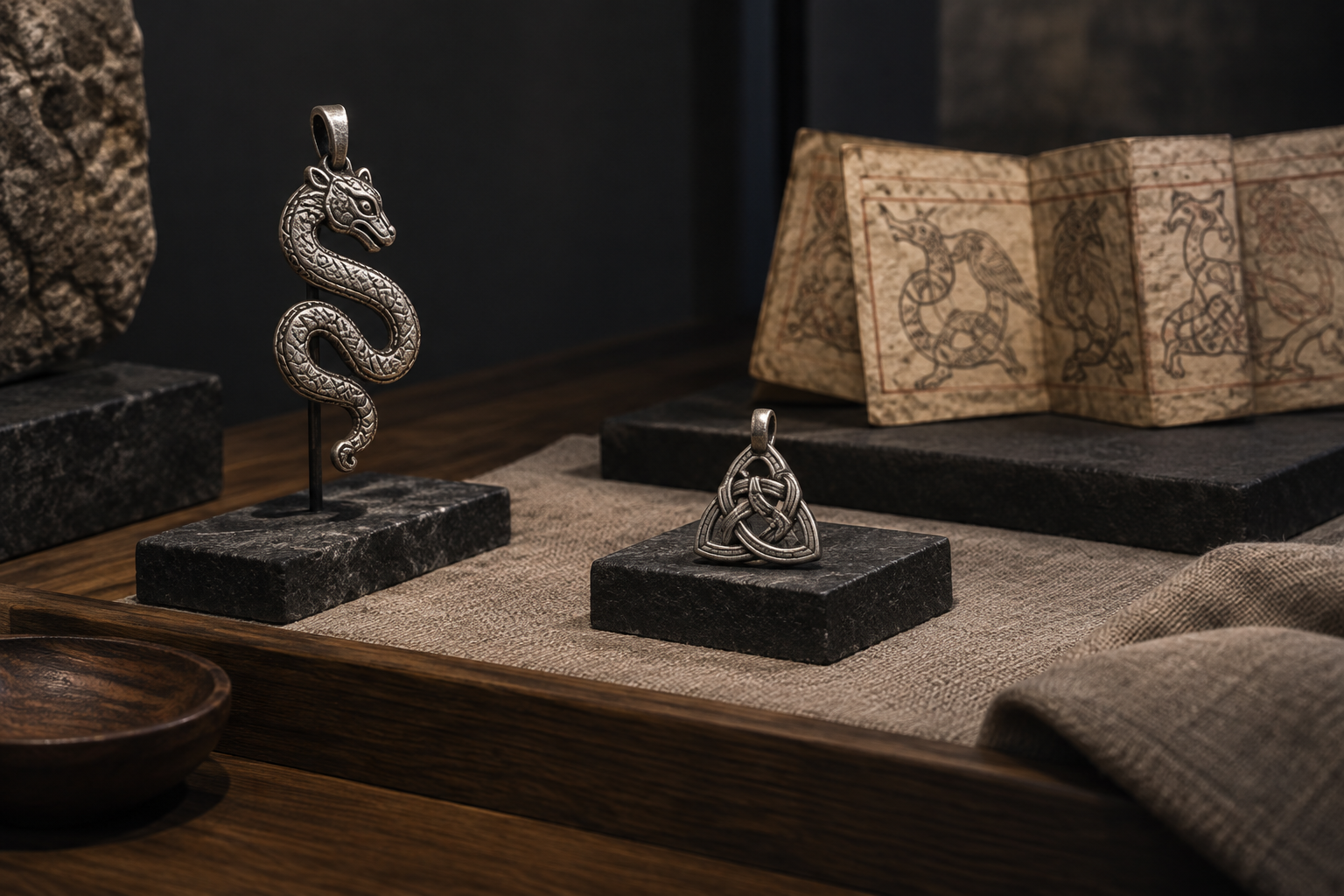
Modern sellers and some designers commonly connect motifs such as serpents, interlaced knots, masks or stylized faces, and invented bindrunes to Loki. Historically, serpentine forms and intertwined animals are well-attested in Viking Age art, but the presence of a snake or knot on an object is not secure evidence that contemporaries intended it specifically for Loki. The museum literature warns that assigning a particular mythic identity to such motifs requires independent contextual evidence, which is often lacking.
Bindrunes and 'Loki runes' are largely modern inventions or modern reinterpretations of runic practice. While runes were used historically across the Viking world, the creation of single-use bindrunes specifically labelled as a 'Loki sign' is a recent, creative practice rather than an established Viking Age ritual or emblem.
Modern interpretations versus documented historical meanings
Modern designers and wearers often adopt Loki-related themes for aesthetic, symbolic, or personal reasons. These contemporary meanings can be meaningful to the wearer—Loki as trickster, boundary-crosser, or agent of change is attractive in modern narratives—but those modern personal interpretations are not the same as documented Viking Age practice. The Uppsala Edda gives us textual personae; it does not provide a list of emblems used as heraldry or religious insignia for Loki among Viking Age communities.
Museums and academic publishers caution that modern labeling should make a clear distinction between historically attested facts and contemporary interpretation. If a piece is sold as inspired by Norse myth or 'Loki-themed' that is an aesthetic and narrative choice by the maker; it should not be presented as a direct continuation of a single historically attested Viking Age emblem unless the seller can point to clear provenance and archaeological context.
How motifs and traditions appear in contemporary jewelry
In the current jewelry market, motifs associated with Loki commonly appear as engraved pendants, sculpted rings, stylized chains, or printed and cast charms. Designers borrow visual language from Norse art—interlace, animal heads, and stylized faces—and combine them with modern techniques such as casting, CNC engraving, and 3D printing. Sellers may add runic-style lettering or bindrune-like designs to reinforce a mythic association.
Materials and gemstones vary widely across designers and regions. Some makers emphasize historically influenced materials and techniques, while others prioritize contemporary aesthetics and commercial materials. Importantly, a modern object that uses a snake, knot, or mask motif is a contemporary piece using historical visual vocabulary; it does not, by itself, prove that the motif was originally an emblem for Loki in the Viking Age.
Practical and respectful selection or gifting guidance
If you are selecting or gifting jewelry advertised as 'Loki symbols,' decide first whether you prize literary association, historical authenticity, or purely aesthetic design. If you want a piece grounded in historical practice, ask the maker or seller for clear provenance and whether the design is a modern interpretation or copied from an archaeologically documented object. Sellers who follow museum best practice should disclose when a design is inspired rather than historically attested.
When gifting for cultural respect, avoid presenting modern reinterpretations as authentic Viking talismans. Offer context: a card explaining that the design is inspired by Norse myth or modern creativity rather than an archaeological fact helps recipients understand the difference. For people with an interest in history, consider pairing the piece with reputable reading suggestions or linking to museum resources that explain the difference between medieval textual sources and Viking Age artifacts.
If symbolism matters for the recipient, use clear language about intended meaning. Many people adopt Loki-themed jewelry for personal reasons—rebellion, transformation, mischief—but those meanings are contemporary and subjective. Encourage wearers to own and define their personal relationship with the symbol rather than assuming a historical universality.
Concluding guidance
Loki’s rich presence in medieval Norse literature makes him a compelling subject for modern jewelry, storytelling, and artistic reinterpretation. At the same time, the historical record represented by medieval manuscripts and by archaeological surveys summarized by museum authorities does not support the idea of a single, verifiable Viking Age emblem for Loki.
Buyers, makers, and gift-givers benefit from clear labeling that distinguishes medieval literary origins from Viking Age material culture and from modern creative invention. Treat contemporary 'Loki symbols' as modern designs inspired by myth unless reliable provenance and scholarly context demonstrate otherwise.
Frequently asked questions
Was there a historic 'Loki symbol' used by Vikings?
No secure evidence identifies a single Viking Age emblem for Loki. Medieval Icelandic manuscripts record Loki’s stories, but museum summaries of Viking Age artifacts do not support the existence of a universal historic emblem for him.
Why do many modern pieces claim to be 'Loki symbols'?
Contemporary designers and sellers often draw on visual motifs from Norse art and medieval literature to create evocative pieces; labeling them 'Loki symbols' is usually a modern interpretive choice rather than proof of a historical emblem.
Are snakes or masks historical evidence of Loki in jewelry?
While serpentine and mask-like motifs appear in Viking Age art, their presence alone does not demonstrate that they represented Loki. Museums caution against equating recurring motifs with specific mythic identities without clear contextual evidence.
How can I tell if a piece is historically informed or purely modern?
Ask the maker for provenance and whether the design is copied from a documented artifact. Responsible sellers will state when a design is inspired by myth or archaeology rather than claiming direct historical continuity.
Is it disrespectful to wear or gift Loki-themed jewelry?
Wearing or gifting such jewelry is not inherently disrespectful, but it is respectful to avoid presenting modern designs as authentic historical or religious artifacts and to acknowledge the difference between inspiration and proven tradition.
Sources and further reading
- The Uppsala Edda: DG 11 4to — Viking Society for Northern Research
- The Viking gods — National Museum of Denmark
- Sources of the Viking Age — National Museum of Denmark