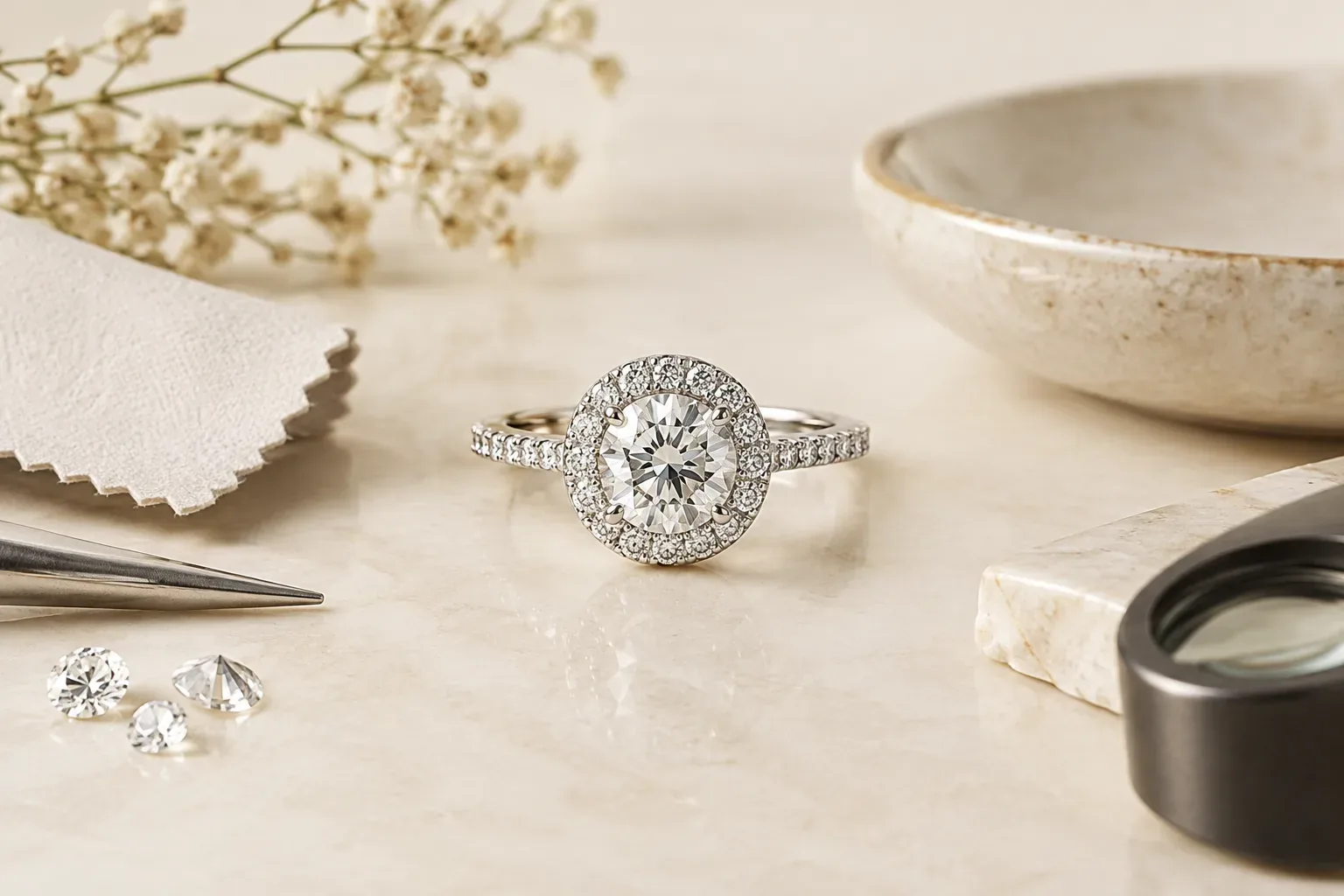
Meaning at a glance
Halo settings add sparkle but introduce more small settings and edges that raise the chance of snagging and of tiny accent stones loosening over time; choose lower profiles, sturdier metals and conservative micro‑pavé, get regular inspections, and understand that definitive checks on mounting integrity or treatments require a qualified jeweler or gem lab.
Short answer — what shoppers want to know
Halo setting engagement ring durability is a balance of trade‑offs: halos increase visible surface area and the number of small stones and prongs, so they generally raise the chance of snagging and the long‑term need for maintenance compared with a single‑stone solitaire. At the same time, a well‑made halo can partially shield the center stone and add a layer of visual protection. Evidence‑led decision criteria are lifestyle (how much manual work you do with your hands), setting style (low‑profile bezel or tight bezel‑style halo versus tall prongs and loose micro‑pavé), metal choice, and the type of center and accent gemstones. Regular inspection and timely repairs are the practical ways to manage the added risk.
What the approved evidence supports about demand and trends
Recent market and trade commentary show a strong continuing demand for engagement rings and related styles, and that shoppers are focused on craftsmanship, versatility and contemporary forms. Imaginaire Digital’s 2026 UK search data highlights high search interest in engagement rings alongside other popular categories, indicating halo styles are competing in a busy market. Jewelers Mutual’s 2026 trends summary places craftsmanship and versatility among buyer priorities, which helps explain why more elaborate settings such as halos remain widely offered by retailers.
Historical evidence and cultural claims — what our sources do and don’t document
The set of approved sources for this article does not include primary historical treatises or museum catalogues that would let us make precise, sourced claims about when specific cultures first used the halo motif in personal jewelry. Because of that gap, this article avoids asserting specific historical dates or attributing the halo setting to a particular culture or period without independent, specialist citation.
What is documented in the approved sources is modern consumer and trade behaviour rather than deep historical provenance. For shoppers who want historically authoritative statements linking halo settings to a named culture or era, consult specialist jewelry history works, museum publications, or academic research rather than the market and consumer sources summarized here.
Documented meanings versus modern personal interpretation
None of the approved sources provide a universally agreed symbolic meaning for the halo setting. Historical symbolism for motifs often comes from art and religion, and modern wearers typically attach personal meanings—such as the halo representing light, protection, or emphasis of the central gem. Those are personal or contemporary interpretations, not claims grounded in the specific evidence set used for this article.
When assessing meaning, treat historical claims and personal meanings separately: documented historical symbolism requires primary cultural sources or museum evidence; contemporary or individual symbolism is valid as a personal or gift intention but not a documented cultural fact.
How halo design choices affect durability and snagging risk
A halo setting surrounds a center stone with a ring of smaller accent stones or a metal rim. That design increases the number of settings, prongs or beads. Each additional prong or bead is a potential wear point: prongs can thin, beads can lift, and pavé stones can become loose if struck or if the metal holding them wears.
Micro‑pavé halos—in which many tiny diamonds are held by small beads—offer outstanding sparkle but use very small settings that are more easily affected by everyday abrasion and knocks. Larger accent stones set with distinct prongs can be more robust, though they create more exposed edges that can catch on fabric.
Halo profile matters. A low‑profile halo (where the halo sits close to the finger) reduces snagging and the amount of leverage a catch creates. High‑profile halos or those with tall center prongs are more likely to catch and to transmit force that can stress prongs and accent settings.
Gemstone and metal choices that change risk and repair needs
Gemstone hardness and toughness affect how a ring wears. Harder gems resist scratching; tougher gems resist chipping. The Gemological Institute of America notes that treatments and material properties create distinct care needs and durability differences, meaning that materials and their treatments can change how a halo ring should be maintained.
Metal choice affects how quickly prongs and beads wear. Denser, harder mounting metals resist deformation longer, and metals vary in how they respond to repeated knocks. Jewelers and insurers commonly recommend matching the mounting metal and workmanship to the recipient’s lifestyle. If you expect heavy daily handwork, select a lower profile, simpler halo, and a sturdier metal and setting style.
Routine care, inspection and realistic repair expectations
Regular inspection is the single most effective way to manage a halo setting’s long‑term durability. Jewelers Mutual’s industry guidance on trends and craftsmanship underscores why professional workmanship and scheduled care matter to durability. Most jewelers recommend an inspection at least once a year and sooner if you notice a catch, movement, or missing stone.
Repairs for halos most commonly involve re‑tipping or replacing worn prongs, resetting loose accent stones, and polishing or re‑finishing the metal. Micro‑pavé repairs can be more labor‑intensive and therefore more costly than simple prong work because they require precise resetting of many tiny stones. Buyers should expect ongoing maintenance costs to be higher for intricate halo work than for a plain solitaire.
What you can verify before purchase — and what requires an expert
Before buying, you can and should verify seller disclosures in writing. The Federal Trade Commission advises consumers to seek clear distinctions among natural, lab‑created, treated and imitation materials and to keep written seller disclosures. Ask for grading reports for the center diamond, confirm any treatments for center and accent stones, and request a clear returns and warranty policy.
What you cannot fully verify without an expert or laboratory includes internal treatments not disclosed on documentation, microscopic mounting flaws, exact prong thickness, and long‑term metal fatigue. A trained jeweler or gemological laboratory is required to inspect mounting integrity, confirm undisclosed treatments, and issue formal grading or conservation recommendations. If a seller will not provide documented disclosures or allow a pre‑purchase inspection by an independent jeweler, consider that a red flag.
Practical selection and gifting guidance
Match the ring’s design to the wearer’s lifestyle. For someone who uses their hands heavily, favor a low‑profile halo, fewer accent stones, or a partial halo that frames only the sides. Consider a bezel‑style halo or a halo with shared prongs and larger accents instead of micro‑pavé if you want a more durable daily wear ring.
Choose metals and workmanship to fit both budget and use. Prioritize reputable craftsmanship and documented warranty or inspection plans. If you are gifting and unsure about the recipient’s daily habits, include an inspection or resizing voucher and purchase from a retailer who provides clear disclosures and a repair or maintenance plan. That combination protects the recipient and preserves the ring’s appearance over time.
When shopping, ask specific questions: what is the setting style (micro‑pavé, bead, shared prong, bezel)? What metal is used for prongs? Are accent stones natural, lab‑grown, or treated? Is a grading report available for the center stone, and what repair or warranty coverage exists? Written answers to these questions are among the most useful verification steps a shopper can take without specialist testing.
A short maintenance checklist
Remove the ring for heavy manual tasks, gym sessions that involve equipment, and tasks involving chemicals or abrasive cleaners. Have a professional jeweler inspect the setting annually, or sooner if you feel a catch or see a loose stone. Keep written records of purchase, grading reports, and any repair history; those documents matter for insurance and resale.
For accent stones or treated gems, follow any special care guidance from the seller or the Gemological Institute of America regarding treatments and possible vulnerabilities. When in doubt, treat halos with the assumption that their many small settings make them more maintenance‑sensitive than a plain solitaire.
When to consult a qualified jeweler or laboratory
Consult a qualified jeweler for mounting assessments, prong re‑tipping, and routine resetting work. If you need a definitive answer on whether a stone has been treated, or if you require a formal grading or authentication for insurance or resale purposes, a gemological laboratory is required. The FTC highlights the importance of documented disclosures and the limits of what a consumer can determine without laboratory testing.
If a seller cannot provide the disclosures you request or refuses inspection by an independent jeweler, pause the purchase. The combination of professional inspection, documented grading, and a clear repair policy is the strongest practical protection a buyer can obtain short of laboratory analysis.
Final practical takeaways
Halo setting engagement ring durability depends more on design details, metal and workmanship than on the halo idea itself. Expect higher sparkle and higher maintenance: more small stones and settings mean a greater long‑term need for inspection and occasional repair. Lower profiles, conservative setting choices, and documented seller practices reduce risk.
Use the buyer checklist, insist on written disclosures and inspection options, and factor possible repair frequency into your decision. That approach answers the distinct search intent behind “halo setting engagement ring durability” with actionable trade‑offs and limits on what a shopper can verify without professionals.
Frequently asked questions
Are halo settings more likely to snag than solitaires?
Generally yes: halos add extra stones, prongs and edges, which increases the number of places that can catch fabric compared with a plain low‑profile solitaire. A low‑profile halo or a bezel‑style halo reduces snag risk. For personalized advice, ask a jeweler to examine the profile and prong style before purchase.
How often should a halo engagement ring be inspected?
Most jewelers recommend at least an annual inspection, and sooner if you feel a catch or see movement. Regular checks catch worn prongs and loose accent stones early, which reduces the risk of losing stones and lowers long‑term repair costs.
Does a halo protect the center stone?
A halo can provide partial visual and physical shielding in some designs, especially if the halo and prongs sit close to the center stone. However, a halo does not make a delicate center stone indestructible; impact can still transmit force to the center, and protection depends on profile and mounting specifics.
Are micro‑pavé halos riskier to own than larger accent halos?
Micro‑pavé delivers intense sparkle by using many tiny stones held by small beads; those tiny settings are more maintenance‑sensitive and can require more frequent, precise repairs than larger accent stones. Micro‑pavé is beautiful but generally higher maintenance.
What can I verify myself before buying a halo ring?
You can and should get written disclosures: center stone grading reports, statements on whether stones are treated or lab‑created, the metal type, warranty and repair policy, and clear photos or videos of the setting profile. Anything involving internal treatments or microscopic mounting flaws requires a qualified jeweler or gem lab to confirm.
Sources and further reading
- Imaginaire Digital — Imaginaire Digital
- Jewelers Mutual — Jewelers Mutual
- Gemological Institute of America — Gemological Institute of America
- Federal Trade Commission — Federal Trade Commission