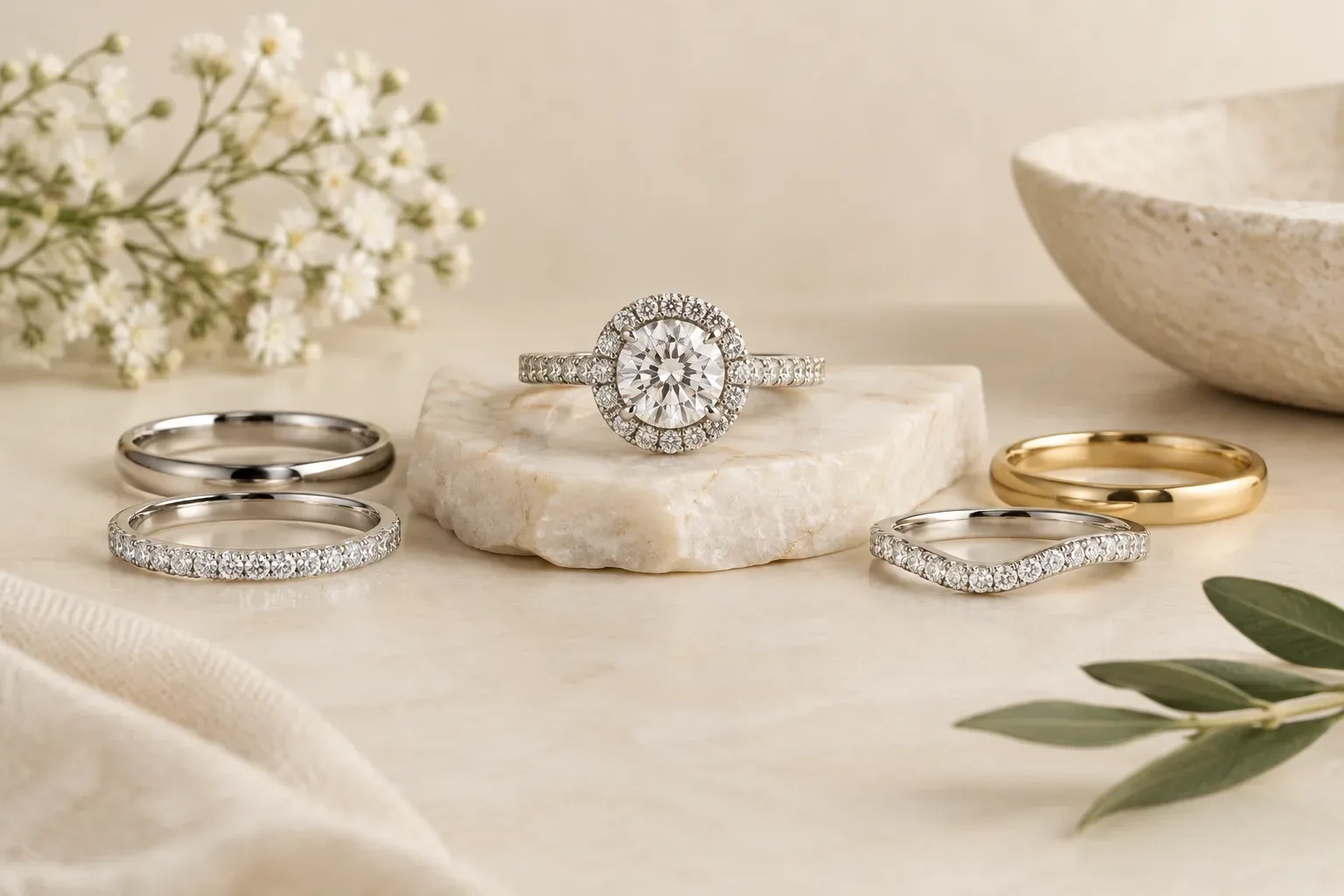
Meaning at a glance
Pairing a wedding band with a halo setting is primarily a design decision guided by the halo and center shape, desired gap or flush look, and metal choice; practical trade-offs include stackability, wearability, maintenance, and disclosure or testing limits that only a qualified jeweler or gemological lab can resolve.
What the approved evidence says about recent demand and design trends
Recent industry reporting shows a clear consumer interest in engagement rings that emphasize versatile, modern silhouettes and stackable styling. Imaginaire Digital’s 2026 search analysis indicates strong demand for engagement styles including oval engagement rings and related searches that place halo-style settings among sought engagement-ring shapes. Jewelers Mutual’s 2026 trends research describes market demand for fluid forms, modern stacking, colored gemstones, craftsmanship and gender-neutral styling—all relevant to how shoppers pair bands with halo settings. Use these findings as market context: contemporary shoppers often prioritize stackability and versatility when pairing a wedding band with a halo engagement ring.
Historical evidence and how to treat claims about origins
The set of approved sources for this article does not include primary historical studies or archival documentation that trace the halo setting to a specific culture or date. None of the cited industry or consumer-protection sources (Imaginaire Digital, Jewelers Mutual, GIA, FTC) provide a detailed history of the halo motif in jewelry. Because the available evidence is modern and commercial in focus, avoid asserting a precise historical origin or attributing a single, documented historical meaning to halo settings without consulting dedicated jewelry history sources or museum records.
Distinguishing documented meanings from modern personal interpretation
Documented meanings supported by the approved sources are primarily contemporary and market-focused: halo and stacked styles function as design choices that support versatility and visual emphasis in modern ring fashion. Personal and symbolic interpretations—such as reading halos as ‘protection’ or ‘radiance’—are modern, individual, or cultural attributions and are not documented in the approved industry reports. Treat symbolic readings as valid personal meanings you or a gift recipient may hold, and keep them distinct from the market and technical facts offered by industry sources.
How the halo motif and related traditions appear in jewelry today
In contemporary jewelry, a halo setting usually surrounds the center stone with a ring of smaller stones or metalwork to increase apparent size and sparkle. Halos can be full (encircling the entire center) or partial (accenting a portion of the perimeter). Designers vary halo shape to echo the center stone—round halo for round centers, cushion or cushion-shaped halos for square centers, and elongated halos for ovals or marquise stones. Types of gemstones used in halos include diamonds for maximum brilliance or small colored stones for contrast. The halo can be part of the engagement ring or repeated as a design cue on an accompanying band, depending on whether the wearer prefers matched continuity or complementary contrast.
Shape: matching center stones and band contours
Start pairing with the center stone shape. A round center usually pairs well with a straight or gently curved band. For emerald, cushion or princess cuts, a contoured or notched band that follows the halo’s outline keeps metal gaps minimal. Oval or marquise centers often benefit from a curved or U-shaped band that nestles against the halo’s longer silhouette. If you plan to stack multiple bands, choose narrower bands that sit flush or arrange wider bands outside a narrow contoured band to preserve the halo’s visibility. When in doubt, bring the engagement ring to try alternative band profiles—visual fit and comfort are best judged in person.
Gap: flush, contoured, or stacked—trade-offs and fits
A flush pairing aims for no visible gap between the halo and the band and usually requires a contoured or custom-notched wedding band. Flush looks give cleaner lines and reduce dirt accumulation between rings, but custom work raises cost and may limit future resizing. Contoured bands curve to the halo’s shape and allow a near-flush look without precisely copying the engagement ring, offering a compromise between aesthetics and cost. Stacked bands deliberately create a small visible gap, which supports breathing space for accent stones and can highlight the halo separately; gaps can collect dirt more easily and may require more frequent cleaning. Choose the gap strategy that balances aesthetic preference, budget for custom shaping, and long-term maintenance needs.
Metal choices: matching, contrasting, and practicality
Matching metals provide an immediately cohesive look and simplify maintenance because similar alloys and hardness ages at comparable rates. Common choices include platinum or 18K/14K yellow, white or rose gold. Contrasting metals—white gold with a rose-gold band, for example—create a deliberate modern juxtaposition aligned with current design trends emphasizing contrast and gender-neutral styling, as documented by Jewelers Mutual. Consider hardness and wear: platinum is highly durable but can develop a patina; lower-karat gold alloys resist bending better than higher-karat gold but change hue. If your halo includes pavé diamonds or small accent stones, choose a metal that supports secure settings and is familiar to the jeweler who will resize or repair the ring.
Gemstone treatments, disclosure and verification limits
Gem treatment, origin, and whether a stone is natural, lab-created, treated, or imitation are material facts that affect durability and value. The Gemological Institute of America (GIA) explains that treatments change detectability and care needs, and the Federal Trade Commission requires sellers to disclose whether gemstones are natural, lab-grown, treated, or imitation. A shopper can ask for written disclosures and certificates during purchase, but some details—such as subtle treatments, origin, or the presence of certain enhancements—may only be confirmed by a qualified jeweler or a gemological laboratory. For consumer protection, rely on written disclosures and, when in doubt about a stone’s treatment or authenticity, obtain a lab report from a recognized gemological lab.
Care and long-term considerations
Small accent stones in halo and pavé settings are more exposed to knocks and require periodic inspection to check prongs and seats. Regularly clean rings using appropriate methods for the metals and stones involved, and arrange inspections with a reputable jeweler. Given market interest in craftsmanship and versatility reported by Jewelers Mutual, invest in a well-made band that can be resized or repaired by a professional. Keep receipts and disclosures to aid warranty or insurance claims; insurers and jewelers will ask for documentation if repairs, evaluations, or claims are necessary.
Practical selection and gifting guidance
When selecting or gifting a wedding band for a halo engagement ring, prioritize fit and comfort first—try the band with the engagement ring on the same finger, in the same hand, and in various lighting. Bring the engagement ring to the jeweler for on-the-spot fitting, or ask for a mock-up or wax model if choosing a custom contour. Respect the recipient’s style: if they favor minimalism, a slim, matching band may be best; if they embrace bold contrasts, a wider, differently colored band can be a thoughtful choice. For surprise gifts, learn ring size carefully and arrange an exchange or resizing option. Finally, request written disclosures for gemstones and metals at purchase, and consider lab certification for higher-value stones.
Limits on what you can verify without experts
You can evaluate fit, shape, metal color, and visual compatibility in person, and you can verify a seller’s written disclosures. However, confirm treatment type, origin, and subtle enhancement detection only through professional gemological testing. A retail inspection can check prong security and fit, but a lab report is necessary to verify claims about natural versus lab-grown origin or specific treatments. The Federal Trade Commission advises that consumers obtain clear written statements about material type; rely on those statements and independent lab verification when necessary.
Frequently asked questions
Can a plain wedding band pair with a halo engagement ring?
Yes. A plain band creates contrast and emphasizes the halo’s detail. Opt for a band width that balances the halo’s scale; try the band with the engagement ring in person to confirm visual balance and comfort.
Do I need a custom contoured band to avoid a gap?
Not always. Contoured bands offer the cleanest fit with a halo but cost more. Curved or U-shaped stock bands often provide an acceptable near-flush look; custom notches are recommended only if you require a precisely flush profile.
Should I match metals between the engagement and wedding ring?
Matching metals give the most cohesive look and simplify maintenance. Contrasting metals are a valid contemporary choice and can highlight design elements, but consider differing wear characteristics and long-term care.
How often should halo and pavé settings be checked?
Have prongs and pavé settings inspected by a reputable jeweler at least once a year and after any significant impact. Small stones can loosen over time and need professional tightening to avoid loss.
Can I verify if a diamond or gemstone is treated or lab-grown at the store?
You can request written disclosure at purchase, but some treatments and origin details require a gemological laboratory report or an expert jeweler’s assessment to confirm. The FTC advises consumers to obtain clear written statements about material type.
What should I do if I'm buying a wedding band as a surprise?
Confirm ring size carefully, choose a retailer with reasonable return or resizing policies, and retain receipts and seller disclosures to facilitate adjustments after the surprise.
Sources and further reading
- Imaginaire Digital — Imaginaire Digital
- Jewelers Mutual — Jewelers Mutual
- Gemological Institute of America — Gemological Institute of America
- Federal Trade Commission — Federal Trade Commission