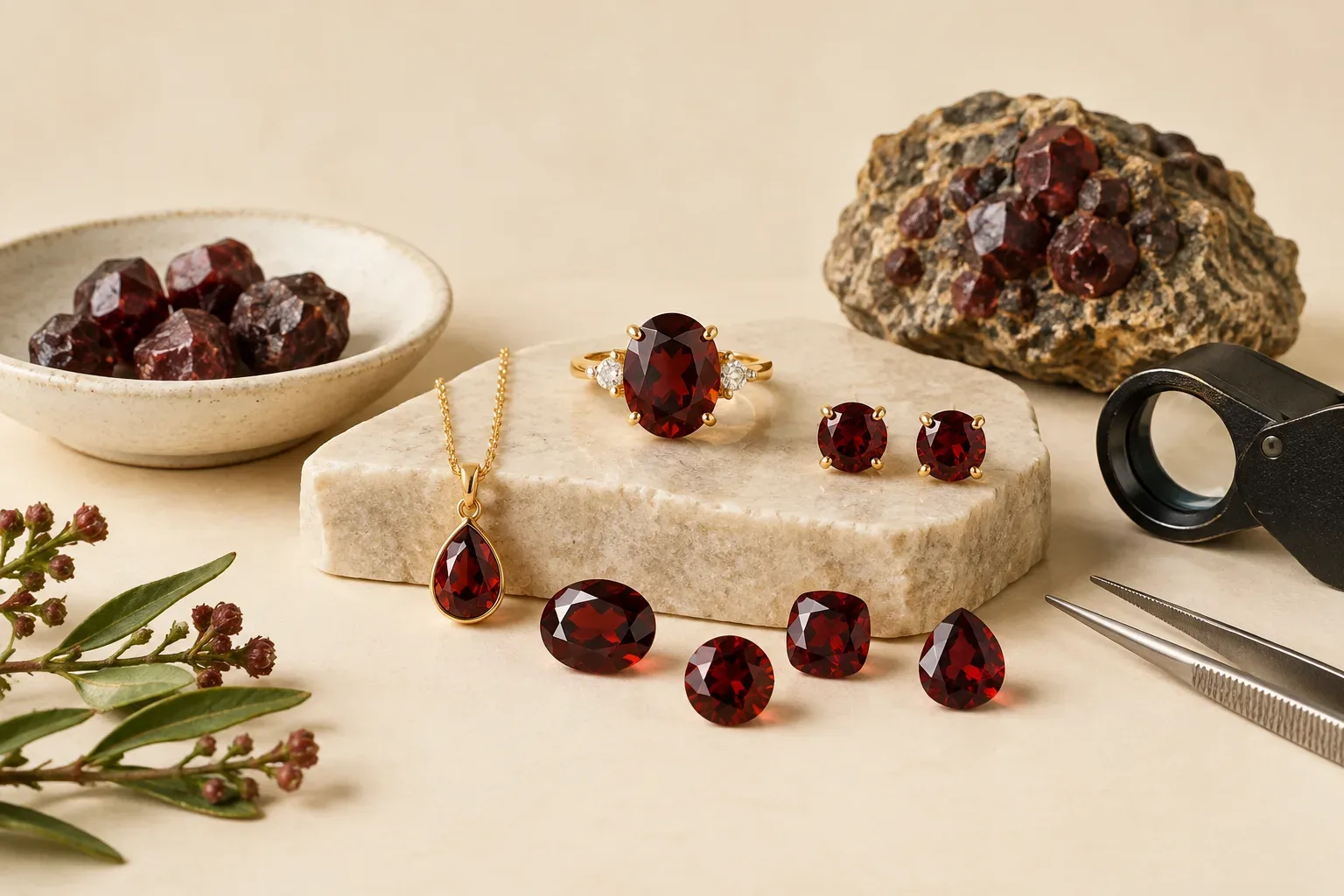
Meaning at a glance
This garnet buying guide explains the practical decision criteria shoppers use: color preferences and species, clarity and inclusions, cut and setting choices, how common treatments influence value and care, and what only a qualified jeweler or laboratory can verify.
Direct answer — what a shopper needs from a garnet buying guide
If you search for a "garnet buying guide," you are usually trying to decide which garnet is the best combination of color, clarity, cut, and price for your purpose, to understand treatments and care, and to know when to ask for professional verification. This guide answers those needs with evidence-led decision criteria, practical trade-offs between appearance and durability, safe care advice, and clear limits on what a buyer can verify without a qualified jeweler or gemological laboratory.
How to evaluate garnet color
Color is the single most important factor for most garnet buyers. Garnet is a group name that includes several species and varieties that produce different hues. When judging color, look for tone (how light or dark the stone is), saturation (color intensity), and uniformity across the stone. Rich, saturated colors usually command higher prices when they are also desirable in the market.
Market context shapes which colors are most sought-after. Recent retail and search-trend research shows strong consumer interest in gemstone rings and necklaces, including birthstone and colored-gem pieces, which affects demand for particular garnet colors in certain seasons and categories (Professional Jeweller / PRYA Jewellery Search Insights; Imaginaire Digital). Use photos and in-person inspection: photographs on different screens can misrepresent hue and saturation, so see the stone under balanced daylight or ask for a neutral-light photo prior to purchase.
Clarity and inclusions: what to accept
Unlike diamonds, many garnets are valued despite visible inclusions. Clarity assessment depends on the variety: for some garnets, eye-clean material (no inclusions visible to the unaided eye) is preferred; for others, characteristic inclusions are normal and do not detract from value. When clarity affects transparency or color, it will influence price more heavily.
Ask the seller for close-up images and, if possible, an in-person inspection with a jeweler’s loupe. Sellers must disclose material treatments and whether a stone has been fracture-filled or otherwise stabilized (see the GIA and FTC guidance below). If clarity or inclusion type materially affects the look or durability, a professional appraisal or laboratory report is worth the cost.
Cut, shape, and how setting influences perception
Cut determines how color and brilliance present in the finished gem. For colored stones like garnet, cuts that maximize color saturation (such as oval, cushion, and mixed cuts) are common. A well-proportioned cut will enhance the stone’s hue and hide minor inclusions, while a shallow or poorly cut stone may look washed-out.
Setting choices also change perceived color and durability. Open settings showcase color, while bezel or partial-bezel settings add protection for stones prone to edge damage. Consider the intended wear: rings worn daily benefit from protective settings and harder metals; earrings or pendants can prioritize color and light performance because they face less mechanical wear.
Treatments, disclosure, detectability, and consumer protections
Treatments can materially affect appearance, durability, and value. Authoritative gemological guidance stresses that treatments must be disclosed and that consumers should understand whether a stone is natural, treated, lab-created, or an imitation (GIA; Federal Trade Commission). The GIA explains common treatment types and their detectability, and the FTC requires clear distinctions in advertising and written disclosures so consumers can make informed choices.
Before buying, ask the seller to state in writing whether the garnet is natural, untreated, heat-treated, fracture-filled, or synthetic. For any treatment that affects durability or appearance, request documentation or a clear policy on returns. If the seller cannot or will not provide disclosure, treat that as a red flag and consider a different vendor.
Value and pricing trade-offs
Value for garnet depends on the interplay of color, clarity, cut, carat weight, and rarity of the variety. Eye-clean, richly saturated stones in popular shapes command the highest prices among comparable sizes. Rarer garnet species or unusually pure colors can be priced significantly higher than common red almandine garnets.
Buyers will routinely trade off carat weight for better color or cut. For pieces intended for frequent wear, prioritize durability and protective settings over maximum size. Use current market indications—search-trend and retail research show ongoing consumer interest in gemstone rings and necklaces, which influences availability and pricing for popular garnet types (Imaginaire Digital; Professional Jeweller / PRYA Jewellery Search Insights).
Historical evidence vs. modern interpretation (limits of the sources used)
This article relies on a small, approved set of contemporary sources focused on market trends, gem-treatment practices, and consumer protections; those sources do not provide the primary archaeological or museum documentation needed to support precise historical claims about garnet symbolism in specific cultures or periods. Because those documented-historical sources are outside the evidence set used here, this guide does not assert particular ancient beliefs or dates as fact.
Many modern descriptions of garnet symbolism—romance, protection, renewal, or other personal meanings—are contemporary interpretations used by retailers, writers, and consumers. Treat those narratives as modern personal or cultural storytelling unless you consult museum catalogs, archaeological reports, or academic publications that provide primary evidence for a specific culture or historical period.
How garnet appears in jewelry today
Retail and design trends show garnet commonly used in rings, pendants, and cluster necklaces where color is the focal point. Birthstone necklaces, charm clusters, and gemstone rings remain strong categories in consumer searches, and garnet often appears where designers want a deep red or warm-toned center stone (Professional Jeweller / PRYA Jewellery Search Insights; Imaginaire Digital).
Design choices range from single-stone solitaires that emphasize color to multi-stone clusters that combine garnet with diamonds or other gems. Contemporary makers use garnet in both sculptural and vintage-inspired settings, reflecting broader trends toward Art Deco revival and highly textured metalwork reported by industry research.
Practical selection and gifting guidance
Decide the wearer’s priorities before buying: do they value color above all, do they wear jewelry daily, and do they prefer a statement piece or a subtle accent? For daily-wear rings, choose eye-clean stones with protective settings and reliable metals. For pendants and earrings, you can favor more open settings and deeper saturated colors because the stones face less mechanical stress.
Ask sellers for clear written disclosure about whether the stone is natural or treated, request close-up photographs taken in neutral light, and obtain a return policy that covers dissatisfaction with color or clarity. When buying as a meaningful gift, include a personal note explaining why you chose that color or variety, and supply care instructions so the recipient can preserve the piece.
Durability, safe care, and maintenance
Garnets vary in hardness and toughness across species; authoritative gemological guidance emphasizes that treatment, setting, and daily wear affect long-term durability (GIA). For routine care, clean most garnet jewelry with warm soapy water and a soft brush; avoid harsh chemical cleaners unless you know the stone’s treatment status and the metal used. Ultrasonic cleaners may be inappropriate if a stone is fracture-filled or has other treatments that reduce toughness.
Store garnet jewelry separately from harder stones to avoid scratches, and remove pieces during physical tasks or exposure to strong chemicals. If a stone shows chips, cracks, or a sudden change in appearance, consult a professional jeweler or gemologist rather than attempting home repairs.
When to seek a qualified jeweler or laboratory report
You cannot reliably confirm certain important attributes—species identification for rare varieties, subtle treatments, or origin claims—without professional testing. The GIA explains that some treatments are detectable only with specialized equipment, and the FTC requires sellers to disclose relevant information but does not itself verify individual stones.
If a stone’s price, rarity claim, or treatment status materially affects your purchase decision, ask for a current laboratory report from a recognized gemological laboratory or a written appraisal by a qualified gemologist. For high-value purchases, a report gives certainty on identity and treatments and is often worth the cost for peace of mind.
Final checklist for shoppers
Before you buy, verify the seller provides written disclosure of natural vs. treated vs. synthetic material, request neutral-light photographs or in-person inspection, compare color and cut across examples, confirm the return policy, and consider professional testing for high-value stones. Use the trade-offs described here—color versus size, clarity versus price, and cut versus color—to match your choice to the intended use and budget.
Frequently asked questions
Are garnets durable enough for everyday rings?
Durability varies by garnet species; authoritative gemological guidance notes that hardness and toughness differ and treatments can affect durability (Gemological Institute of America). For daily-wear rings, choose eye-clean stones with protective settings and confirm whether any treatment affects toughness before using ultrasonic or steam-cleaning methods.
How can I tell if a garnet has been treated or is synthetic?
Some treatments and synthetics are detectable only with specialized gemological equipment. The GIA explains common treatments and their detectability, and the Federal Trade Commission requires sellers to disclose material treatments. Ask the seller for written disclosure and, for certainty on important purchases, request a laboratory report from a recognized gemological laboratory.
Should I expect a certificate with my garnet purchase?
Not all garnets come with laboratory reports. For routine, low-cost purchases, detailed reports are uncommon. For higher-value stones or rare varieties, insist on a report from a recognized lab or a written appraisal; such documentation helps confirm identity, treatments, and value.
Can I clean garnet jewelry at home?
Most garnet jewelry can be cleaned at home with warm soapy water and a soft brush, but the GIA warns that some treatments make stones unsuitable for ultrasonic or steam cleaning. If the seller discloses a treatment status that may be sensitive to cleaning, follow professional advice or consult a jeweler.
Is garnet a good choice for an engagement ring today?
Market trend reports show sustained interest in gemstone engagement rings and birthstone jewelry (Imaginaire Digital; Professional Jeweller / PRYA Jewellery Search Insights). Garnet can make a distinctive engagement ring, but choose color, clarity, cut, and a protective setting appropriate for daily wear and verify treatment disclosures before committing.
Sources and further reading
- Imaginaire Digital — Imaginaire Digital
- Professional Jeweller / PRYA Jewellery Search Insights — Professional Jeweller / PRYA Jewellery Search Insights
- Gemological Institute of America — Gemological Institute of America
- Federal Trade Commission — Federal Trade Commission