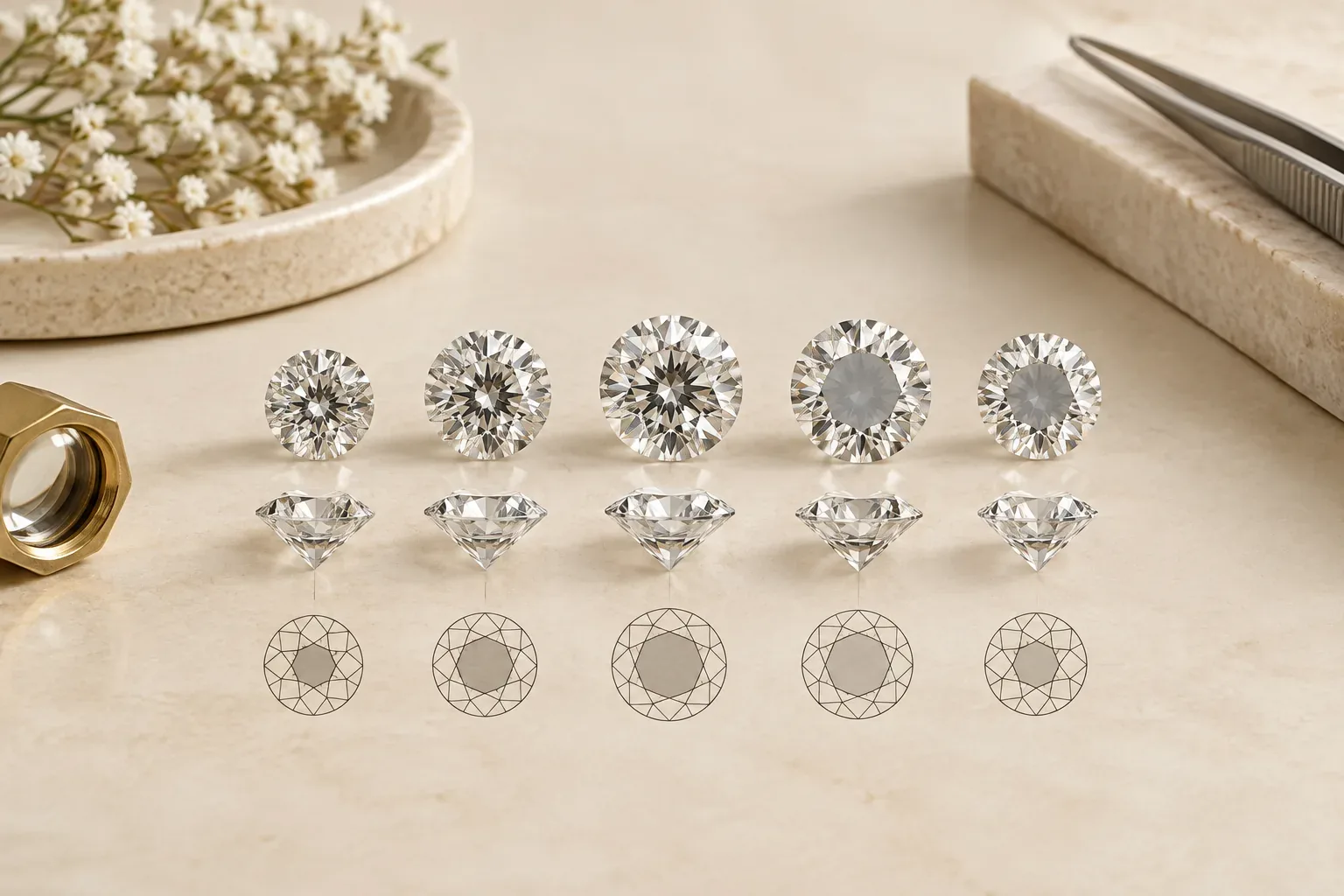
Meaning at a glance
The table percentage determines how much of a diamond’s crown is flat and therefore how the stone distributes light, face-up size, and apparent brightness; choosing a table is a trade-off between perceived size and optical performance, and shoppers should use an evidence-led checklist, ask for lab reports or a qualified jeweler’s assessment, and require clear seller disclosures on origin and treatments.
Quick answer
Diamond table percentage is the ratio of the flat top facet (the table) to the diamond’s average girdle diameter expressed as a percent, and it matters because it changes face-up appearance, the pattern of light return, and often price. This guide defines table percentage in clear terms, explains decision criteria and trade-offs you can expect when comparing smaller, medium, and larger tables, and sets safe limits on what a shopper can verify without a gemological laboratory or qualified jeweler.
What the table percentage is and how to read it
In plain terms, the table percentage tells you how large the flat top facet is relative to the stone. A smaller table gives more crown facets opening above the table; a larger table increases the flat area you see when looking straight at the diamond. When retailers or reports list a table percentage they are providing a simple geometric measurement that helps describe how the cutter distributed material.
When you compare table percentages, think of them as a dial that shifts a stone’s balance between face-up spread (how large it looks) and the character of its sparkle. This guide focuses on that practical comparison rather than claiming a single ‘best’ number, because the ideal table depends on the diamond’s shape, other cut proportions, and the look you prefer.
How table percentage changes appearance: practical trade-offs
A smaller table usually produces more visible pavilion and crown facet interaction at typical viewing angles. That can create a livelier mix of pinpoint brilliance and contrast (areas of dark and light) and sometimes make a diamond appear more scintillating as you move. Smaller tables can reduce the apparent face-up spread, so a stone may look slightly smaller for its carat weight compared with a similar stone with a larger table.
A medium table often reads as a balanced choice: it preserves a mix of brilliance and scintillation while maintaining good face-up presence. Many shoppers find this look broadly appealing because it provides both brightness and perceived size without extreme visual trade-offs.
A larger table increases the flat, bright center you see face-up, tending to make the diamond appear larger ‘face-up’ for its carat weight. Very large tables can flatten the overall pattern of light return, producing a broader bright area but fewer small sparkles and less contrast, which some people perceive as less lively. Large tables can also expose more inclusions that lie near the center, so clarity considerations matter more with larger tables.
How table percentage changes price
Table percentage is one of several cut-related factors that influence price. Because table size affects face-up spread and the way a diamond presents visually, two stones with identical weight, color and clarity can have different market value depending on how a table interacts with other proportions. Buyers and sellers price based on perceived beauty to consumers and the measured optical performance on a certificate.
Price is also indirectly affected because table percentage interacts with other cut details. A table that improves face-up spread may command a premium if consumers prefer that look, while a table that produces desirable optical performance can raise value for buyers prioritizing sparkle. Conversely, a table that makes inclusions more visible or reduces optical performance in a way many buyers dislike can lower a stone’s marketability and price.
Other factors that alter appearance and price alongside table percentage
Table percentage never acts alone. Crown angle, pavilion angle, total depth, symmetry, polish, color grade, clarity, fluorescence and the diamond’s shape all interact with table size to produce final appearance. For example, crown and pavilion angles change how light is reflected through the table; the same table size can perform very differently with different angles or pavilion depths. Symmetry and polish quality affect how clean facet junctions look and thus influence perceived brightness.
Treatments and origin also change buyer considerations. The Gemological Institute of America (GIA) explains that treatments, disclosure and detectability create distinct consumer questions for gemstones. The Federal Trade Commission (FTC) requires clear distinctions among natural, lab-created, treated and imitation materials and written seller disclosures, so these factors affect both price and what you should confirm before purchase.
What you can check yourself and what requires a qualified jeweler or lab
You can visually inspect how the diamond looks in the setting and ask for photos or videos that show movement and lighting. Compare face-up size visually between stones of similar weight and note whether the center appears flat and broad or lively and faceted. Ask the seller for the reported table percentage, a cut description, and images taken from multiple angles.
However, you cannot reliably verify optical performance metrics, exact proportions, or treatment history without trained instruments or a laboratory report. Limits include precise measurement of table and depth, detection of many treatments, and accurate assessment of how crown and pavilion angles interact. The FTC advises consumers to require written disclosures about origin and treatments, and a qualified gemological laboratory report (for example from a recognized lab) or a professional jeweler’s assessment is necessary to verify many claims.
How table percentage appears in finished jewelry
Table percentage influences how a diamond reads in common settings. In solitaire settings, a larger table will be more immediately visible and can emphasize face-up size. In halo or pavé settings, a medium or smaller table may help maintain a balance of sparkle between the center and the surrounding accent stones, because the halo adds visual spread.
Different shapes show table percentage differently. Round brilliants and fancy shapes have distinct facet architectures, so the same table percentage may appear to perform differently between a round, oval, cushion or radiant cut. Settings that lift the diamond, such as cathedral or prong settings, let more light reach the stone and therefore can increase perceived sparkle regardless of table size; bezel settings restrict side light and may emphasize table area more heavily.
Documented historical evidence and cultural notes
Among the allowed evidence for this guide, the available sources focus on market demand, treatments and consumer protection rather than a deep, cross-cultural history of symbolism. Imaginaire Digital provides contemporary market data showing strong demand for engagement rings and other diamond jewelry in the United Kingdom as of 2026, which documents modern consumer interest rather than ancient cultural meanings.
The GIA material included in our source set primarily addresses technical matters such as treatments, detectability and durability—which are relevant to modern consumer decisions and disclosure practices rather than to long-term symbolic history. The FTC documentation addresses legal and consumer-protection contexts for buying gemstones and diamonds today. Because those are the sources permitted for this article, this section limits itself to what they document: modern commercial and regulatory contexts, not exhaustive cultural histories.
Separating documented history from modern personal interpretation
Documented evidence in the sources used here supports claims about contemporary market patterns, treatment disclosure and the technical importance of cut-related measurements. Personal or cultural interpretations—such as whether a particular table percentage 'represents' elegance, luck, or status—are modern, subjective responses and are not universal. Personal taste, the intended wearer’s preference, and cultural background will shape whether a person prefers a larger face-up look or a more scintillating effect.
Practical selection and gifting guidance
Decide which visual priority matters most: perceived face-up size (spread) or lively optical performance (brilliance and scintillation). Use images and videos of the actual stone in similar lighting and settings, not only stock photos. Ask the seller for the table percentage, other cut proportions, and any available laboratory report or independent appraisal.
Require clear written disclosures about whether the diamond is natural, lab-grown, or treated, and verify return, warranty, and insurance options before you finalize a purchase. The FTC emphasizes the need for this kind of disclosure in order to protect consumers. If the stone’s visual performance is your top concern, ask a qualified jeweler or gemological laboratory to evaluate the diamond’s cut and light performance rather than relying on table percentage alone.
When gifting, consider the recipient’s style: someone who loves bold, face-up presence may prefer a larger table in a solitaire, while someone who favors lively sparkle could prefer a smaller or medium table combined with a setting that maximizes light return. Keep budget realistic by prioritizing the characteristics that matter most to the wearer rather than chasing a single ideal metric.
Care and safe handling
Basic care for diamonds does not change because of table percentage, but any stone should be cleaned regularly to maintain its light return. The GIA notes that treatments, disclosure and durability affect care needs and consumer questions; if a diamond has been treated or is a specific manufacture (for example, lab-grown), confirm special care or limitation instructions with the seller.
Avoid household chemicals, take jewelry off during heavy manual work, and consider professional cleaning and inspection periodically. Keep documentation, lab reports, and receipts with the jewelry for insurance and future resale.
When to get expert help
If you need an exact measurement, want to detect treatments, or are buying a high-value stone, ask for a certificate from a recognized gemological laboratory and for an independent appraisal. Many cut-related subtleties—how crown and pavilion angles pair with table percentage, or whether a particular table makes inclusions obvious—require trained instruments and experience to evaluate reliably.
The FTC advises clear written seller disclosures and the GIA explains the detectability and disclosure issues for treatments; rely on those formal reports rather than seller claims alone for high-value purchases.
Frequently asked questions
What exactly is a diamond table percentage?
Table percentage is the measurement of the flat top facet compared with the diamond’s average girdle diameter, expressed as a percent. It describes how large the table facet is relative to the stone and helps predict face-up appearance and how light patterns will read.
Does a bigger table always mean a larger-looking diamond?
A larger table often increases face-up presence because it provides a broader bright area, but that’s not always preferable: larger tables can reduce small-point sparkle and may make central inclusions more visible. Preferences vary by wearer and shape.
Can I judge table percentage by eye or phone photos?
You can get a general sense from photos and videos, especially moving footage under real lighting, but precise measurement and assessment of how the table interacts with other proportions require instruments or a laboratory report and sometimes a jeweler’s expertise.
How do I verify whether a diamond has been treated or is lab-grown?
Ask for written disclosure from the seller and request a report from a recognized gemological laboratory. The GIA notes that treatments and detectability create distinct consumer questions, and the FTC requires clear written disclosures about origin and treatment.
Should I prioritize table percentage when shopping?
Prioritize the visual outcomes you want—face-up spread, sparkle, or balance—rather than a single metric. Table percentage matters, but it must be considered alongside crown and pavilion angles, depth, symmetry, polish, color, clarity and setting.
When should I get a professional appraisal or lab report?
For high-value purchases, complex cut assessments, or when you need definitive verification of treatment or origin, obtain a certificate from a recognized gemological laboratory or a qualified jeweler’s appraisal before finalizing the purchase.
Sources and further reading
- Imaginaire Digital — Imaginaire Digital
- Gemological Institute of America — Gemological Institute of America
- Federal Trade Commission — Federal Trade Commission