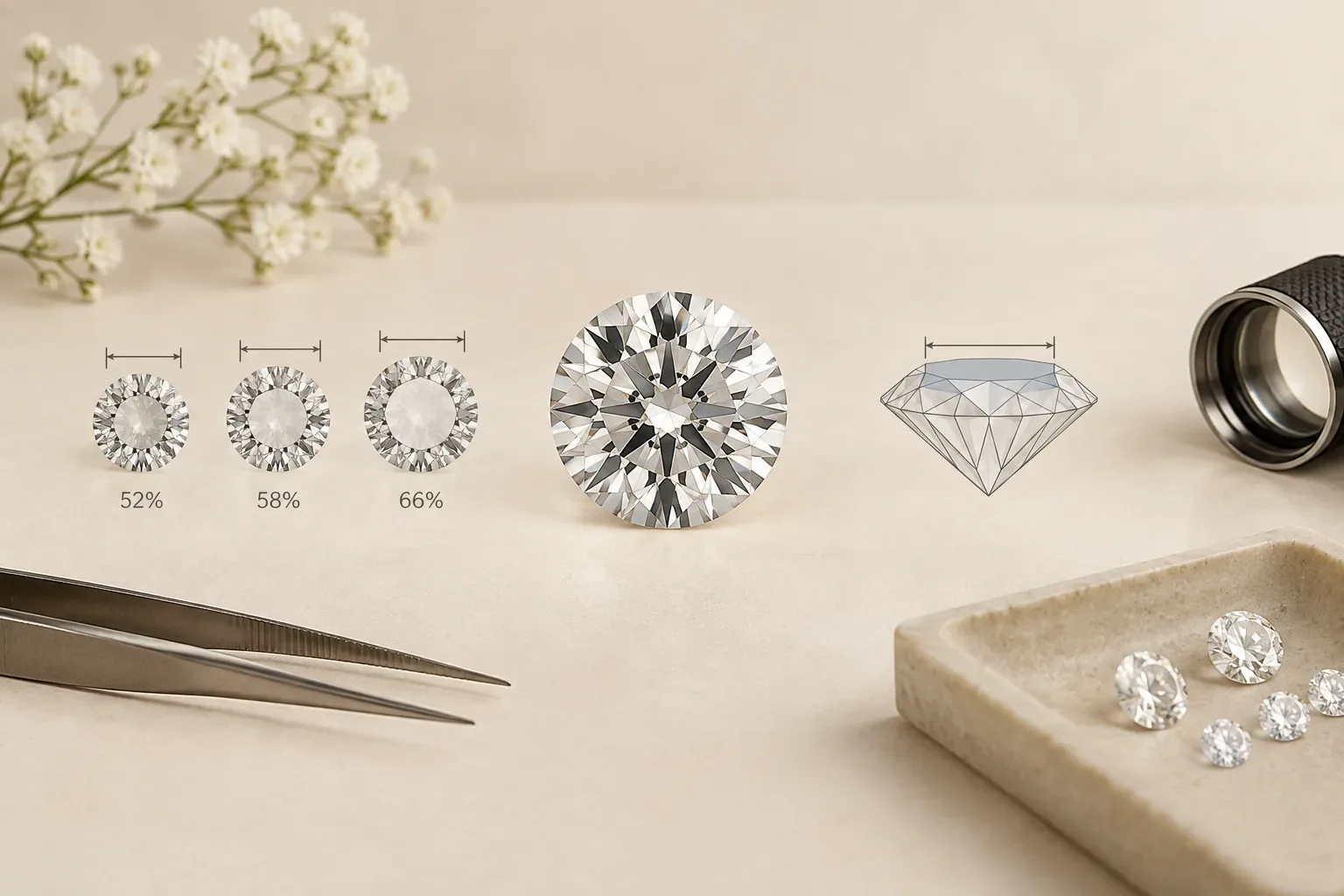
Meaning at a glance
Table percentage is the ratio of a diamond's largest facet (the table) to its average diameter; it affects face‑up size, light return, and look. Use lab reports and reputable disclosures to compare table with depth and angling; prioritize the combination of proportions and an independent certificate over any single number. Ask for the lab report, exact table and depth percentages, crown and pavilion angles or diagrams, images/video, and written disclosure about treatments or origin; have a qualified jeweler or gemological laboratory confirm treatments or origin when needed.
Quick answer
Table percentage is the table facet diameter divided by the diamond’s average diameter, expressed as a percent. It matters because it is one of several proportions that influence how large the diamond looks face‑up and how it returns light. There is no single “best” table percentage for every diamond or buyer: the right choice depends on the cut style, the stone’s crown and pavilion proportions, personal taste, and budget. Use an independent laboratory report and written seller disclosures to compare stones, and ask a qualified jeweler or gemological laboratory to verify any treatment or origin claims you cannot confirm yourself.
What the table percentage is and why it matters
The table is the large, flat facet on the top of a faceted diamond. Table percentage is calculated by dividing the table facet’s diameter by the diamond’s average diameter and multiplying by 100. A higher table percentage increases face‑up spread but reduces the area of the crown facets that contribute to certain aspects of brilliance and contrast. A lower table percentage typically allows for larger crown facets and can increase the pattern of light return in some cutting styles.
Historical evidence and the emergence of modern concerns
Documented modern concern with proportions such as table percentage is principally a product of 20th‑ and 21st‑century gemology and the widespread availability of laboratory reports and imaging. The Gemological Institute of America (GIA) explains that treatments, detection and documented durability have created distinct consumer questions that laboratories and trained gemologists address, which is why proportion data is now commonly included on reports and used by buyers.
Cultural meanings attached to diamonds—status, marriage, permanence—have varied widely and are not universal. Contemporary search and purchase patterns show that engagement rings and other diamond jewellery remain a major consumer focus. Imaginaire Digital’s 2026 search analysis for the UK market records strong demand for engagement rings and related diamond jewellery categories, which helps explain why buyers increasingly compare fine proportion details such as table percentage when selecting an engagement diamond.
Documented historical meanings versus modern personal interpretations
Historically documented meanings depend on time and place and are not captured by a single statement. What is documented in modern sources is that diamonds occupy many social roles—ornamental, symbolic, and commercial—and that modern buyers often associate specific diamond choices with personal meanings such as commitment or status. Those contemporary associations are buyer‑created and vary by individual and culture.
Separate from historical symbolism, modern technical meanings—how a diamond’s proportions influence appearance—are measurable and are the basis for trade‑offs shoppers face today. Distinguish between cultural or sentimental meaning, which is personal and variable, and proportion‑based effects such as face‑up size or light behavior, which are physical and can be described and tested.
How table percentage shows up in jewellery appearance
In finished jewellery the table percentage contributes to the apparent size and character of a diamond. For example, two round brilliants of the same carat weight can look noticeably different face‑up because of differences in table and depth percentages and facet angling. A larger table can make a diamond appear flatter and show more of the pavilion through the table, which can affect perceived sparkle and contrast. A smaller table with taller crown facets often produces more visible crown facet patterns and can increase perceived fire in some light.
Beyond rounds, other cuts—princess, oval, emerald, cushion—use different proportion systems, and the table percentage interacts with the cut’s geometry. For instance, elongated shapes rely on face‑up proportions to affect perceived length and width, while step cuts emphasize clarity and facets over scintillation patterns.
Practical decision criteria: what to compare and why
Prioritize a complete picture of proportions rather than a single number. Ask for table percentage together with depth percentage, crown and pavilion angles, girdle thickness, and the diamond’s cut grade if available. A table number alone cannot predict brilliance or beauty; it must be read alongside pavilion and crown angles and the overall depth.
Value also depends on market demand, which varies by region and style. Imaginaire Digital’s 2026 analysis shows ongoing consumer focus on engagement rings and related diamond pieces, so local market tastes can affect what proportions are most sought after and how much premium is attached to them.
Common trade‑offs to consider
Choosing a larger table typically increases face‑up size for a given carat weight but can reduce the contrast and dispersion produced by crown facets. This can be desirable if you want a larger look for the budget, but it may make the stone appear less lively in certain lighting. Conversely, choosing a smaller table often emphasizes crown facet patterning and can increase certain types of sparkle, but the diamond may look slightly smaller face‑up for the same weight.
Other trade‑offs include cut grade versus carat weight, and clarity/colour versus table/depth balance. Because lab reports and seller photos show proportions and appearance, you’ll often choose the best overall combination for your priorities—size, sparkle, symmetry, and budget—rather than optimizing a single percentage.
Questions to ask sellers and what you can verify yourself
Ask the seller for a current independent laboratory report that lists table and depth percentages, crown and pavilion angles or a proportion diagram, the cut grade where given, and the laboratory’s name and report number. Per guidance emphasized by the Federal Trade Commission, consumers should expect clear written distinctions among natural, lab‑created, treated and imitation stones and written disclosure of any treatments.
You can verify many facts yourself without a lab: read the lab report and confirm the report number, compare the listed table and depth percentages, view high‑resolution images or video of the actual stone, and check for seller return policies and written disclosures. You can also ask for a current invoice that names the stone’s reported proportions and treatment disclosures.
What requires a qualified jeweler or gemological laboratory
Confirming whether a stone has received certain treatments, or determining origin (natural versus lab‑grown) and detecting some advanced treatments, may require specialized equipment or laboratory testing and should be left to a qualified gemological laboratory or experienced gemologist. The GIA notes that treatments, their detectability and the proper disclosures create specific consumer questions; when treatment or origin is material to you, rely on an independent lab report and, if necessary, a second opinion from a recognized lab.
Similarly, evaluating subtle aspects of optical performance—how pavilion angles, inclusions and facet junctions combine to affect light return in person—benefits from an in‑hand inspection by a trained person using tools such as proportion scopes, ideal‑scope or ASET imaging, and a loupe or microscope.
Safe care and handling considerations
Diamonds are extremely hard, but they are not immune to damage. Protect settings from sharp knocks, and have prongs and mounts inspected periodically. Follow any care and durability guidance provided by the laboratory or seller, and ask whether the stone has undergone treatments that change its care needs. The GIA advises that treatments and related durability issues create distinct consumer questions, and sellers should disclose such treatment so buyers can take appropriate care.
For daily wear, especially in engagement rings, choose a secure setting for stones with large tables or thin girdles and establish a regular maintenance schedule with a trusted jeweler.
Practical gifting guidance
When buying a diamond as a gift, prioritize documentation and return policy. Obtain the lab report, ensure clear written disclosure of material facts, and select a stone that balances the recipient’s likely taste with objective proportions. If you are unsure of the recipient’s preferences, choose a classic cut and a reputable laboratory report to keep options open, and confirm a generous return or exchange window in writing.
If the stone is a surprise but the recipient cares about origin or treatments, consider discussing these topics with a qualified jeweler on your behalf before purchase so you can make an informed choice without revealing the surprise.
Final checklist before purchase
Before you buy, confirm you have the independent lab report and report number, the exact table and depth percentages, a proportion diagram or the crown/pavilion angles, clear photos or video of the actual stone, written disclosures about treatments or origin, and a written return policy. Where treatment or origin is material, obtain verification from a recognized laboratory or an experienced gemologist.
Remember that table percentage is one part of a set of proportions. Use it with depth and angling data to make an informed choice that matches your aesthetic priorities and budget.
Frequently asked questions
What is a good table percentage for a round brilliant diamond?
There is no single ‘best’ table percentage. Common round brilliant tables often fall in a mid range, but the right number depends on crown and pavilion angles and overall depth. Evaluate table percentage together with depth and angling, and use an independent lab report and images to judge the stone’s appearance.
Can I rely on online photos to judge table percentage effects?
Photos and video are useful but can be misleading. Always ask for the laboratory report that lists table and depth percentages and, if necessary, an in‑hand inspection or imaging from a qualified jeweler to confirm how proportions affect light return in person.
Does a larger table make a diamond look bigger?
A larger table can increase face‑up spread for a given carat weight, but it may change the stone’s light performance. Consider the trade‑off between apparent size and the pattern of brilliance; balance table percentage against depth and facet angling.
How can I confirm a diamond is natural or untreated?
Request a current independent laboratory report and written seller disclosure. The Federal Trade Commission emphasizes written disclosure of material facts, and the Gemological Institute of America explains that detecting treatments and origin sometimes requires laboratory testing. For definitive answers, rely on a recognised gemological laboratory.
What should I ask a seller before buying?
Ask for the independent lab report and report number, exact table and depth percentages, crown and pavilion angles or a proportion diagram, clear photos or video of the actual stone, written disclosures about treatments and origin, and the return policy. If treatment/ origin matters to you, request a laboratory verification.
Sources and further reading
- Imaginaire Digital — Imaginaire Digital
- Gemological Institute of America — Gemological Institute of America
- Federal Trade Commission — Federal Trade Commission