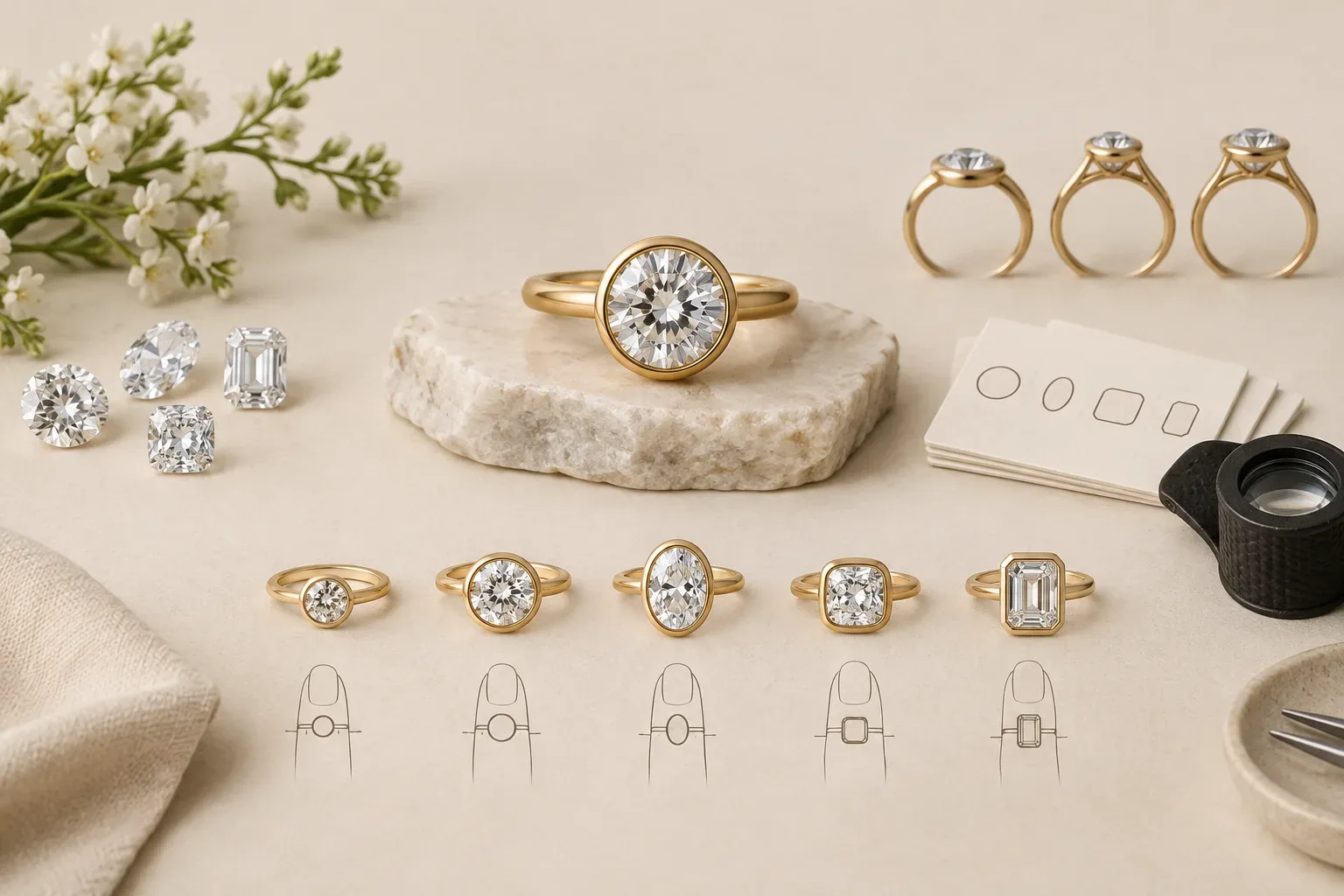
Meaning at a glance
Bezel-setting engagement ring styling is about balancing bezel width and profile, stone size and shape, and band proportion to achieve desired finger coverage and visual scale while accepting trade-offs between protection and brilliance; shoppers should follow clear selection criteria, use safe care practices, and understand the limits of what can be verified without a qualified jeweler or gemological laboratory.
Quick answer
A well-styled bezel-setting engagement ring balances three dimensions: how much of the finger the band and bezel visually cover across the finger, how the bezel’s width and height relate to the gemstone’s face-up size, and how the ring’s overall proportions sit against the wearer’s hand and other jewelry. Choose a narrower bezel and slimmer shank for a daintier look, a wider low-profile bezel for protection and a bolder silhouette, and expect trade-offs in perceived stone size and light return. For certainty about treatments, origin or grades you cannot verify visually, obtain written disclosure and a report from a qualified jeweler or independent gemological laboratory.
What a bezel setting is and how it affects styling
A bezel setting wraps metal around part or all of a gemstone’s girdle to hold it in place. Styling choices include full bezels that encircle the stone, partial or rub-over bezels that frame the girdle, and the bezel’s profile—low and flush to the finger or higher and more pronounced. These design decisions directly affect finger coverage and proportion: a wide bezel occupies more surface area on the finger and creates a contiguous metal edge that can make a stone read smaller face-up but appear bolder as a ring unit.
Beyond coverage, bezels change the interaction between light and the stone. Because they obscure the girdle and often overlap the pavilion edge, bezels reduce direct light entry at high angles. That can mute brilliance in highly faceted diamonds but can intensify color in gemstones and protect cabochons and softer materials that benefit from a secure metal rim.
Historical evidence and how to confirm period and culture
This guide focuses on styling and shopper decision criteria rather than publishing new primary historical research. Jewellery historians and museum catalogues document bezel-like mountings across many periods and regions, and those secondary sources are the appropriate place to find precise attributions to particular cultures or centuries. If you need exact historical identifications—such as a bezel form attributed to a named culture or dated to a specific century—consult specialist publications, museum records, or academic jewellery histories rather than relying on general styling guides.
For contemporary context, recent industry reporting shows where consumer demand is headed. Imaginaire Digital’s 2026 search data shows strong search demand for classic engagement shapes and related categories, and Jewelers Mutual’s 2026 trends reporting highlights modern preferences for fluid forms, versatile stacking and gender-neutral styling. Use those contemporary sources to understand how bezel styling fits current tastes while consulting specialised historical literature to confirm provenance or period-specific forms.
Documented historical meanings versus modern personal interpretations
Documented symbolic meanings that scholars attach to specific historic jewellery pieces are context-dependent and vary by culture, maker and era. Those historical interpretations belong in academic or museum descriptions; this article does not assert universal historical meanings for bezel settings. If a particular historical piece is said to have held amuletic, marital or status significance, verify that claim with the primary historical source or museum label.
Modern personal interpretations of bezel-set engagement rings are more varied and individual. Many contemporary buyers value bezels for durability and low profile, treating them as practical choices for active lifestyles. Jewelers Mutual’s trend commentary identifies craftsmanship, versatility and gender-neutral styling as current drivers, which helps explain the bezel’s renewed popularity among buyers who prioritize wearable design over maximum brilliance.
How the motif, gemstone or tradition appears in jewelry today
In modern jewellery the bezel functions as both a structural feature and a visible motif. Designers use continuous bezels to create clean, minimal profiles or step-shaped bezels for Art Deco–inspired geometry. Bezel cups are common for cabochons and colored stones because the metal rim protects edges that can chip. For faceted diamonds and gemstones, thin bezels can preserve sparkle while offering protection; wide bezels make a deliberate graphic statement and pair well with stacked bands.
The choice of gemstone interacts with the bezel’s visual effect. Colored stones and cabochons often gain saturation when surrounded by metal because the bezel blocks side light and intensifies perceived color. By contrast, high-clarity, highly faceted diamonds may lose some scintillation with a heavy bezel, so designers balance bezel thickness against the desire for brilliance.
Practical selection criteria and trade-offs
Begin with the wearer’s lifestyle. If the wearer is active with frequent hand use or works in environments where snags and knocks are likely, a low-profile full bezel provides superior protection and reduces the chance of the stone catching. If the wearer values maximum sparkle and the stone is a brilliant-cut diamond, choose a thinner bezel or a partial bezel to preserve light return.
Consider finger proportions and ring relationships. Narrow fingers typically suit slimmer bezels and narrower shanks so the ring does not overwhelm the hand. Wider fingers can carry broader bezels and heavier shanks without losing balance. Also think about wedding-band pairing: a flush-fitting wedding band is easier to achieve with a low-profile bezel, while a higher bezel may require a contoured or notched band.
Accept the fundamental trade-offs: wider bezels increase protection and create a bolder silhouette but reduce the apparent face-up size and can mute sparkle; narrow bezels maximize perceived stone size and light but offer less edge protection.
Care, durability and what you cannot verify without expertise
Everyday care for bezel-set rings includes routine gentle cleaning with warm soapy water and a soft brush, regular professional inspections to check for metal wear where the bezel meets the stone, and avoidance of harsh chemicals that can damage some gemstones or metal finishes. The Gemological Institute of America (GIA) advises that treatments and durability affect care and longevity; ask about known treatments and whether a stone requires special handling.
There are clear limits on what a shopper can verify visually. You cannot reliably determine treatments, whether a gemstone is natural or lab-grown, or the precise clarity and color grades of a diamond without instruments and qualified expertise. The Federal Trade Commission (FTC) emphasizes the need for written seller disclosures on natural versus synthetic materials and treatment histories. For definitive answers, obtain a written report from an independent gemological laboratory or a qualified jeweler who can provide documented testing.
Selection and gifting guidance — practical and respectful
When selecting a bezel-set engagement ring as a gift, prioritize fit, lifestyle compatibility and return or resizing policies. If you plan a surprise, try to discreetly learn the wearer’s ring size, metal preference and whether they prefer a low profile or a showier ring. If there is uncertainty about size or style, choose a retailer with a generous exchange or resizing policy and ask for written disclosures about the gemstone and setting.
Respect cultural and personal traditions. Some recipients prefer to choose their own engagement ring or to be involved in the selection; others value surprise. If the ring carries a cultural or familial motif, verify its appropriateness and provenance before presenting it. For insurance and long-term care, document the purchase with receipts and any gemological reports and consider discussing coverage options with providers such as Jewelers Mutual that specialize in jewelry insurance and trends.
Styling examples by finger proportion and pairing suggestions
A delicate solitaire with a slim bezel and narrow shank reads classic and minimal on smaller hands and works well with stacked bands that maintain a subtle profile. For active wearers, a low full bezel with a slightly wider shank creates a unified, protective unit that resists catching and suits single-band looks.
For statement styling, choose a wide bezel or a bezel with decorative milgrain or engraved edges; pair this with a plain wedding band or a contoured band to maintain balance. For gender-neutral and modern stacking, bezels lend themselves to mixed-metal combinations and asymmetrical arrangements that emphasize form over traditional sparkle hierarchy, which aligns with contemporary trends reported by Jewelers Mutual.
Conclusion and limits on verification
Bezel-setting engagement ring styling is a practical design choice that must be balanced against finger coverage, proportion and the wearer’s priorities for protection versus brilliance. Use the visual and proportional cues above to narrow choices, and always obtain written seller disclosures for material origin and treatment. For definitive verification of origin, treatments or official grading you will need testing and documentation from a qualified jeweler or an independent gemological laboratory; these are the only reliable paths to the facts that cannot be confirmed by sight alone.
Frequently asked questions
Will a bezel make my center stone look smaller?
A bezel can visually reduce the apparent face-up size because metal overlaps the stone’s girdle, but the effect depends on bezel thickness and stone shape; thin bezels preserve more visible stone area while wide bezels create a bolder, more contiguous metal surface that reduces face-up presence.
Is a bezel setting better for everyday wear?
Yes—because the bezel surrounds and protects the stone’s edges, it is generally one of the most secure and low-profile choices for daily wear, especially for active lifestyles or for softer gemstones that chip easily.
Can I verify whether the gemstone is natural or treated by sight?
No—you cannot reliably determine whether a gemstone is natural, lab-grown, or treated by unaided visual inspection; the FTC advises consumers to seek written disclosures, and the GIA explains that treatments and detectability often require laboratory testing.
Will a bezel make resizing harder?
Resizing is possible with most bezel-set rings but can be more complex when the bezel extends into the shank or when a continuous pattern must be preserved; always ask the jeweler about resizing options before purchase.
How do I care for a bezel-set ring at home?
Use warm soapy water and a soft brush for routine cleaning, avoid harsh chemicals, and have a jeweler inspect the bezel and mounting periodically to ensure metal has not worn thin where it contacts the stone.
Sources and further reading
- Imaginaire Digital — Imaginaire Digital
- Jewelers Mutual — Jewelers Mutual
- Gemological Institute of America — Gemological Institute of America
- Federal Trade Commission — Federal Trade Commission