Meaning at a glance
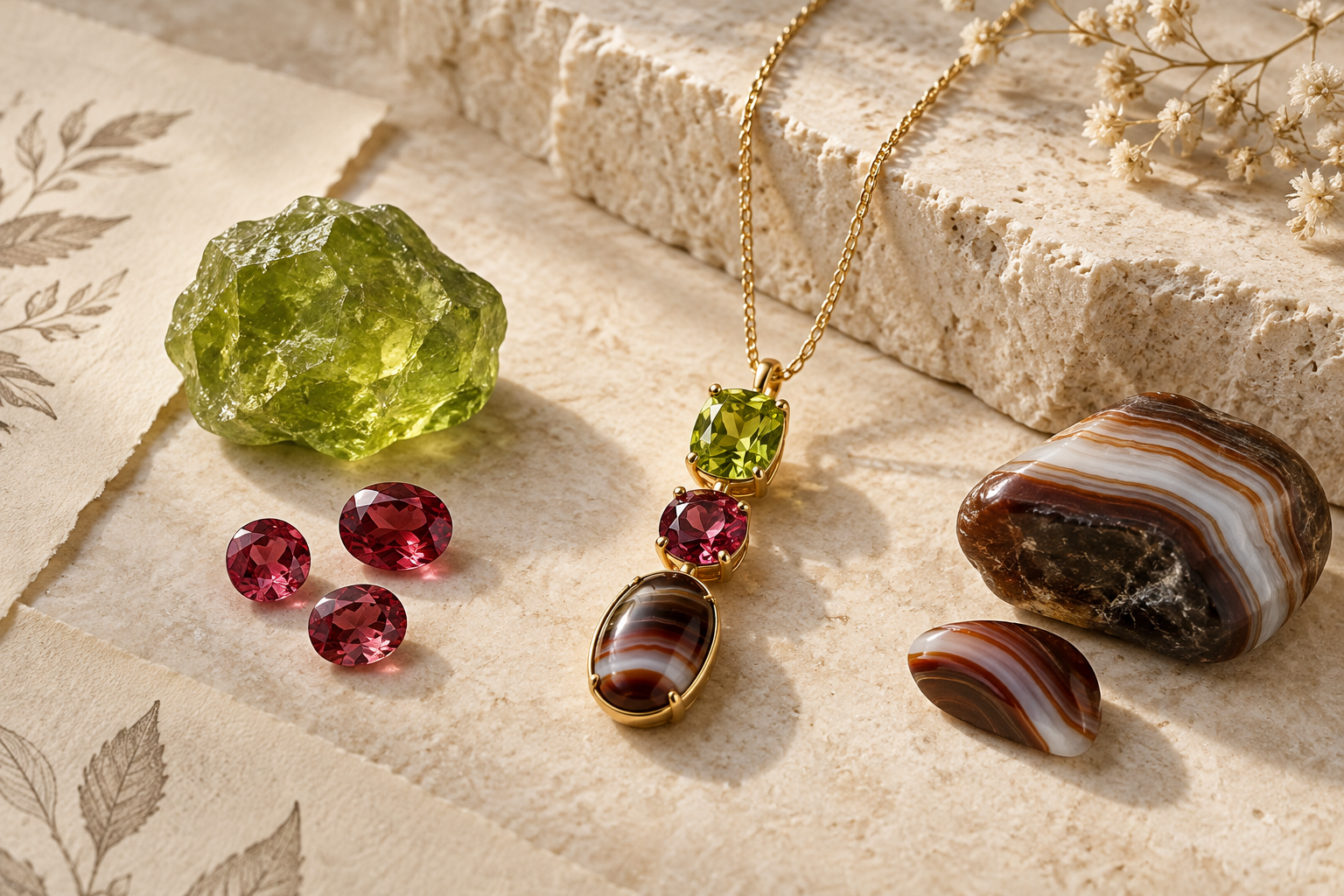
Peridot, spinel, and sardonyx are all associated with August, but they are different minerals with distinct histories, documented meanings, and care requirements—treat each on its own terms when buying or gifting.
Quick answer
Quick answer: Peridot, spinel, and sardonyx are three recognized August birthstones; compare them as August birthstones without treating their different histories, materials, or care needs as interchangeable.
What the historical record shows (evidence-based)
The historical record for birthstones and gem use is varied and changes by time and place. The Gemological Institute of America (GIA) documents that the idea of assigning specific gems to months and to other calendars is not static and that lists and meanings have evolved across periods and cultures. The GIA museum exhibit on birthstones traces gem use from ancient civilizations through medieval and modern periods and emphasizes that what people called a particular gem, and how they used it, differed by region and era.
For peridot, historical references in museum collections show long use in jewelry and ornament. GIA notes that green olivine varieties (the mineral name olivine includes peridot in gem contexts) occur in historical jewelry contexts. For spinel, GIA records explain a long history in which spinel was often confused with ruby and appeared in royal jewels that were later reclassified as spinel when gemological testing advanced. For sardonyx, GIA's historical material documents that banded chalcedony varieties were carved for cameos and intaglios in ancient Mediterranean civilizations and continued to be used for engraved jewelry through the classical and later periods.
GIA's materials make clear that modern birthstone lists—what most people now consult when choosing a birthstone—were formalized over time and reflect twentieth-century standardization as well as later adjustments. These lists and the museum record are the best-documented sources for how certain gems came to be associated with particular months in modern jewelry practice; the links between a gem and a cultural meaning are often reconstructed from surviving objects and written records rather than from a single universal tradition.
Documented historical meanings versus modern personal interpretations
Documented historical meanings rely on surviving sources. According to GIA, many historical meanings assigned to gems came from their use in religious, protective, or status contexts. For example, banded stones carved as signet rings or cameos (including sardonyx) functioned as identification or amuletic objects in ancient Mediterranean societies, which is a use documented in museum collections. The attribution of symbolic properties—such as a stone 'protecting' the wearer or signifying rank—comes from how those objects were worn and recorded, not from an immutable metaphysical property inherent to the mineral.
Modern personal interpretations are widespread and flexible: people today often assign emotional or personal meanings to peridot’s lively green, to spinel’s range of colors, or to the striped, carved look of sardonyx. These contemporary meanings—for example, taxonomies like 'peridot for renewal' or 'sardonyx for strength'—are personal or cultural choices rather than fixed historical facts. The GIA's overview of birthstones and gem history helps distinguish these modern associations from what is documented in the archaeological and museum record.
Materials and care: how they differ
Peridot, spinel, and sardonyx are different minerals or mineral varieties with differing physical characteristics; GIA’s birthstone guide highlights those differences as they affect durability and care. Peridot is a green gem material that can be more prone to scratching and can be sensitive to sudden temperature changes; that affects how jewelers set and protect it in rings and earrings. Spinel is a distinct mineral that is relatively hard and durable compared with peridot, making it suitable for everyday jewelry. Sardonyx is a banded chalcedony (a form of microcrystalline quartz) whose layered structure made it ideal historically for carving cameos and intaglios and which has moderate toughness.
GIA’s guidance on durability and care underscores that these distinctions matter for cleaning, setting, and choosing which gemstone is appropriate for a given type of jewelry. For example, a delicate peridot center in a ring should be treated differently than a faceted spinel intended for everyday wear. For commercial and disclosure practices around treatments or lab-grown alternatives, the Federal Trade Commission (FTC) advises buyers to ask jewelers directly about treatments, enhancements, or synthetic origins and to expect accurate disclosure.
How these gems appear in jewelry (historical forms and modern styles)
Peridot in jewelry often appears as faceted greens in solitaire rings, pendants, and studs. Historically and today, jewelers choose warm gold settings to complement peridot’s yellow-green tones. GIA’s resources show peridot in museum holdings and in modern jewelry because its color is distinctive and fashionable in seasonal palettes.
Spinel is commonly faceted and set much like ruby or sapphire, and it appears in a range of colors from red and pink to blue and purple. Historically, spinel’s red varieties were used in royal and ceremonial jewelry—items that later required gemological reclassification. In contemporary jewelry, spinel is sold as a standalone gem or as a colorful alternative to other colored stones, often in engagement rings or cocktail rings because of its relative toughness and brilliance.
Sardonyx typically appears in carved form. Traditional uses include cameos, intaglios, and signet rings where the layered bands are carved to create contrasting relief. In modern design, sardonyx is used for both classical revival-style jewelry and for contemporary pieces that favor artisanal carving or geometric banded patterns. GIA’s museum and birthstone materials document both the carved historical uses and the continued presence of banded chalcedony in jewelry.
Practical and respectful selection and gifting guidance
Start with the recipient’s style, lifestyle, and any metal allergies. Because these three gems differ materially and visually, choose the one that aligns with how the person dresses and what they wear daily. For a wearer who prefers robust everyday pieces, a durable spinel set in a secure mounting may be the best practical choice. For someone who loves carved or vintage looks, sardonyx cameo or signet styles respect the stone’s historical use. For those who prefer bright color in seasonal or dress jewelry, peridot’s vivid green can be a joyful choice.
Ask the seller about treatments, enhancements, and origin. The FTC’s guidance for buyers of gemstones, diamonds, and pearls recommends that consumers request clear disclosure about treatments, whether a stone is natural, treated, or laboratory-grown, and any origin claims. Reputable jewelers will provide that information and, when appropriate, a gemological report. Keep in mind that the perceived meaning you attribute to a gift is subjective; if a cultural symbolism matters to the recipient, ask respectfully about that context rather than assume a universal meaning.
Consider setting and protection when gifting: for peridot, choose protective settings or designs that minimize exposure to knocks and heat; for spinel, classic prong or bezel settings work well because of the stone’s durability; for sardonyx, show off the carving with a setting that frames the cameo or banding and keeps it from abrasion. If you are unsure, a versatile pendant or pair of studs is often safer than a ring intended for everyday wear.
Personal touches matter: pair the gemstone with a note explaining why you chose it, or select an engraving or a design element meaningful to the recipient. That frames a modern personal interpretation of a stone’s meaning without claiming the symbolism is universal or historically fixed. Finally, consider insurance or a jewelers’ appraisal for valuable pieces and keep receipts and any gem reports together for future care or resale.
Closing: choosing with knowledge and respect
Peridot, spinel, and sardonyx are all legitimate ways to mark August in contemporary jewelry, but the GIA’s documentation and the FTC’s consumer advice both point to the importance of treating each stone as a distinct material with its own history, uses, and care needs. Use documented history to inform your appreciation and use personal interpretation to make the piece meaningful to its wearer, while relying on reputable disclosure when you shop.
Frequently asked questions
Which gemstone is the official August birthstone?
Modern birthstone lists include more than one option for August; reputable institutional lists such as the GIA explain that month-to-gem assignments have changed over time and that multiple gems can be associated with a single month. Check a current list from a professional source if you need a single 'official' name for a given market.
Is peridot durable enough for everyday wear?
GIA guidance notes that peridot is less durable than harder gems and can be more prone to scratching and thermal shock, so choose protective settings and avoid exposing it to hard knocks or sudden high heat if you want daily wearability.
Can spinel substitute for ruby?
Historically spinel was often confused with ruby and has been used in similar roles in jewelry. Today spinel is valued in its own right and is a durable, facetable gem that can function as an attractive alternative depending on color preference and budget.
What is sardonyx traditionally used for?
GIA documents that sardonyx and other banded chalcedony varieties were traditionally carved for cameos, intaglios, and signet rings in ancient Mediterranean and later European contexts because their layered structure creates contrasting relief when carved.
How should I confirm a gem's treatments or origin before buying?
Follow the FTC’s advice: ask the seller directly about treatments, enhancements, and whether the stone is natural, treated, or lab-grown. Reputable sellers will disclose treatments and provide supporting documentation or a gemological report when appropriate.
Sources and further reading
- August Birthstone Guide — Gemological Institute of America
- Birthstones — Gemological Institute of America
- Birthstones: Gems Through the Ages — Gemological Institute of America
- Buying Gemstones, Diamonds, and Pearls — Federal Trade Commission