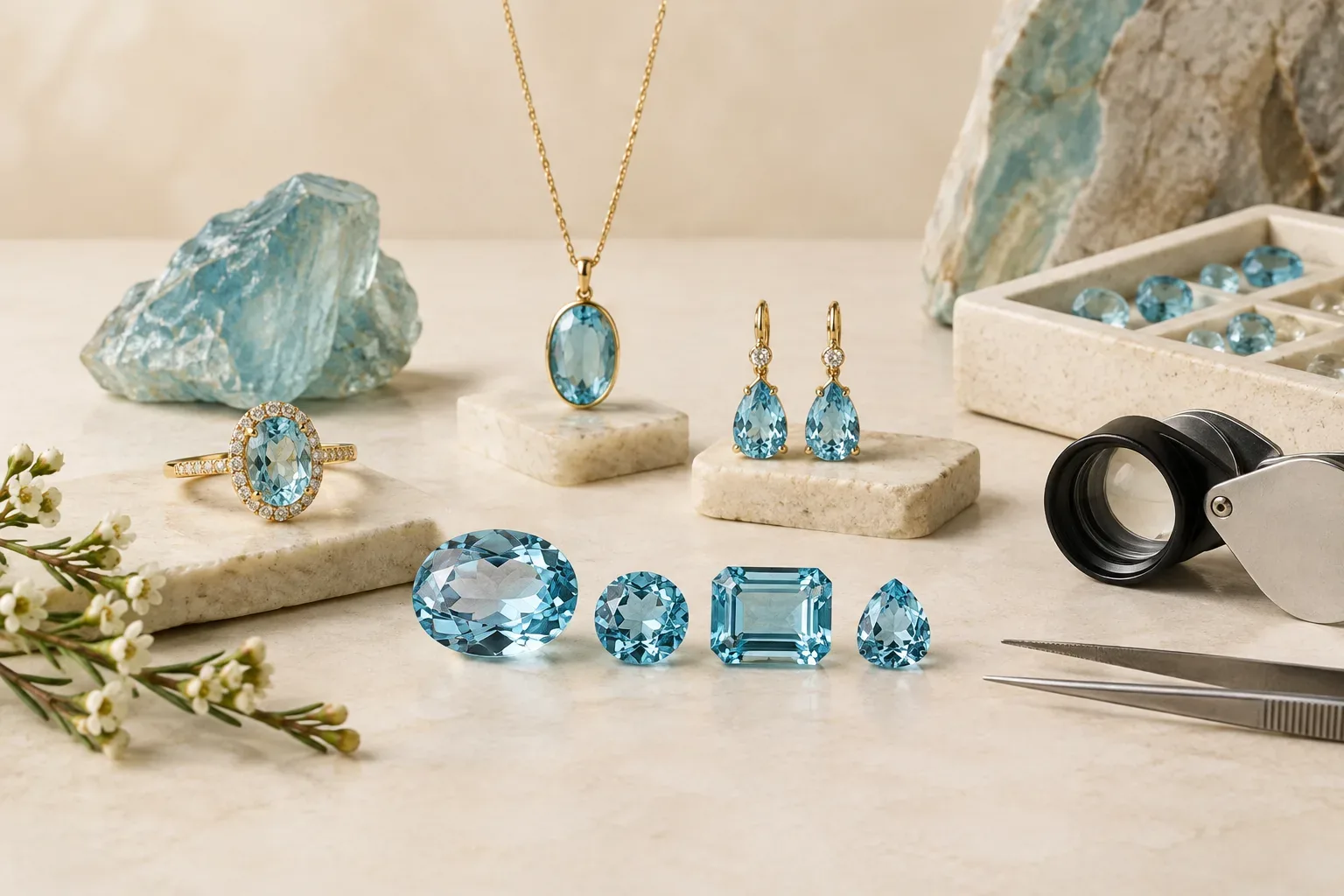
Meaning at a glance
An aquamarine authenticity guide should define four distinct categories—natural, lab-created, treated, and imitation—explain what information reliable sellers must disclose, identify which purchase checks a buyer can reasonably perform, and outline what only a qualified jeweler or gem lab can confirm. Use seller disclosure and, when in doubt, a gemological report to resolve questions about origin or treatment.
What those categories mean (evidence-led definitions)
Natural: A natural aquamarine is a beryl species formed in the earth. Sellers should disclose whether a natural stone has been treated. The FTC emphasizes that consumers need clear, written distinctions among natural, treated and synthetic materials.
Lab-created: Lab-created stones have essentially the same chemical composition and crystal structure as natural aquamarine but are grown in controlled conditions. The FTC’s guidance requires sellers to label these products plainly as lab-created or synthetic.
Treated: According to the Gemological Institute of America, gemstones are sometimes altered to improve color, clarity or stability; treatments vary in visibility and detectability. Sellers are expected to disclose any known treatments and provide care instructions when treatments affect durability.
Imitation: An imitation is a different material made to look like aquamarine (for example, glass or a lower-cost gem). The FTC requires that an imitation be clearly described as such to avoid consumer deception.
Historical evidence and cultural notes (what the approved sources support)
Within the approved sources for this guide the emphasis is on consumer protection, gemology and market trends rather than on deep cultural histories of individual gemstones. The Gemological Institute of America focuses on treatments and detectability. The Federal Trade Commission lays out consumer-facing disclosure obligations. Industry publishers such as Professional Jeweller and Imaginaire Digital document contemporary jewelry trends, including a renewed appetite for birthstone pieces and gemstone rings.
Because the selected evidence does not provide primary historical records tying aquamarine to specific ancient rituals or beliefs, any detailed cultural or period-specific historical claims about aquamarine must be treated as outside the scope of this report unless documented by primary historical scholarship. Where people today assign symbolic meanings to aquamarine—such as calmness, clarity or birthstone associations—those are modern interpretations and retail narratives unless supported by a named historical source.
How aquamarine appears in modern jewelry
Contemporary jewelry demand trends show growth in gemstone rings and birthstone necklaces, and sellers commonly present aquamarine within those categories. Professional Jeweller’s market insights note renewed interest in gemstone rings and birthstone necklaces, which is where aquamarine is typically offered in modern retail assortments.
Imaginaire Digital’s search and trends reporting indicates strong consumer demand across categories that include engagement rings, earrings and necklaces. Aquamarine appears in those formats as center stones in rings, paired stones in earrings, and set into necklaces and pendants marketed for personal meaning or March birthday gifts.
Practical decision criteria for shoppers
Start with seller disclosures. The FTC makes clear that sellers must distinguish natural, lab-created, treated and imitation stones in writing. Always request, and keep, any written statement about the stone’s origin and any known treatments.
Ask for a gemological report from an independent laboratory if the stone’s authenticity or treatment state matters to your purchase. The Gemological Institute of America notes that detectability and the reliability of treatment identification vary, and that independent testing is the definitive route for many questions.
Evaluate price and provenance together. If a price seems unusually low for a strongly colored, large aquamarine, ask why. Lab-created and imitation stones are typically less expensive than comparable natural stones; a big price gap can be a legitimate indicator, but not definitive proof, of category.
Inspect the stone’s appearance and setting. Visible inclusions, color zoning, and how the stone is mounted can offer clues about quality and care but are not definitive for origin or treatment. Confirm the seller’s return policy and any post-purchase grading or appraisal options.
Practical trade-offs: natural vs lab-created vs treated vs imitation
Natural stones often carry higher resale value and appeal to buyers who prioritize geological origin and rarity, but they typically cost more and can show inclusions or color variations. Lab-created aquamarine offers predictable color, lower cost and chemical equivalence to natural beryl, but may be less desirable to collectors who seek natural origin.
Treated natural stones can offer improved color or clarity at lower cost than untreated, top-quality natural stones, but treatments may affect durability or value over time and should be disclosed. Imitations can deliver the look for a low price but are a materially different product and should be priced and labeled as such.
What you can verify yourself and what requires experts
You can verify seller disclosure documents, the presence of a lab report, the return policy, and the basic visual condition of the stone without specialists. You can also compare stated price to market ranges for similar sizes and colors as a sanity check.
Only a qualified jeweler or an accredited gemological laboratory can provide tests that reliably distinguish natural from lab-grown origin in many cases, identify certain treatments, and issue an authoritative grading report. The Gemological Institute of America highlights that detectability varies by treatment and that laboratory analysis may be necessary to resolve disputes.
Care and stewardship (safe, practical guidance)
Ask the seller for care instructions specific to the stone and any disclosed treatments. Because treatments can affect durability and cleaning recommendations, the GIA recommends that treatment details be part of consumer guidance.
In general, treat aquamarine as you would most transparent, faceted gemstones: avoid exposure to harsh chemicals, remove jewelry during high-impact activities, and store pieces separately to prevent scratching. For detailed cleaning methods and to protect any treatment, follow the seller’s or a professional jeweler’s directions.
Selection and gifting guidance
If you are buying or gifting an aquamarine where authenticity matters—such as an engagement stone, an heirloom purchase, or an investment—insist on clear written disclosure and an independent laboratory report. For gifts where appearance, price and immediacy matter more than geologic origin, a clearly labeled lab-created or treated stone can offer excellent value and consistent color.
When gifting a birthstone or sentimental piece, label the card with the stone’s true description as provided by the seller so the recipient understands whether it is natural, lab-created, treated, or an imitation. This respects both the recipient and consumer protection principles emphasized by the FTC.
Final checklist before you buy
Confirm written disclosure of natural, lab-created, treated or imitation status. Ask whether any treatments are permanent, detectable, or require special care. Request an independent gemological report for high-value purchases. Verify the seller’s return policy and get any promised disclosures in writing. If the seller cannot provide clear answers or paperwork, consider walking away or seeking another vendor.
Frequently asked questions
How can I tell if an aquamarine is natural without a lab report?
You can confirm whether the seller provides written disclosure of origin and treatments, inspect the stone’s appearance and setting, and compare price to market expectations. However, neither visual inspection nor price alone reliably proves natural origin; only a qualified jeweler’s testing or an independent gemological report can resolve origin and many treatment questions definitively.
Are lab-created aquamarines the same as natural ones?
Lab-created aquamarines have essentially the same chemistry and crystal structure as natural beryl grown in the laboratory, but their origin is different. The FTC requires sellers to label lab-created stones clearly; whether you prefer natural or lab-created depends on your priorities for price, appearance and provenance.
Should I ask for a gemological report?
For high-value purchases, engagement stones, or when provenance matters, request an independent gemological report. The Gemological Institute of America notes that laboratory analysis is often necessary to detect certain treatments and to provide authoritative confirmation of origin.
Do aquamarines often undergo treatments?
The Gemological Institute of America explains that various gemstones can be treated to improve appearance and that these treatments affect detectability and care. Ask the seller to disclose known treatments in writing and to explain any special care required as a result.
How should I care for an aquamarine?
Ask the seller for care instructions tied to any disclosed treatments. In everyday terms, avoid harsh chemicals, remove jewelry during strenuous activity, and store pieces separately to reduce scratching. Follow professional cleaning guidance if the stone has been treated.
Sources and further reading
- Imaginaire Digital — Imaginaire Digital
- Professional Jeweller / PRYA Jewellery Search Insights — Professional Jeweller / PRYA Jewellery Search Insights
- Gemological Institute of America — Gemological Institute of America
- Federal Trade Commission — Federal Trade Commission