Meaning at a glance
Brown jewelry meaning is not universal; it depends on the material—brown diamonds, brown quartz (including smoky variants), tiger's eye, amber-like resins, wood, or metal patina—and on cultural or personal context. Gemological sources emphasize that color, hue, tone, saturation and the material identity (including treatments) matter for both meaning and value.
Historical evidence and cultural contexts
Documentary evidence that links brown tones to a single symbolic meaning across cultures is limited. Museum and curatorial literature tends to describe materials, techniques, and decorative roles rather than assert universal color symbolism. For example, The Metropolitan Museum of Art's publication on Islamic jewelry discusses historical use of metalwork, enamels, and colored materials in specific objects and contexts; it documents how artisans combined hues and finishes for aesthetic and technical reasons rather than assigning one global meaning to a brown hue.
Gemological research likewise privileges material identification and treatment histories over generalized cultural symbolism. The Gemological Institute of America (GIA) emphasizes that color parameters — hue, tone, saturation and uniformity — affect value and classification of colored gems. GIA's resources on colored-stone identification and treatments show that similar brown appearances can result from distinct minerals and processes, so any historically recorded association with a brown object usually refers to the material and object type rather than the color alone.
Separating documented historical meanings from modern interpretations
Where museums or gemological literature describe historical uses of brown-toned materials, they typically do so in material and technical terms. The Met's catalogue entry style, for instance, records what materials and techniques were used, where objects were made, and how they were worn in particular cultural settings, without presenting a single, cross-cultural symbolic meaning for brown.
Modern interpretations—especially in fashion and personal symbolism—frequently read brown as 'earthy,' 'grounded,' 'warm,' 'reliable,' or 'understated.' These attributions are contemporary and personal rather than universally documented in historic sources. When selecting or discussing brown jewelry, treat historic documentation of materials and techniques as distinct from present-day symbolic readings; consult curatorial or gemological sources for provenance and identity and treat symbolic meaning as an additional, personal layer.
How specific brown materials and motifs appear in jewelry
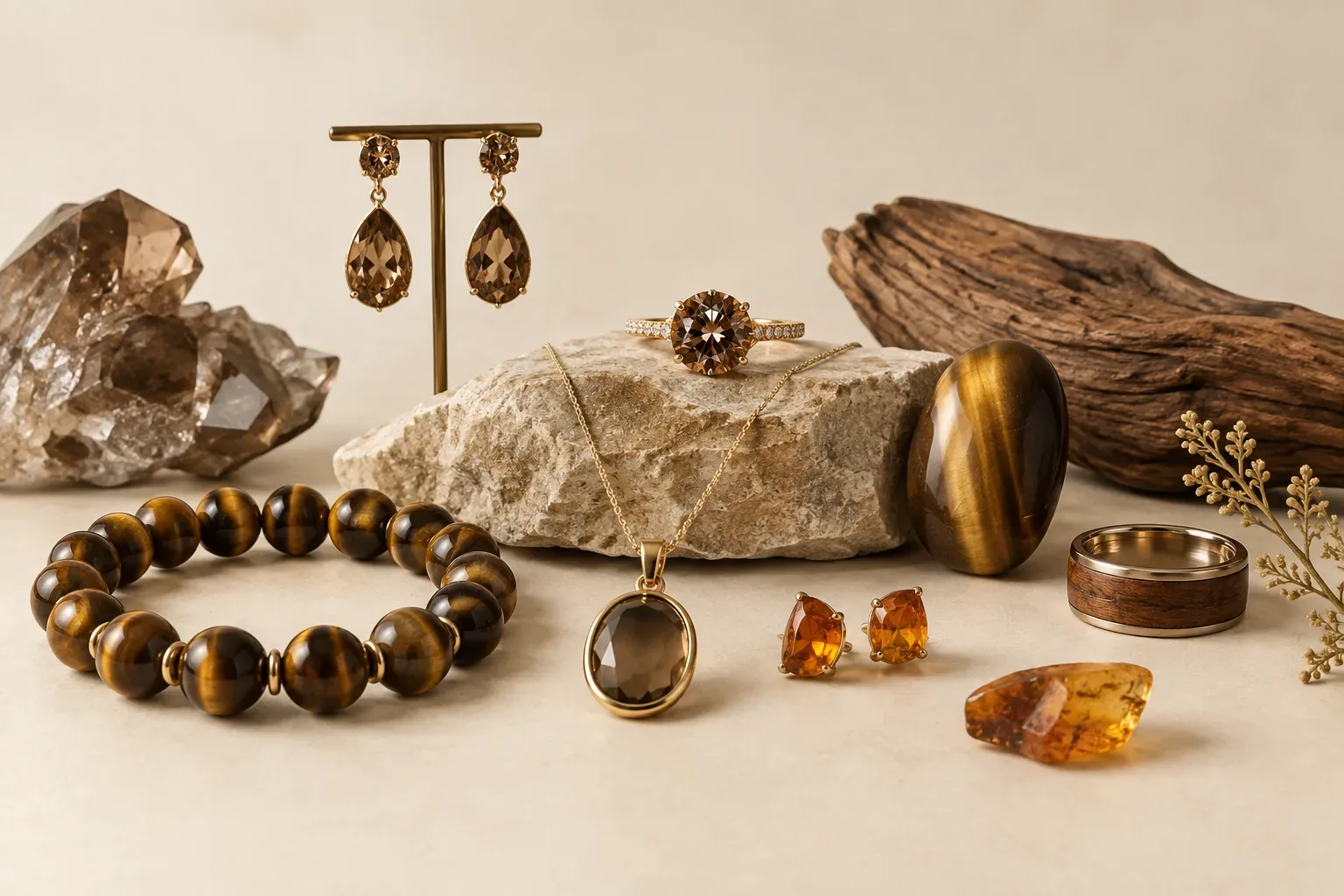
Brown diamonds and brown-colored natural diamonds appear in jewelry as faceted stones and melee accents. The GIA explains that the appearance and market value of colored gems are governed by hue, tone, saturation and color uniformity; for diamonds, both the gem's material identity and color characteristics affect classification and pricing. Because a brown appearance can arise from natural color centers, irradiation, or post-extraction treatments, accurate identification is important for understanding both value and the object's history.
Brown quartz appears in several forms: varieties such as smoky quartz are faceted or cabochon-cut and used in rings, necklaces and bracelets. The GIA's colored-stone research highlights that identification and disclosure of treatments or enhancements — for instance heat or irradiation — are major factors when assessing colored quartz and other stones that display brown tones.
Tiger's eye is a silica-based mineral recognized for chatoyancy (a cat's-eye effect) and golden-to-brown bands. In jewelry it is commonly cut into cabochons, beads, and inlays so the chatoyant banding is visible. Designers may pair tiger's eye with warm metals and wood to emphasize an earth-tone palette; see the site’s dedicated article on tiger’s eye for more on history and care.
Amber and amber-like resins contribute warm yellow-brown tones to jewelry. Genuine amber is fossilized tree resin used historically and today in beads and pendants; contemporary pieces that show similar coloring may be glass, stabilized resins, or imitations, making material identification relevant to meaning and care.
Wooden elements and patinated metal finishes are non-gem materials that produce brown tones in jewelry. Artisans use different woods, stains, lacquers, and metal patinas to achieve warm browns or to evoke historical surfaces. Museum publications such as The Metropolitan Museum of Art’s work on Islamic jewelry describe how metal finishes and applied color were part of design vocabularies in specific regions and periods, emphasizing technique rather than an overarching symbolic meaning.
Practical guidance for selecting or gifting brown jewelry
Identify the material first. Because brown can describe many different materials, ask or check for material identification and treatment disclosure. The Gemological Institute of America stresses that value and care hinge on both the stone's material and its color parameters, so a clear description from a seller is essential.
Consider durability and lifestyle. Some brown materials are hard and suitable for daily wear (for example, certain varieties of quartz or diamonds), while others (amber, some resins, and many woods) are softer and require more cautious wear and storage. Align the choice with how and where the recipient is likely to wear the piece.
Respect cultural context. If the jewelry references a specific cultural style or traditional technique, learn about its provenance and avoid assuming that modern fashion uses reflect the original cultural meanings. Museum resources can help you understand historical contexts before gifting a piece that borrows traditional motifs.
Match color to metal and wardrobe. Brown stones and finishes generally pair well with yellow gold, rose gold, and warm-toned metals, but designers also contrast brown gems against cool metals for modern effects. Think about the recipient's existing jewelry and favored colors.
Ask about treatments and disclosure. The GIA recommends clear disclosure of treatments that affect color and durability. For example, heat treatment, irradiation, or stabilization may be used to enhance brown tones in some materials; whether those treatments matter depends on the recipient’s values and the piece’s intended use.
Gift with meaning but not assumption. If you choose brown for symbolic reasons—such as grounding or mature elegance—frame the gift as a personal interpretation. Because historical documentation seldom ascribes one universal symbolic meaning to brown, presenting your intention as your sentiment rather than a cultural fact is more respectful and accurate.
Summary
Brown jewelry meaning is rooted in both material identity and personal or cultural interpretation. Gemological sources emphasize that color is a property to be understood in relation to the material, its treatments, and the object's provenance. Museum literature documents regional materials and techniques without assigning a single symbolic meaning to brown hues. For meaningful selection or gifting, prioritize accurate material identification, disclosed treatments, and respectful framing of personal symbolism.
Frequently asked questions
What does brown jewelry mean?
There is no single universal meaning. Contemporary readings often describe brown as earth-like, warm, or grounded, but historical records typically document materials and techniques rather than one symbolic meaning. Treat any attributed meaning as contextual and often personal.
Are brown diamonds less valuable than colorless diamonds?
Value depends on both material and color characteristics. The Gemological Institute of America notes that hue, tone, saturation and color uniformity influence value for colored gems, so some brown diamonds may command strong prices depending on these factors and market terminology; accurate identification and disclosure are important.
Is tiger's eye associated with specific meanings?
Tiger's eye has been used for centuries as an ornamental stone and is known gemologically for its chatoyancy. Any particular symbolic meaning is a modern cultural attribution rather than a universally documented historic fact; consult specialist sources for region-specific histories.
How should I care for amber or wood in jewelry?
Amber and wood are softer than many gemstones and sensitive to heat, chemicals and abrasion. Because material identity affects care, ask the seller for care instructions and avoid ultrasonic cleaners or harsh chemicals on organic materials.
How do I choose a respectful gift when a piece references another culture?
Learn about the object’s provenance and the cultural context of any motifs before gifting, and present your gift as a personal sentiment rather than an assumed cultural statement. Museum publications can help provide accurate background information.
Sources and further reading
- Colored Gemstone Value Factors — Gemological Institute of America
- GIA Colored Stone Research — Gemological Institute of America
- Islamic Jewelry in The Metropolitan Museum of Art — The Metropolitan Museum of Art