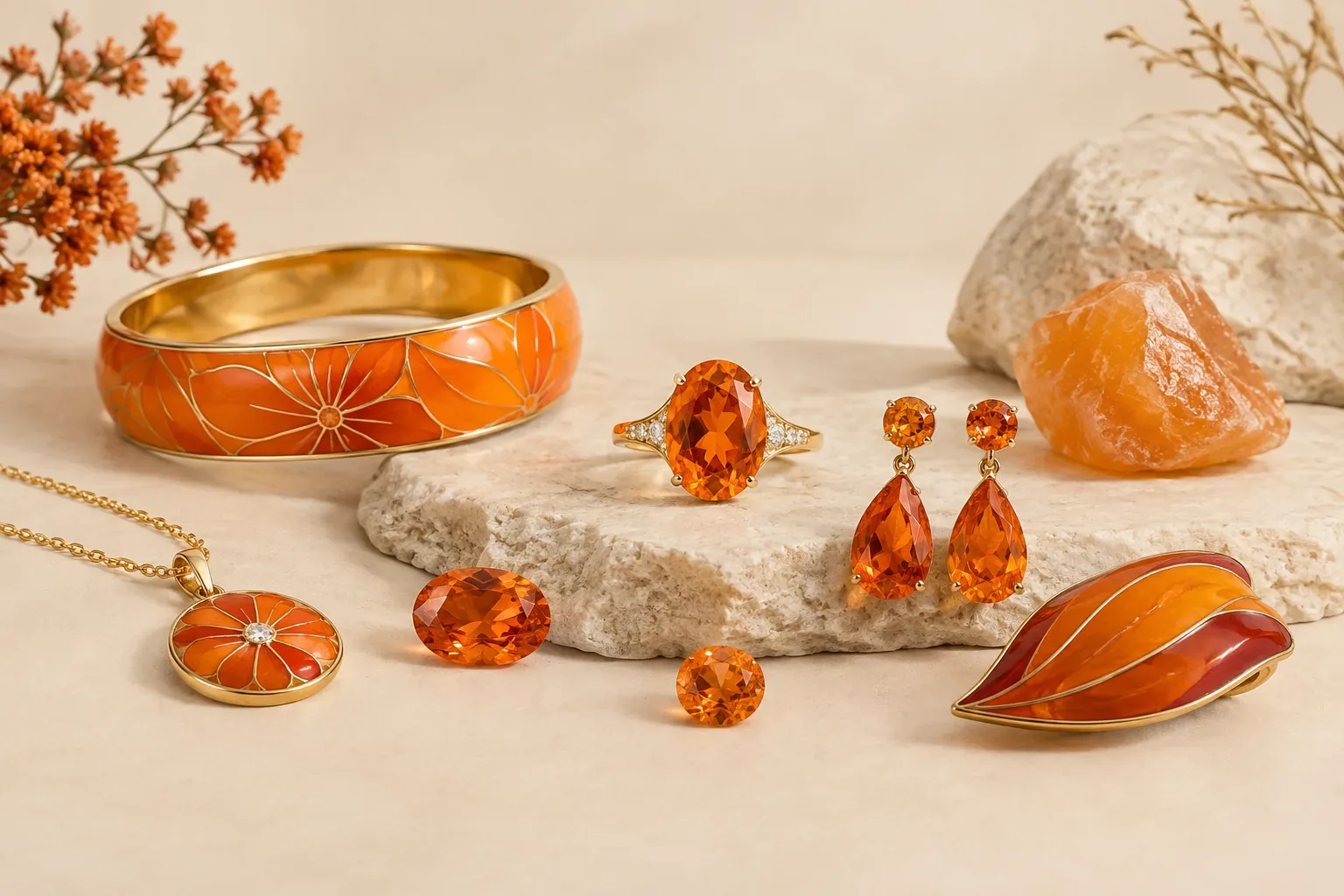
Meaning at a glance
Orange gemstones and orange enamel are best described with careful gemological and historical terminology; documented sources focus on materials, color, and technique, while modern wearers often use orange to express warmth, energy, or creativity as a personal association.
Short answer
Documented evidence treats orange gems and enamel principally as materials defined by hue, tone, saturation, and technique; modern personal and contemporary associations often frame orange jewelry as conveying warmth, energy, or creativity. Explain orange gems and enamel with careful terminology and frame warmth, energy, or creativity as personal and contemporary associations.
What historical evidence shows (by source and context)
Museum documentation and curatorial research emphasize the material and technical histories of colored gems and enamel rather than a single, universal symbolic meaning. For example, The Metropolitan Museum of Art records the use of colored stones and cloisonné and champlevé enamel in works from Islamic regions and other cultures, describing how artisans combined color, metalwork, and surface decoration to achieve visual effects and social prestige. The Met’s catalogue and exhibition research focuses on the objects themselves, their materials, and manufacturing techniques rather than asserting a single, culture-wide symbolic definition for the color orange.
Professional gemological authorities such as the Gemological Institute of America (GIA) approach colored gems through identification, treatment, and market factors. GIA research emphasizes how hue, tone, saturation, and color uniformity affect a colored gemstone’s value and appearance, and it documents how origin and treatment affect a stone’s properties. These technical records are essential when discussing orange gems because they explain how color is measured and how treatments or origins influence appearance and durability rather than prescribing symbolic meanings.
Separate documented historical meanings from modern personal interpretations
Historical records that museums and professional bodies provide are often descriptive: they tell us what materials were used, how objects were made, and where examples were found. Those records do not justify claims that a single meaning for orange jewelry existed across cultures. It is more accurate to say that material color and decoration played roles in aesthetics, status display, or ritual contexts in particular cultures, and that those roles varied by region and period.
Contemporary associations—such as describing orange jewelry as symbolizing warmth, creativity, or energetic personality—are modern, personal, and culturally contingent interpretations. These associations are valid as contemporary design or gifting choices, but they should not be presented as historically universal meanings. When choosing language about symbolic meanings, distinguish clearly between what a museum catalogue or gemological study documents and what a modern wearer or designer intends.
How orange gemstones and enamel appear in jewelry
Orange color in jewelry comes from both gemstones and applied color such as enamel. Gemstones that produce orange tones include varieties whose natural chemistry and crystal structure create orange hues; gemological study, including the color evaluation factors GIA describes, is the proper way to discuss those hues and their market value. Gem settings typically reflect hardness and toughness: harder gems are often used in rings and bracelets that see everyday wear, while softer or more delicate materials appear in pendants and earrings.
Enamel is a glassy surface material fused to metal and historically appears as colored cloisonné, champlevé, or painted enamel on rings, pendants, and metalwork. The Metropolitan Museum of Art’s research documents many historical examples where enamel provided saturated color fields and fine detail, enabling vibrant orange accents that complemented gemstones or stood alone as decorative color areas. Enamel allows jewelers to achieve uniform flat color, gradients, or pictorial scenes in hues that may include orange.
Common orange gems, their jewelry uses, and what professional sources recommend you check
When selecting orange gemstones, consider the gem’s color quality and durability. Professional gemological guidance from GIA stresses hue, tone, saturation, and uniformity as central to color significance and to market value. Those technical attributes determine how a stone will look in different settings and lighting, which matters for both appearance and long-term satisfaction.
Many orange stones are popular in contemporary jewelry—examples include orange sapphires, spessartine garnet, fire opal, and agate—each with different hardness and care requirements. Some orange stones are treated, enhanced, or available as lab-grown or imitation versions; GIA research on colored stone identification and treatments explains why asking a seller about treatments, origin reporting, and certification is important before purchase. Treatments often affect value and maintenance needs, so documentation from a reputable laboratory or jeweler is useful.
How artists and designers use orange motifs and color in jewelry
Designers use orange in a range of ways: as a focal gemstone, as enamel panels, or as small accent stones that warm a palette. In metalwork traditions documented by museums, enamel provided saturated patches of color that could be combined with gemstones to create contrast, pictorial scenes, or stylized motifs. Contemporary designers adopt these approaches and may pair orange stones with warm metals such as yellow gold or with cool metals for contrast.
Modern motif choices—floral, geometric, or abstract—affect how orange is read by a viewer or wearer. An orange cabochon set in a simple bezel will read differently from multiple small orange pavé stones in a band. These are aesthetic decisions driven by fashion and personal taste rather than by universal symbolic meaning; artists often describe the effect they intend, and wearers apply personal meaning when gifting or selecting pieces.
Practical and respectful selection and gifting guidance
Clarify the recipient’s preferences first. If you do not know how the recipient reads color, choose a versatile design such as a pendant or studs where the orange accent is present but not dominant, or select an orange stone known for durability if the piece will be worn daily. Consider metal pairing, as warm metals like yellow or rose gold typically enhance orange tones, while white metals create high-contrast contemporary looks.
Ask sellers for documentation. GIA’s guidance on colored stone value factors and on identification and treatment supports requesting information on hue, saturation, treatments, and any lab reports. Treatment history and origin can affect price and care requirements. For sentimental or symbolic gifting, explain your personal association—warmth, creativity, or energy—so the recipient understands your intention, and avoid asserting a historic or universal symbolism that the object’s documented history does not support.
Care matters. Enamel can chip from hard impact and requires different attention than a faceted gemstone; softer orange gems need gentler wear. When selecting an orange piece intended for everyday use, prioritize harder stones and secure settings and ask your jeweler about recommended cleaning and maintenance practices.
Design examples and where to learn more
A single orange cabochon set in a simple pendant makes a contemporary, wearable statement and highlights the stone’s color without requiring elaborate care. Enamel accents in a bracelet or ring can provide vibrant, flat color fields that coordinate with wardrobe choices. Museum collections such as those documented by The Metropolitan Museum of Art are good places to study how historical makers combined enamel and gems for durable decorative effects and social display.
If you want to learn more about choosing meaningful jewelry, researching symbols, or understanding how natural, lab-grown, and imitation stones differ, see our related articles which give practical, non‑commercial guidance on selecting and researching jewelry.
Frequently asked questions
Does orange jewelry have a single historical meaning?
No. Historical records and museum research typically document materials, manufacture, and contexts of use rather than a single universal symbolic meaning for the color orange; meanings varied by place and period and are best treated as specific to particular cultures or objects.
What should I ask a jeweler about when buying an orange gemstone?
Ask about the stone’s identification, whether it has been treated or enhanced, any available lab reports, and the gem’s hardness and care needs. The Gemological Institute of America recommends evaluating hue, tone, saturation, and color uniformity because those factors directly affect appearance and value.
Is enamel a good way to get orange color in jewelry?
Yes; enamel provides bright, uniform color and fine decorative possibilities. Museum documentation shows enamel’s historical use for sustained color fields and detailed images. Keep in mind enamel can chip if struck and may require more careful wear than some faceted gemstones.
Can orange jewelry be given as a symbolic gift?
Absolutely, but frame your intent as personal and contemporary. Modern associations such as warmth, creativity, or energy are meaningful in gifting contexts, but avoid stating them as historically universal meanings unless documentation for a specific culture or object supports that claim.
How do I care for orange stones and enamel?
Care depends on the material. Harder faceted stones tolerate more wear, while softer stones and enamel need gentler handling. Consult the seller about cleaning methods and avoid harsh ultrasonic cleaners for treated stones or delicate enamel pieces unless a professional jeweler confirms it is safe.
Sources and further reading
- Colored Gemstone Value Factors — Gemological Institute of America
- GIA Colored Stone Research — Gemological Institute of America
- Islamic Jewelry in The Metropolitan Museum of Art — The Metropolitan Museum of Art