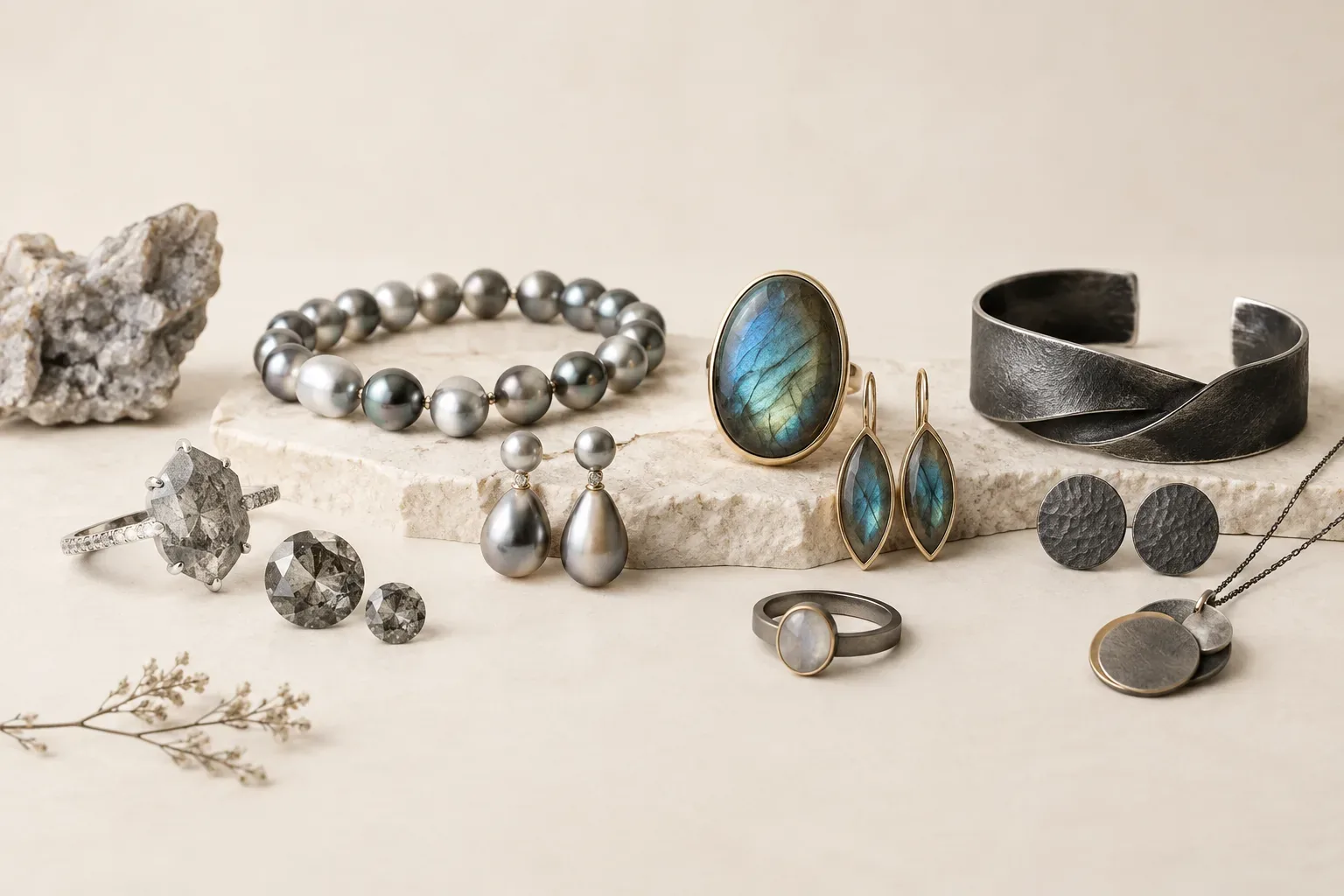
Meaning at a glance
Gray jewelry meaning is not a single, universal symbol but a set of material-specific associations: subdued or rare color in gray diamonds; natural and regional associations in gray pearls; optical schiller in labradorite-like stones that reads gray in neutral light; deliberate darkening or patina in oxidized metals; and contemporary neutral design language that emphasizes restraint and versatility. Documented historical uses appear in museum collections and gemological research, while many current meanings are personal or stylistic.
How we separate documented history from modern interpretation
When discussing color and materials in jewelry it matters to distinguish documented historical practice from modern personal readings. For historical and technical claims I rely on museum documentation and gemological research. For example, the Metropolitan Museum of Art has cataloged historical jewelry objects and materials, providing context for how makers used metals, enamel, and surface color in Islamic jewelry. The Gemological Institute of America provides the research basis for how hue, tone, saturation, and treatments affect colored gemstone identification and value. Statements about what people today feel or intend when they choose gray jewelry are modern interpretations and not universal; they vary by culture, individual taste, and design context.
Gray diamonds: what the gemology shows and what people read into them
Documented evidence: The Gemological Institute of America (GIA) describes colored gemstone value in terms of hue, tone, saturation and uniformity; those same color principles apply to diamonds that display gray body color. Gray diamonds are evaluated by their position on color scales and by whether the gray results from natural structural causes, trace elements, or treatments. The GIA's colored stone research also frames how identification and disclosure affect market perception.
Modern interpretation: Today some buyers read gray diamonds as understated luxury, moody sophistication, or gender-neutral alternatives to traditional white or colored diamonds. Those interpretations are contemporary styling choices rather than universal symbolic meanings. Because the GIA emphasizes identification and disclosure, buyers who want a natural gray stone should ask for gemological reporting that addresses origin and any treatments.
Gray pearls: species, provenance, and cultural associations
Documented evidence: Pearl color is a biological trait tied to species, nacre thickness and environment, and trade history. The GIA's research into colored stones and gem identification extends to understanding how natural and cultured pearls are classified. Gray or silver-gray pearls often come from specific mollusk species or cultivation methods and have been valued differently across markets and periods.
Modern interpretation: Contemporary wearers may associate gray pearls with modern minimalism, maritime heritage, or unusual/luxury taste. Those are stylistic associations rather than historically universal meanings. When selecting or gifting gray pearls, consider whether the recipient prefers natural color variation or highly uniform, treated shades, and request authoritative identification if origin or treatment matters to you.
Labradorite-like effects and other feldspar schiller
Documented evidence: Some gemstones show optical phenomena—such as labradorescence, the play of color typical of labradorite—that can read as muted gray in neutral light and flash vivid color at other angles. The GIA's colored stone research includes identification of such phenomena and guidance on how optical effects influence a stone's appearance and value. These phenomena are material properties, not symbolic content in themselves.
Modern interpretation: Designers and wearers often prize labradorite and similar stones for their dynamic, mysterious quality. The gray ground with flashes of color lends itself to jewelry meant to feel enigmatic or chameleon-like. That reading is a contemporary aesthetic choice; the optical property itself is a physical characteristic cataloged by gemology.
Oxidized metals, patina, and historical surface treatments
Documented evidence: Historical jewelry collections show intentional darkening, patination, and contrasting metal finishes used for decorative effect. The Metropolitan Museum of Art's cataloguing of Islamic jewelry highlights how artisans used metal color, surface treatments, and inlay to achieve specific visual contrasts and technical outcomes. Darkened or blackened metal surfaces have long been part of jewelry craftsmanship across many cultures.
Modern interpretation: Today, oxidized silver, blackened gold surfaces, and intentional patina are often read as vintage, industrial, or gothic style markers, depending on context. These are contemporary interpretations of an established technique. When a maker deliberately oxidizes a metal, the result is a design choice that communicates restraint or contrast but not a fixed symbolic message.
Neutral design language: gray as a stylistic vocabulary
Documented evidence: Museum and gemological documentation show that neutral or metallic tones have been used for both practical reasons and aesthetic coherence. The GIA's work on value factors notes that color uniformity and how a gem sits within a design affect perception and desirability. Historical objects cataloged by museums demonstrate deliberate choices about palette and finish.
Modern interpretation: In contemporary jewelry design gray functions as a neutral vocabulary that supports minimalism, layering, and gender-neutral styling. Designers use gray to avoid the decorative cues of bright color and to emphasize form, texture, or movement. That usage is cultural and current; it is not an intrinsic symbolic meaning that applies everywhere or in all times.
How gray materials and motifs appear in actual jewelry
Gray diamonds are most commonly cut and set as center stones or accents where their muted body color provides a contemporary alternative to colorless or fancy colored diamonds. Jewelers may present gray diamonds with lighter accent stones to emphasize contrast or set them in warm metals to create a subtle mix of tones.
Gray pearls appear in strands, single-drop pendants, and as accent pearls in multi-material pieces. Cultured saltwater and some freshwater varieties supply a range of silvery-to-graphite tones that designers incorporate for a sleek, subdued effect.
Stones with labradorite-like effects are usually cabochon cut to maximize their schiller. They are set to show the play of color, often in bezel settings or organic mountings that favor the stone's surface sheen rather than faceting brilliance.
Oxidized or patinated metals are used as surface finish choices on silver, bronze, and even gold alloys. Designers use the dark surface to create contrast with polished highlights, enamel, or gem facets, and to emphasize engraved or textured details.
As a design language, gray appears as base color in modular, stackable, and mixed-metal jewelry where it functions to harmonize different elements rather than dominate them.
Practical guidance for choosing or gifting gray jewelry
Consider the material story: ask whether the gray effect is natural, treated, or the result of surface finish. For diamonds and colored stones, request a gemological report if origin, treatment or value matters; the Gemological Institute of America provides standards for identification and valuation that sellers should reference. For pearls, ask about species and whether the color is natural or enhanced.
Match the piece to the recipient's palette and lifestyle: gray jewelry is versatile but reads differently next to warm or cool wardrobes. Gray metals and stones can complement both cool and warm tones depending on the metal setting and accent colors. Consider how the recipient dresses and whether they prefer low-contrast or statement pieces.
Care and permanence: oxidized surfaces and patina may wear with time or change with cleaning. If you want a lasting dark finish, ask how the maker sealed or treated the surface and what maintenance is recommended. For gemstones with optical phenomena, cabochon surfaces are more vulnerable to scratching than faceted stones, so consider lifestyle when selecting a setting.
Respect cultural contexts: some historical practices and color uses are tied to particular cultures and periods. If you plan to reference a historical style, consult reliable museum sources and avoid asserting that a contemporary interpretation reflects a single cultural meaning.
Use internal resources to research further: for help choosing meaningful pieces consider our gift guide and our article on how to research jewelry symbols, and if birthstone type matters to you review guidance on natural, lab-grown, and imitation birthstones.
Closing note
Gray in jewelry is best read as a set of material-specific signs rather than a single symbolic message. The Gemological Institute of America provides the technical framework for understanding colored stones and optical effects, while museum collections such as those cataloged by The Metropolitan Museum of Art demonstrate how metals and surface color have been used historically. Use those factual foundations to inform purchases, and treat personal and cultural meanings as fluid and contingent.
Frequently asked questions
Does gray always symbolize sadness or mourning in jewelry?
No. While some cultures may associate gray tones with restraint or somberness, there is no universal symbolic meaning. Historical and technical sources show gray as a material attribute or design choice; modern associations such as minimalism or mystery are contemporary interpretations.
Are gray diamonds less valuable than colorless diamonds?
Value depends on hue, tone, saturation, uniformity, and whether the color is natural or treated. The Gemological Institute of America explains that colored stone value factors apply, so some gray diamonds can be rare and valuable while others may be less so depending on their gemological characteristics.
How can I tell if a gray pearl is natural or dyed?
Ask the seller for identification information about species, culturing method, and whether any dyes or treatments were applied. Reputable labs and gemological reporting can confirm natural color versus enhancement.
Will oxidized metal finishes wear off with time?
Some surface darkening and patina are intentionally designed to age or to be permanent, but cleaning and abrasion can change a finish. Ask the maker about maintenance and whether the finish is sealed or expected to evolve.
How should I care for stones with labradorescence or similar effects?
Stones that display optical schiller are often cut as cabochons and can be more susceptible to surface scratches than faceted gems. Clean gently according to the stone's specific care recommendations and consider protective settings if the wearer leads an active lifestyle.
Sources and further reading
- Colored Gemstone Value Factors — Gemological Institute of America
- GIA Colored Stone Research — Gemological Institute of America
- Islamic Jewelry in The Metropolitan Museum of Art — The Metropolitan Museum of Art