Meaning at a glance
Renewal and rebirth are useful modern jewelry themes, but no single historically verified Norse symbol universally carried that meaning across the Viking Age.
What the historical evidence can and cannot tell us
When designing, wearing, or gifting jewelry that references Norse ideas of renewal, it helps to separate the written mythic sources from archaeological material and to respect regional and chronological differences. The mythic corpus collected in the Uppsala Edda contains stories about cycles, death, and the remaking of the world; the Uppsala Edda is therefore a primary literary source for ideas of cosmic destruction and restoration in Old Norse myth (Viking Society for Northern Research). Archaeological finds and museum interpretation give direct material evidence for what people actually wore or deposited in graves, but they rarely record a single, fixed symbolic meaning for an image or object (National Museum of Denmark; The British Museum).
Museum collections and catalogues make clear that many motifs now associated with Norse identity—animal interlace, zoomorphic panels, runic inscriptions, and representations of gods or mythic scenes—appear in a variety of contexts across Scandinavia and the North Atlantic. The National Museum of Denmark emphasizes that ritual practice, burial behavior, and votive depositions vary by region and century, so a motif found on a brooch in one place does not automatically have the same meaning in another. Likewise, the British Museum’s Viking gallery materials underline the interpretive limits of material evidence: an object’s presence among grave goods or in a hoard tells us about use and value, but not a universal symbolic language shared by every person in the Viking Age.
Documented mythic themes that relate to renewal
The Uppsala Edda provides the clearest surviving Old Norse literary accounts that explicitly describe cosmic renewal. The Edda narrates a chain of events culminating in Ragnarök, a destructive end in which many gods perish, followed by a renewed world where surviving and reborn figures repopulate and restore order. These stories establish a mythic pattern of death and subsequent regeneration, but they do not provide a single pictorial emblem that contemporaries used to mean “rebirth.”
Baldr’s death and his prophesied return after Ragnarök is one specific mythic example of death followed by renewal in the Edda. That narrative has been taken in modern times to symbolize restoration and hope, and it forms a legitimate literary precedent for themes of renewal, but the Edda itself does not present a portable emblem that ancient Scandinavians universally wore to invoke Baldr’s return.
Common motifs seen in archaeology and how they are interpreted
Archaeological and museum evidence shows a set of frequent visual motifs on Viking Age jewellery and portable art: interlaced animals, stylized trees, runic inscriptions, and symbolic groups of shapes that later commentators have named and reused. The British Museum and National Museum of Denmark collections document these motifs on brooches, pendants, and belt fittings, but both institutions stress that identification of a single symbolic meaning is often impossible from context alone.
The so-called "tree" or world-tree imagery appears in several mythic descriptions in the Edda and may have inspired tree-like motifs in decorative art, but surviving objects rarely carry labels committing them to an exclusive meaning of 'rebirth.' Similarly, knotwork and animal interlace may imply life, continuity, or protection to modern viewers, yet museum interpretation cautions that such readings are modern syntheses rather than uniformly attested Viking-age meanings (The British Museum; National Museum of Denmark).
Where the historical record is strongest and weakest
The literary record (the Edda) is strong for narratives: cosmogony, the gods’ deaths, and the remaking of the world are explicit themes. The Uppsala Edda is therefore the most direct medieval source for the idea that the world will be renewed after catastrophic loss (Viking Society for Northern Research).
By contrast, the material record is strongest for craftsmanship, preferred media, and the distribution of objects: archaeologists and museums can reliably show what metals, beads, and forms were used and where they were found. The material record is weaker when asked to supply single, fixed meanings for motifs across time and place. The National Museum of Denmark emphasizes regional diversity in religious practice, and the British Museum’s educational materials warn against overreading motifs without archaeological context.
How motifs and materials appear in jewelry (historical and modern)
Historically, Viking-age jewelry visible in museum collections shows extensive use of metalwork—bronze, silver and occasionally gold—together with organic materials such as glass and amber beads. Museums catalogue brooches, pendants, and other wearable items that employed stamped, cast, or repoussé techniques. These finds provide the craft vocabulary modern makers borrow from: interlace, animal heads, stylized trees and runic text are all part of that vocabulary (The British Museum; National Museum of Denmark).
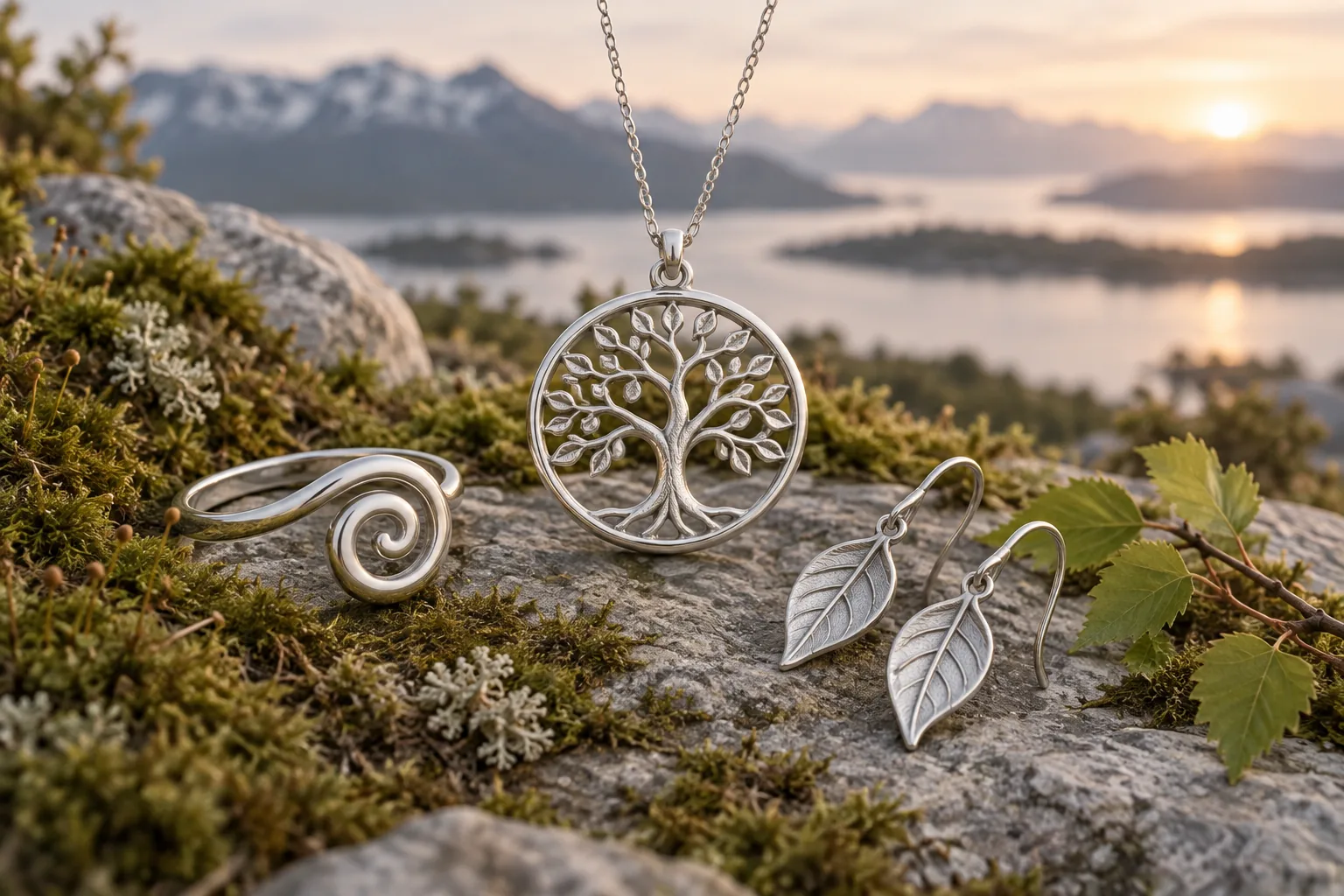
In contemporary jewelry, designers frequently adapt scenes and motifs from the Edda and from archaeological ornament. A modern piece might depict a stylized tree inspired by the world-tree passages in the Edda, a knot based on Viking interlace, or a small pendant shaped like an object found in a grave. Those adaptations are creative acts: they make modern meanings explicit—renewal, memory, protection—that are meaningful to wearer and giver but not necessarily identical to any single Viking-age interpretation. The Uppsala Edda supplies mythic narratives that inspire such pieces, while museums supply visual templates and technical precedents.
Gemstones and materials: historic precedents and modern choices
Museum collections show that amber, glass beads, and metalwork were commonly used in Viking-age adornment. Amber, in particular, appears frequently in northern European finds and is often chosen today to evoke a tangible link to the prehistoric and Viking past (The British Museum; National Museum of Denmark). Silver and bronze were common metals for personal ornaments, with regional and chronological variation in style and ornamentation.
Modern makers combine these historic materials with contemporary gemstones and finishes to express renewal visually. A green gemstone might be chosen today for its association with growth and renewal, while historically no single gemstone consistently symbolized rebirth in the Viking Age as far as the material record and museum interpretation can demonstrate.
Practical and respectful selection and gifting guidance
Choose pieces that honestly reflect what you want the symbol to mean to you and the recipient. If you want a piece to signify renewal, select a motif or inscription whose modern interpretation you can explain: a stylized world-tree, a rune chosen for its contemporary meaning, or a commission that incorporates personal symbolism. Be transparent that the emblem is a modern interpretation inspired by Norse myth and archaeology rather than a recovered, one-to-one message from the Viking Age.
Favor reputable makers and museum-quality reproductions when historical authenticity matters. Museums like the British Museum and the National Museum of Denmark provide reliable images and descriptions that help distinguish regionally specific types and materials. If the object is intended as a cultural gift—especially to people with living Scandinavian or Indigenous North Atlantic traditions—ask about cultural sensitivity and provenance, and avoid claiming that any single design was 'the' Norse rebirth symbol.
Consider materials and wearability. Historically grounded choices such as silver or amber reference the archaeological record, but ethical sourcing and personal comfort matter in contemporary jewelry. A thoughtful inscription or explanatory card that cites the Edda or museum display may enrich the gift by explaining why you linked a piece to renewal, while also acknowledging the interpretive gap between mythic texts, archaeological finds, and modern meaning.
Brief conclusion
The idea of death followed by renewal is deeply present in Old Norse myth as collected in the Uppsala Edda, and archaeological finds preserved in museum collections give us abundant visual material to inspire jewellery. However, no single image or token can be shown from the Viking Age to have been universally understood as a symbol of rebirth. Contemporary jewelers and gifters can responsibly use Norse themes to express renewal, provided they signal when a meaning is a modern interpretation and respect the cultural and regional diversity documented by museums and the Edda.
Frequently asked questions
Was there a specific Norse symbol for rebirth in the Viking Age?
No single symbol can be demonstrated from the Viking Age to have been universally used to mean rebirth. The Uppsala Edda records mythic narratives of death and remaking, and museum collections document motifs and objects, but neither the literary nor the material record supports a solitary, universally recognized emblem for rebirth.
Is Yggdrasil a historically attested rebirth symbol?
Yggdrasil, the world-tree described in the Uppsala Edda, is part of Old Norse cosmology and appears in narratives about the world’s cycles. The Edda supplies mythic material that inspires modern associations with renewal, but artifacts with tree-like motifs do not come with a guaranteed, uniform meaning of 'rebirth' across Viking-age contexts.
Can I safely give Norse-inspired jewelry as a renewal or healing gift?
Yes, you can give Norse-inspired jewelry to express renewal, provided you present the piece as a modern interpretation inspired by myth and archaeological motifs. Be mindful of cultural sensitivity, check provenance for historically styled reproductions, and prefer reputable makers or museum reproductions if authenticity matters.
Which materials are historically appropriate for Viking-inspired pieces?
Museum collections show frequent use of silver, bronze and organic materials such as amber and glass beads in Viking-age adornment. These materials are reasonable historical references for modern jewelry, though ethical sourcing and contemporary comfort should guide final choices.
How can I learn more about regional meanings or specific archaeological types?
Consult museum catalogues and specialist publications. The National Museum of Denmark and the British Museum provide regional context for finds and caution against broad symbolic claims; the Uppsala Edda supplies the mythic narratives that underlie many modern interpretations.
Sources and further reading
- The Uppsala Edda — Viking Society for Northern Research
- The old religion — National Museum of Denmark
- Vikings gallery activities — The British Museum