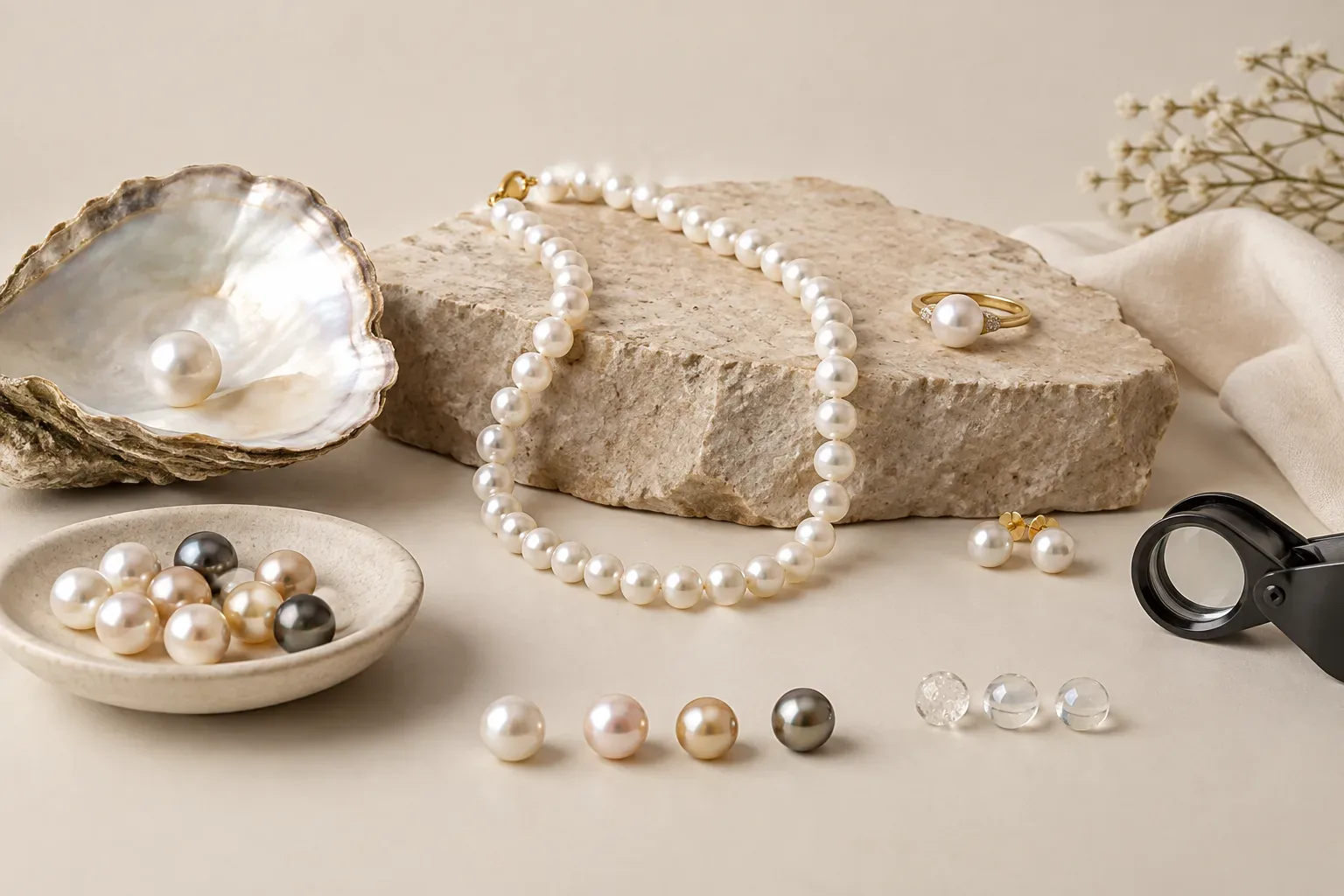
Meaning at a glance
This pearl buying guide defines pearl types (natural, cultured, imitation), presents decision criteria for color, luster, surface quality and shape, explains common treatments and disclosure expectations, offers care and gifting advice, and clearly states what requires a jeweler or gem lab for verification.
Pearl types: definitions buyers must know
Start by separating the basic types. Natural pearls form without human intervention; cultured pearls form when a technician implants a bead or tissue into a mollusc and the mollusc deposits nacre; imitation pearls are man-made beads coated to look like pearls. The U.S. Federal Trade Commission requires clear seller disclosure of natural, cultured, treated and imitation materials, so written confirmation of type is a basic consumer right (Federal Trade Commission).
Cultured pearls are the vast majority of pearls sold today. A trained jeweler or a gemological laboratory can distinguish natural from cultured pearls and detect treatments; these are not reliably separable by sight alone without documentation or testing (Gemological Institute of America; Federal Trade Commission).
Color, overtone, and luster: what they mean for appearance and value
Color describes the body color of the pearl (white, cream, silver, gray, black, gold, pink, etc.). Overtone is a subtle additional hue that seems to float over the body color. Luster is the brightness and mirror-like quality of the nacre surface and is one of the strongest drivers of perceived beauty and price.
When assessing pearl color, decide whether you want a body color that matches the wearer’s skin tone or wardrobe. A strong, even overtone can be desirable, but some buyers prefer a clean, neutral white or soft cream. Luster should be judged in moderate, natural light; pearls with high luster show sharp reflections and more depth, and are typically more valuable than duller pearls of the same size and shape. These are visual judgments buyers make in person or through high-quality photos.
Clarity and surface condition: documented grading traits
Pearl clarity refers to surface quality: blemishes, pits, spots, or irregularities in the nacre film. Unlike gemstones where internal inclusions are common, pearl value is often lowered by visible surface defects because pearls are organic and viewed as smooth, luminous orbs.
Sellers commonly grade surface condition in categories such as 'clean,' 'minor marks,' or 'noticeable blemishes.' Because surface details strongly impact appearance, examine pearls closely and request magnified photos or in-person inspection for any fine jewelry purchase. Written descriptions should disclose prominent blemishes and any drilling or restoration work (Federal Trade Commission).
Shape and cut: what buyers mean by round, near-round, and fancy
Pearls are not cut like faceted gemstones; their 'shape' is a natural result of growth. Round pearls—perfectly spherical—are traditionally the most prized and usually command higher prices. Near-round and off-round shapes such as button, drop, semi-baroque and baroque each have distinct visual characters and price ranges.
Match between pearls matters most in strands and pairs. For a necklace or set, buyers balance shape uniformity with luster and color match. A matched strand of slightly off-round but high-luster pearls can be more visually appealing and valuable than a strand of perfectly round but dull pearls.
Size and nacre thickness: why bigger can cost more, but not always
Size is measured in millimeters and often has the most immediate effect on price—larger pearls typically cost more. However, size should be considered with nacre thickness for cultured pearls: thicker nacre generally means better durability and deeper luster, while thin nacre over a bead nucleus can show wear over time.
Ask sellers about nacre thickness or request documentation for cultured pearls. If nacre thickness is not stated, a trusted jeweler or laboratory test is the only reliable way to determine it.
Treatments, imitations and disclosure: what to expect from sellers
Pearls may receive treatments (dyeing, bleaching, irradiation and other processes) to improve color or surface appearance. The Gemological Institute of America explains that treatments, disclosure, detectability and durability are key consumer questions for gemstones, and the same applies to pearls. Sellers should disclose treatments in writing and explain care implications (Gemological Institute of America).
Distinguishing natural from treated or imitation materials without proper documentation is often impossible. The Federal Trade Commission requires clear distinctions and written disclosure about natural, cultured, treated and imitation materials, so ask for a written description before purchase (Federal Trade Commission).
What you can verify without a lab and what requires expertise
You can verify many practical aspects yourself or with careful inspection: whether pearls match in color and shape how well the necklace is strung, visible surface blemishes, and whether the seller provides written disclosure of treatment and type. You can also ask for return policies, condition reports and close-up imagery.
Only a qualified jeweler with appropriate equipment or a gemological laboratory can reliably identify natural versus cultured pearls, measure nacre thickness accurately, or detect many treatments. If provenance, natural status, or precise treatment history is important to you, plan to request a laboratory report or consult a trusted independent appraiser (Federal Trade Commission; Gemological Institute of America).
Care, storage, and durability guidance
Pearls are organic and softer than most gemstones; they are sensitive to acids, perfumes, cosmetics and abrasion. The Gemological Institute of America advises special care for treated and organic gems and underscores that durability and care differ from faceted stones. Wipe pearls with a soft cloth after wear, avoid spraying perfumes while wearing them, and store pearls flat and separate from abrasive jewelry to protect their nacre.
Avoid ultrasonic or steam cleaning and most harsh chemical cleaners. For routine maintenance, re-string pearl necklaces periodically—ideally every year for frequently worn strands—so that the silk or cord does not weaken and allow loss of pearls.
Documented historical evidence and how meanings differ
Documented history shows pearls have been prized in many cultures. Archaeological finds and historical records indicate pearl use in ancient Rome, Imperial China, and the Mughal courts of South Asia; trade and fashion histories also show pearls occupying elite status in medieval and early modern Europe. Sources summarizing jewelry history and trends note pearls’ recurring prominence across eras and regions (Professional Jeweller).
These documented histories differ from modern personal interpretations. For example, in specific historical contexts pearls could symbolize status, purity, or divine favor, but those meanings were distinct to particular cultures and periods rather than universal. Modern wearers may choose pearls for aesthetic reasons, family tradition, or contemporary symbolic meanings such as simplicity or classic style; these modern interpretations are personal and cultural, not universal facts.
How pearls appear in contemporary jewelry and current trends
Pearls appear in a wide range of jewelry: single-strand necklaces, multi-strand chokers, stud and drop earrings, rings, and mixed-media sculptural pieces. Recent trend reporting from industry sources highlights strong consumer interest in classic pieces like necklaces and earrings alongside more sculptural, cluster and mixed-material designs, which has influenced how designers use pearls in modern collections (Imaginaire Digital; Professional Jeweller).
Design choices often play with contrast—pairing high-luster traditional pearls with textured metals, gemstones, or baroque shapes for contemporary appeal. When shopping, look at how pearls are mounted and whether settings protect the pearl from knocks and exposure.
Selection and gifting guidance
Decide what matters most to the recipient: classic round shapes and high luster, bold size, or modern baroque character. For first fine-pearl gifts, a matched strand or a pair of stud earrings in a neutral body color and strong luster is a safe, wearable choice. For fashion-forward recipients, consider baroque or irregular forms set in contemporary designs.
Request written disclosure of pearl type and any treatments, inspect photographs or see the piece in person, and confirm return or exchange policies. If longevity and heirloom potential are priorities, prioritize pearls with good luster and substantial nacre and ask about re-stringing and maintenance practices. For expensive purchases where origin or natural status matters, plan for independent verification by a gemological laboratory.
Final practical checklist before you buy
Before completing a purchase, confirm in writing the pearl type (natural, cultured, or imitation), any treatments, the seller’s return policy and whether an appraisal or certificate is provided. Inspect luster, surface condition and match, and ask about nacre thickness for cultured pearls if long-term wear is intended. If the answers to provenance or treatment questions are important to you and not clearly documented, consult a qualified jeweler or request laboratory testing.
Frequently asked questions
How can I tell if a pearl is natural or cultured?
You cannot reliably determine natural versus cultured pearls by sight alone. Ask the seller for written disclosure and, if necessary for provenance or value, obtain testing from a qualified jeweler or an accredited gemological laboratory.
What are the most important things to look for when buying pearls?
Prioritize luster and surface condition, then consider size, shape and color match for multi-pearl pieces. Also verify type and any treatments in writing and check return and care policies before buying.
Are treated pearls less valuable?
Treatments such as dyeing or bleaching can affect value depending on visibility and permanence. Sellers should disclose treatments in writing; for significant purchases obtain documentation and understand care differences.
How should I care for pearl jewelry?
Wipe pearls with a soft cloth after wearing, avoid perfumes and cosmetics, store them separately from abrasive items, avoid ultrasonic or steam cleaning, and re-string frequently worn strands periodically.
When should I get a pearl tested by a lab?
Request laboratory testing when natural-versus-cultured status, precise treatment history, or origin affects price or personal importance; also test high-value pieces if the seller cannot provide authoritative documentation.
Sources and further reading
- Imaginaire Digital — Imaginaire Digital
- Professional Jeweller / PRYA Jewellery Search Insights — Professional Jeweller / PRYA Jewellery Search Insights
- Gemological Institute of America — Gemological Institute of America
- Federal Trade Commission — Federal Trade Commission