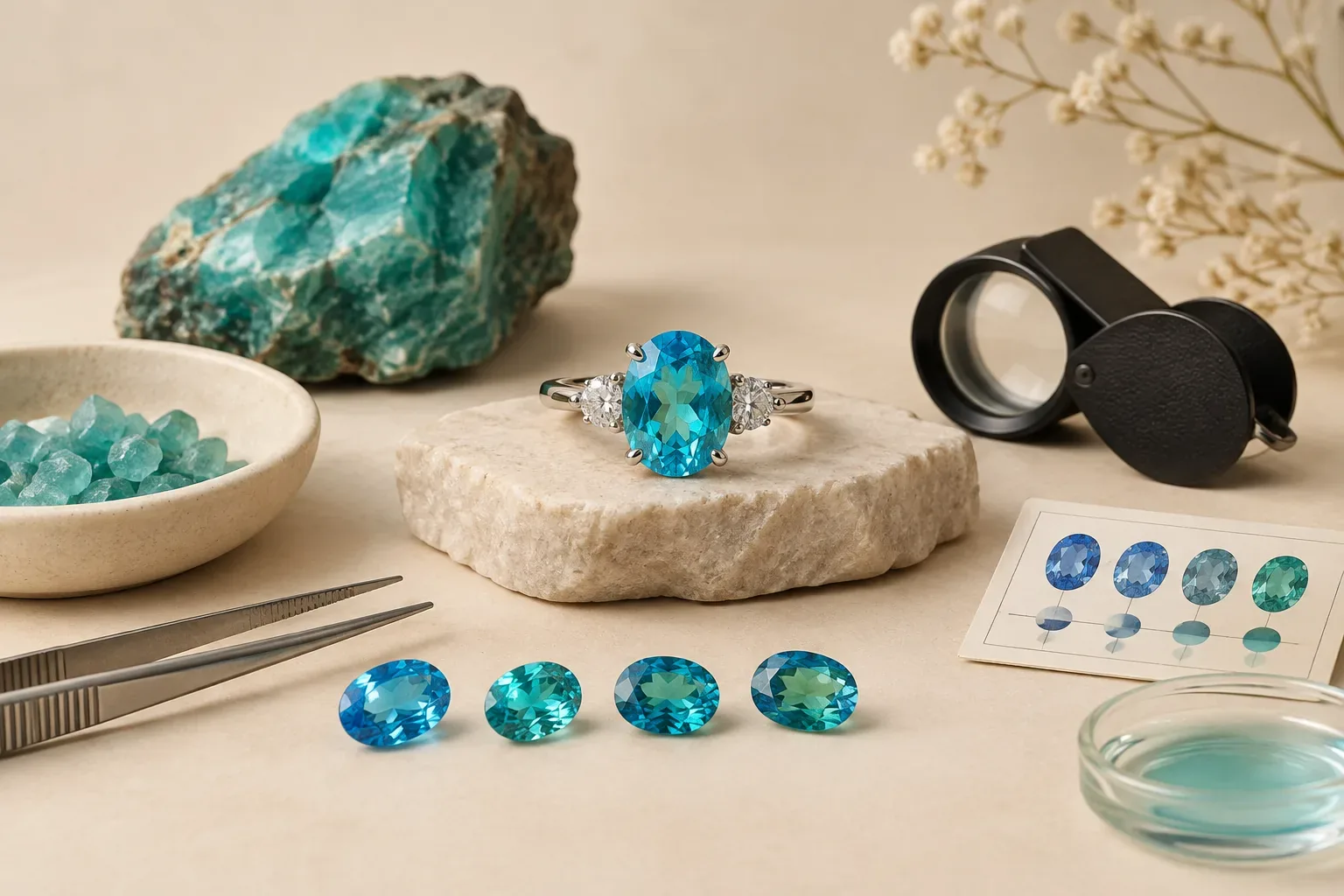
Meaning at a glance
A Paraíba tourmaline treatment guide should define likely enhancements, explain what you can and cannot verify without a gemological laboratory, lay out decision criteria (color origin, certification, durability, price), and offer practical care and gifting guidance; rely on written seller disclosure and independent lab reports and consult a qualified jeweler for microscopic or spectroscopic verification.
What a 'treatment guide' means for Paraíba tourmaline
A treatment guide defines the kinds of enhancements that can affect value, the trade-offs buyers face, how to care for treated material, and what verification is realistically available before purchase. The Gemological Institute of America (GIA) explains that treatments, detectability, durability and special care create distinct consumer questions for gemstones, and that guidance applies to tourmaline varieties as well.
Historical and market context (documented evidence)
Paraíba tourmaline is primarily a modern market phenomenon rather than a long-established cultural symbol. Contemporary search and retail studies show rising consumer interest in colored gemstones and gemstone rings in the 2020s, which frames why shoppers now ask treatment questions about vivacious-copper colors. Imaginaire Digital's 2026 search estimates and Professional Jeweller's 2026 trend reporting document growing demand for gemstone rings, birthstone necklaces and other colored-gem jewelry, providing the market context for why treatment transparency matters to modern buyers.
Documented historical meanings versus modern personal interpretations
There is little documented pre-modern cultural symbolism specific to Paraíba tourmaline; most meaningful associations are contemporary and personal. When authors or vendors ascribe a particular symbolic history to Paraíba tourmaline, treat that as a modern interpretation or marketing narrative unless a credible historical source is cited. Separate those personal or marketing meanings from documented facts about treatments, durability, and disclosure requirements, which are matters for gemological and consumer-protection authorities.
How Paraíba tourmaline appears in jewelry today
In today's jewelry market Paraíba-style tourmalines appear as center stones in rings, drop or stud earrings, pendants and in cluster or halo settings paired with diamonds or other colored stones. Professional Jeweller's trend reporting for 2026 highlights growth in gemstone rings, sculptural jewelry and birthstone necklaces, indicating the kinds of pieces where vivid tourmalines most commonly appear in retail assortments.
Common categories of treatments to know about (definitions and implications)
Gemological treatments fall into broad categories: color alteration, clarity enhancement, surface coating, and stabilizing procedures. The GIA's guidance on gem treatments emphasizes that these treatments vary in detectability and effect on durability. For buyers, the relevant implications are whether a treatment affects appearance permanently, whether it reduces durability or value, and whether it must be disclosed in writing by the seller.
Decision criteria: what to ask before you buy
When evaluating a Paraíba tourmaline, prioritize clear answers to these questions: Is the color natural for the stone as-mined or enhanced by treatment, and what exactly was done? Is there an independent, recent gemological report from a recognized laboratory? Has the stone been subjected to any repair, fracture filling, or surface coating? What are the seller's return and disclosure policies? The Federal Trade Commission's consumer guidance stresses the importance of clear distinctions among natural, lab-created, treated, and imitation materials and recommends written seller disclosures.
What you can verify without a lab—and what you can't
You can verify provenance documentation, seller reputation, viewing-condition photos or videos, and the presence or absence of a recognized laboratory report before purchase. You can also have a qualified local jeweler do a preliminary inspection with loupe or microscope for obvious surface residue or fracture-filling indications. However, subtle color enhancements, diffusion, trace-element causes of color, and certain clarity treatments often require spectroscopy, advanced microscopes, or other instruments available only in a gemological laboratory to detect reliably. For high-value purchases, a current lab report is the only practical way to obtain authoritative verification.
Practical trade-offs and pricing
Treatments can make stones more affordable or improve appearance, but they may also reduce long-term resale value relative to equivalent-size, untreated stones with certified natural color origin. Expect trade-offs among color saturation, size, and certification: intense color in larger sizes is rare and commands premium pricing, while treated material may offer a similar visual effect at a lower price. Your willingness to accept treated stones should reflect intended use (daily-wear versus occasional-wear), resale expectations, and how important full 'natural, untreated' status is to you.
Care and durability guidance
Follow the general precautions recommended for gemstone jewelry: avoid high heat, sudden temperature changes, and harsh chemicals, and remove jewelry during physical work. The GIA notes that treatments and durability are linked—some treatments make stones less tolerant of heat or ultrasonic cleaning—so always confirm with the seller and, where possible, follow any special-care instructions noted on a lab report. When in doubt, clean tourmaline jewelry with warm soapy water and a soft brush and consult a qualified jeweler before using an ultrasonic or steam cleaner.
Selection and gifting guidance
If you are buying a Paraíba tourmaline as a gift, decide first whether untreated, fully documented natural stones are essential to the recipient. For milestone gifts, insist on a current lab report and written disclosure; for fashion pieces or lower budgets, documented treated material with a clear return policy may be acceptable. When gifting, include any lab documentation and care instructions you received so the recipient knows the stone's status and how to care for it. If provenance or resale value matters, buy from reputable retailers who supply independent reports and clear written disclosures in accordance with consumer-protection guidance.
Practical next steps before purchase
Ask the seller for a full disclosure statement and a recent independent laboratory report if the price is significant. If no lab report exists, request time-stamped, high-quality images and an ability to return the stone after an independent verification. Consult a qualified local jeweler to inspect the stone under magnification for obvious indicators, and rely on a recognized gemological laboratory for definitive answers to questions about subtle enhancements and trace-element causes of color.
Final considerations
A Paraíba tourmaline treatment guide is as much about rights and documentation as it is about gemology. Use FTC-style written disclosures and GIA-style treatment awareness to navigate the marketplace, and accept that some issues can only be resolved by laboratory testing. Make decisions based on documentation, intended use, and how much uncertainty you are willing to accept.
Frequently asked questions
Are Paraíba tourmalines commonly treated?
Treatment frequency varies by market and by individual stone; the GIA notes that treatments for gemstones exist and differ in detectability and durability. Always ask the seller for full disclosure and an independent laboratory report if treatment status affects your buying decision.
What should I ask the seller to disclose in writing?
Request a written statement that identifies whether the stone is natural, lab-created, treated or an imitation, and asks for details of the specific treatments performed and any known effects on durability; the FTC recommends clear, written distinctions among these categories.
Can I tell from photos if a stone has been treated?
Photos can reveal color and obvious surface features but cannot reliably reveal subtle treatments; use photos for initial assessment but obtain a lab report or in-person inspection for authoritative verification.
When is a laboratory report necessary?
For high-value purchases, milestone gifts, or when treatment status materially affects your valuation, obtain a recent independent report from a recognized gemological laboratory to provide instrument-based conclusions that a seller's statement alone cannot confirm.
What care precautions should I take for a treated or untreated Paraíba tourmaline?
Avoid high heat, sudden temperature changes, harsh chemicals, and rough wear; follow any special-care advice noted on a laboratory report and consult a qualified jeweler before using ultrasonic or steam cleaners, because treatments can alter cleaning tolerance.
Can treatments be reversed or removed?
Some surface coatings or filling materials can sometimes be removed, but reversibility depends on the specific treatment and may damage the stone; consult a qualified gemologist or conservator before attempting any reversal.
How do I find a qualified jeweler or gemologist for inspection?
Look for established professionals with references who offer independent inspection using a loupe or microscope, and for definitive answers use recognized gemological laboratories; rely on seller-provided lab reports only if the issuing laboratory is reputable.
Sources and further reading
- Imaginaire Digital — Imaginaire Digital
- Professional Jeweller / PRYA Jewellery Search Insights — Professional Jeweller / PRYA Jewellery Search Insights
- Gemological Institute of America — Gemological Institute of America
- Federal Trade Commission — Federal Trade Commission