Meaning at a glance
This amethyst authenticity guide defines natural, lab-created, treated and imitation amethyst; gives decision criteria you can use at home and with a trusted seller; explains common trade-offs of price, appearance and disclosure; offers safe care advice; and makes clear what only a qualified jeweler or gemological laboratory can verify.
Clear definitions and decision criteria
Natural amethyst: A naturally formed variety of quartz whose purple color comes from iron and irradiation-related defects in the crystal lattice. Key consumer checks include consistent purple color with possible color zoning, natural-looking inclusions visible under 10x magnification, and credible seller disclosure. A certified gemological report is the only reliable confirmation of natural origin for high-value pieces.
Lab-created amethyst: Chemically and optically the same species as natural amethyst but produced in a laboratory. Lab-grown stones can display growth features and fewer inclusions. Sellers should disclose lab creation; for significant purchases, request documentation or a lab report because some visual indicators overlap with natural material.
Treated amethyst: Treatments commonly alter color or clarity. Heat treatment is widely used in quartz to change purple amethyst into yellow-to-orange citrine or to modify color saturation. Treatments must be disclosed by sellers; detectability varies and may require gemological testing—GIA guidance emphasizes disclosure and notes that detectability and durability are important consumer concerns.
Imitation amethyst: Any non-amethyst material (for example, colored glass, synthetic spinel, or dyed quartz simulants) fashioned to imitate amethyst. Imitations often lack the refractive properties and inclusion patterns of quartz. Simple tests—weight, refractive sparkle, and magnified inspection—can point to an imitation, but conclusive identification sometimes requires refractive index or spectroscopy testing.
What a shopper can reasonably verify without a lab—and what they cannot
You can reasonably verify the seller’s disclosure, examine the stone under a 10x loupe for natural inclusions or growth features, assess color zoning and consistency, feel the piece for expected weight, and ask for photographs or returns. The Federal Trade Commission emphasizes that consumers need clear distinctions among natural, lab-created, treated and imitation materials and written seller disclosures.
You cannot reliably confirm geographic origin, subtle treatments that leave few visual clues, or definitive natural versus some lab-grown signatures without a qualified gemological laboratory. For high-value purchases, obtain an independent report from a recognized laboratory. For most everyday jewelry, a reputable jeweler’s disclosure and return policy, plus visual checks, are sufficient.
Historical evidence and cultural associations
Amethyst has a long presence in jewelry and material culture, and historical records note its use in several distinct contexts: in classical antiquity (ancient Greece and Rome), in medieval and Renaissance Europe—especially within Christian liturgical and aristocratic settings—and in various Asian traditions. These associations are documented in historical scholarship and museum collections as a recurring gemstone in personal adornment.
Separate from documented historical record are modern, personal, or marketing interpretations of amethyst’s meaning. Historical documentation shows that peoples and periods used amethyst in specific social and symbolic contexts, but it does not support any single universal symbolic meaning across all cultures or eras. Treat historical associations as culturally specific: what a stone meant in a medieval European ecclesiastical setting is not the same as a modern personal or commercial meaning.
Documented history versus modern interpretation
Documented history records where and how amethyst was used: as in antiquity and in European lapidaries and church regalia. Those records describe practices and symbolic uses tied to particular cultures and institutions. When discussing historical meaning, cite the culture and period precisely rather than suggesting the meaning is universal.
Modern interpretations—such as marketing claims about emotional properties or 'healing' attributes—are contemporary personal or cultural beliefs and are distinct from documented historical usage. Buyers and gifters should treat modern symbolic claims as personal or cultural preferences rather than objective facts.
How amethyst appears in jewelry today
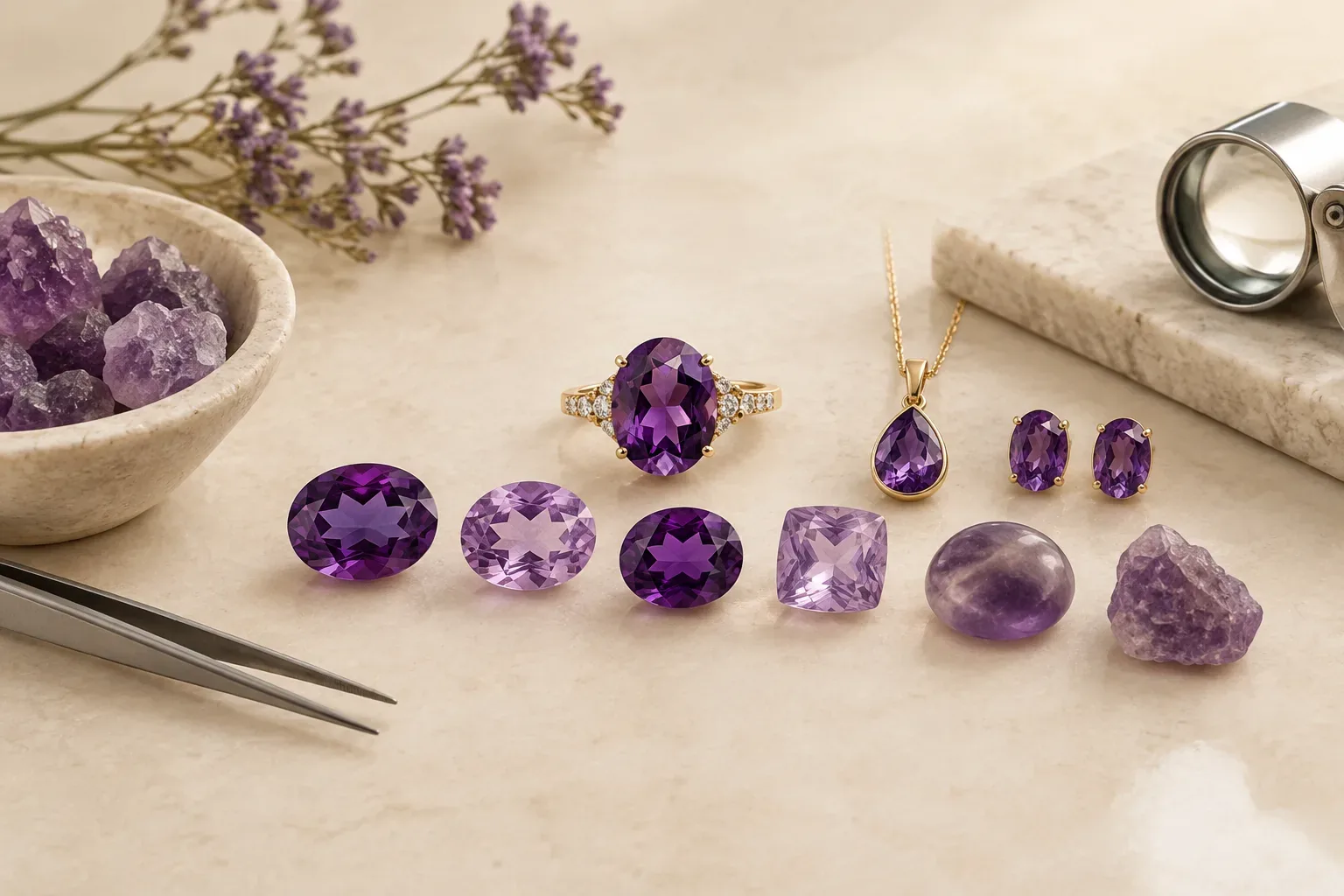
Amethyst is cut and set across many jewelry categories: faceted stones are common in rings and earrings, cabochons appear in pendants and vintage styles, and bead strands are popular for bracelets and necklaces. Current market trends show increased demand for sculptural jewelry, birthstone necklaces, and gemstone rings, which often include amethyst as a cost-effective colored option; market insight sources note growth in sculptural and statement gemstone pieces.
Design choices influence how authenticity matters: in delicate bezel settings you can examine the stone closely; in heavy pavé or cluster settings the individual stone’s verification may be harder. For larger, center-stone amethysts expect to see either a seller’s certificate or clear magnified images showing inclusions and cut quality.
Practical selection and gifting guidance
Decide what matters most: color intensity, size, origin, price, or ethical sourcing. For an every‑day birthstone or fashion piece, a well-disclosed lab-created or treated amethyst may offer excellent value and visual appeal. For a special heirloom or significant investment, prioritize a documented natural stone with an independent laboratory report.
Ask the seller direct questions: Is the stone natural, lab-created, or imitation? Has it been treated (for example, heated)? Can you see a return policy or a written disclosure? The FTC highlights the need for clear written distinctions; get disclosures in writing before purchase.
When gifting, match the recipient’s priorities. If they value natural origin, request a lab report for larger stones. If they prefer sustainability or traceability, ask sellers about sourcing and treatment disclosure. For everyday fashion gifts, a reputable retailer’s return policy, clear labeling, and evidence of good craftsmanship will often be more important than lab certification.
Trade-offs: price, appearance, durability and disclosure
Natural amethysts often command higher prices for comparable size and color, but lab-created stones may offer fewer inclusions and more vivid, uniform color at a lower cost. Treated stones can improve color but may change long-term color stability in some cases; disclosure ensures you know what you are buying. The Gemological Institute of America explains that treatments, disclosure, detectability, durability and special care create distinct consumer questions for gemstones.
Imitations are inexpensive but generally hold little resale value. For buyers balancing budget and appearance, lab-created or well-disclosed treated material can be a pragmatic choice; for buyers prioritizing natural provenance, expect to pay more and to seek formal documentation.
Care and safe cleaning
Amethyst is durable for everyday wear but is sensitive to prolonged exposure to strong heat and intense sunlight, which can fade or alter color. Because heat treatments are used to alter quartz color, avoid exposing amethyst jewelry to high temperatures (for example, intense sunlight for extended periods, hot ovens, or steam cleaners) without knowing whether the piece has been treated.
For routine cleaning, use warm soapy water and a soft brush, or a mild jewelry cleaner suitable for colored stones. Avoid ultrasonic cleaners if the stone has fractures or is set with adhesives. When in doubt, follow care advice from the seller and consider professional cleaning by a trusted jeweler.
When to get a professional opinion
Seek a qualified jeweler or independent gemological laboratory when the stone is high in value, when the seller’s disclosure is absent or unclear, or when you need authoritative confirmation of origin, treatment history, or authenticity. Laboratories use refractive index, spectroscopy, inclusion analysis, and other tests that cannot be replicated reliably at home.
For most fashion and mid‑range purchases, careful visual inspection, seller disclosure, and a fair return policy—along with the practical checks outlined above—will suffice. For investment-grade or historically significant pieces, an independent lab report is essential.
Frequently asked questions
How can I tell if an amethyst is natural?
Check the seller’s written disclosure first. Inspect the stone under 10x magnification for natural inclusions and growth zoning; natural amethyst often shows color zoning and mineral inclusions. Request a reputable jeweler’s opinion or an independent gemological report for definitive confirmation on higher-value pieces.
Are lab-created amethysts inferior to natural ones?
Lab-created amethysts are the same mineral species and can be visually very similar or even cleaner than natural stones. They are not inherently inferior; they offer value and consistent color but should be disclosed as lab-grown. Preference for natural versus lab-grown is subjective and affects price and resale.
Can heating change amethyst color?
Yes. Heat treatment can alter amethyst’s color, often converting purple quartz into yellowish citrine or changing saturation. Because treatments affect appearance and sometimes durability, sellers should disclose them. Avoid exposing unknown amethyst jewelry to high heat or prolonged strong sunlight.
What should I ask a seller before buying?
Ask whether the stone is natural, lab-created, or imitation; whether it has been treated (and how); for any available certificates or laboratory reports; and about return policy and disclosure in writing. The Federal Trade Commission recommends clear written seller disclosures.
Is a gemological laboratory report necessary?
For routine fashion jewelry, a reputable seller’s disclosure and return policy are often adequate. For high-value, investment, or historically significant pieces, an independent gemological laboratory report is recommended because laboratories can run tests not possible at home.
Sources and further reading
- Imaginaire Digital — Imaginaire Digital
- Professional Jeweller / PRYA Jewellery Search Insights — Professional Jeweller / PRYA Jewellery Search Insights
- Gemological Institute of America — Gemological Institute of America
- Federal Trade Commission — Federal Trade Commission