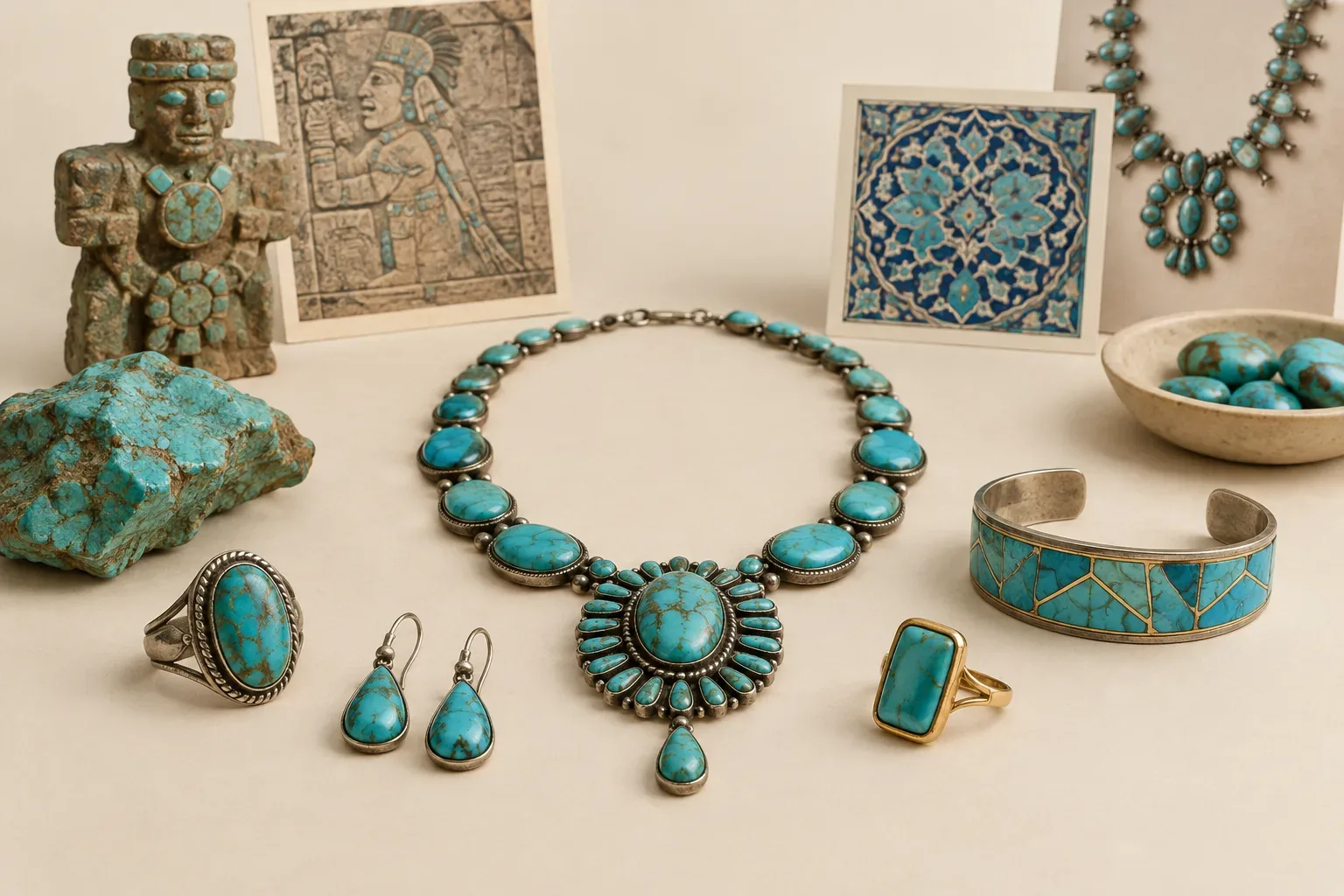
Meaning at a glance
Documented museum scholarship shows turquoise has long been fashioned as cabochons, beads, and inlaid panels across specific cultures; modern choices should prioritize protected cuts and secure bezel or inlay settings, ask about treatments and provenance, and respect cultural contexts when selecting or gifting.
Quick answer
Turquoise cuts and settings have changed with technology and taste, but the practical choice for everyday beauty and durability is clear: favor cuts that protect the stone (traditionally cabochons and beads) and settings that shelter its edges (bezel and inlay mounts). Museum scholarship documents how specific cultures used particular cuts and settings for functional and symbolic reasons; today, prioritize protective mounting, ask vendors about treatments and imitations, and consider cultural provenance and respectful sourcing when giving turquoise jewelry.
What the historical record actually shows
Museum collections and scholarship collect evidence that turquoise has been valued in many distinct cultures, each with its own uses and techniques. The Victoria and Albert Museum records turquoise in ancient and historic jewelry from a range of places, and places pieces within changing social and material contexts rather than ascribing any single meaning to the stone. For clarity, here are documented occurrences attributed to specific cultures or periods in museum literature.
Ancient Egypt: The Victoria and Albert Museum and other museum catalogues document use of turquoise in inlay work, bead strings, and amuletic objects in ancient Egyptian tomb and temple contexts. These pieces show turquoise shaped into beads and inlaid discs that were incorporated into broader decorative programmes rather than a single universal symbolism.
Persian and Central Asian courts: Historical jewellery associated with Persian and Central Asian contexts appears in museum collections as examples where turquoise was used in mounted gems and decorative objects. The evidence highlights skilled lapidary work and settings that suited courtly display.
Tibetan and Himalayan traditions: Museums record turquoise used alongside metalwork in religious and personal ornaments in Tibetan and Himalayan material culture, where the stone often appears as cabochons set into larger metal fittings.
Native American Southwest: The Victoria and Albert Museum and other curatorial records show turquoise extensively used in the Southwestern United States in beadwork, inlay, and cabochon settings—particularly in silver mountings developed in the 19th and 20th centuries. These traditions are regionally specific, produced by distinct communities, and continue to evolve.
Modern and European fashion jewellery: European and Western fashion jewellery of the 18th century onward also used turquoise, with mountings and cuts reflecting contemporary tastes and technologies recorded in museum collections. The V&A places those pieces in changing social contexts, underlining that cuts and settings often followed prevailing styles rather than fixed symbolic rules.
Documented meanings versus modern personal interpretations
Museum documentation tends to treat turquoise as an object with functional, decorative, and occasionally ritual uses, rather than asserting a single symbolic meaning across cultures. The Victoria and Albert Museum’s approach is to situate objects in their historical contexts and to show that meanings shifted with time and place.
Where museums record symbolic or ritual associations, those are always tied to specific cultures and artifacts. For example, certain pieces from a Tibetan or Egyptian context may have been used in rituals or as protective items within those belief systems, but that evidence applies to those cultural and historical settings, not to everyone who wears turquoise today.
Modern personal interpretations—such as seeing turquoise universally as a talisman of protection, health, or emotional balance—are contemporary and largely individual. These meanings can be meaningful for the wearer and are a valid part of modern jewellery practice, but they are not equivalent to historically documented cultural beliefs unless supported by direct historical evidence tied to that culture and period.
How turquoise appears in jewellery: cuts, common mounts, and why they matter
Turquoise is most often worked into shapes that showcase its colour and cope with its material properties. Museum references on gemstones describe how turquoise is commonly cut as cabochons—rounded, polished domes—and as beads and small inlaid panels. These forms emphasize color and pattern rather than faceted brilliance, which suits turquoise’s typically opaque to translucent appearance and its historical uses in inlay and beadwork documented in collections.
Common settings recorded in museum collections include bezel mounts, inlaid channels, prong settings in later fashion pieces, and stringing for beads. Bezel and inlay techniques are especially prominent in pieces from the Native American Southwest, Persian and Central Asian objects, and some Tibetan metalwork. Bezels and inlaid mounts are practical because they protect the softer edges of the stone and secure thin or irregular pieces.
For modern jewellery, the same practical concerns persist. Because turquoise is often relatively soft and can be porous, protective settings such as full bezels, recessed inlays, and secure bead stringing help prevent chips and reduce exposure to chemicals or oils that can alter appearance. Faceting is uncommon for turquoise, so if you encounter faceted turquoise, ask about stabilization or other treatments that make such cutting possible.
Practical guidance for choosing and gifting turquoise
Prioritize cut and setting for durability. If you want a piece for daily wear, choose cabochons with full bezels or stones set in recessed inlay. These mounts shield edges and reduce the risk of knocks. For rings and bracelets that receive frequent bumps, a low-profile bezel or inlay is safer than exposed prongs or tall settings.
Ask about treatments and disclosures. The Federal Trade Commission’s consumer guidance on buying gemstones reminds buyers to ask sellers for information about treatments, stabilizations, and whether a stone is natural, dyed, or reconstituted. Many turquoise pieces on the market are stabilized (a common and legitimate practice) to improve durability and colour; honest dealers will disclose treatments, and you should factor that information into price and care decisions.
Consider provenance and maker when cultural context matters. If you are buying a piece that resembles work from a living Indigenous or regional tradition, consider purchasing from recognized makers or community-run outlets so the work benefits its source community. Museums emphasize distinct cultural contexts for turquoise pieces, and respectful gifting includes recognizing that some designs carry cultural identity and should not be treated as generic fashion motifs.
Match jewellery style to intended use. For occasional or ceremonial pieces, larger flat inlays or freeform cabochons set prominently can be beautiful. For everyday wear, smaller stones, beads, or cabochons in protective bezels are a more durable choice. If the recipient values historical style, consult museum resources or makers who work in traditional techniques to ensure accuracy and respect.
Care and cleaning: Follow conservative care. Avoid harsh chemicals and prolonged exposure to water or perspiration. Have settings checked periodically by a jeweller to ensure stones remain secure. For any cleaning or repair, tell the jeweller about known treatments so they can select appropriate methods.
Frequently asked questions
What cuts of turquoise are most durable for daily wear?
Cabochons and beads set in protective mounts are the most durable choices for everyday wear because the rounded shapes reduce exposed edges. Low-profile bezel settings and recessed inlays help shield the stone from knocks and contact.
Are turquoise stones routinely treated or stabilized?
Yes; it is common for turquoise to be stabilized or otherwise treated to improve durability and colour. The Federal Trade Commission advises buyers to ask sellers about any treatments so you can make an informed decision.
Is faceted turquoise a sign of fake material?
Faceting turquoise is uncommon due to the stone’s typical appearance and material properties. When you see faceted turquoise, ask the seller whether the stone has been treated, dyed, or reconstituted; disclosure should be provided under consumer guidance.
Which settings historically appear in museum examples?
Museum collections show turquoise in bezel mounts, inlaid panels, and bead stringing across different cultures. Bezel and inlay mounts are especially common in contexts documented by museum scholarship.
How can I respectfully gift turquoise that reflects a cultural tradition?
If the design references a living cultural tradition, consider buying from recognized artisans or community-affiliated sellers so proceeds support the source community. Acknowledge the cultural origin when you gift the piece and avoid presenting culturally specific motifs as generic fashion without context.
How should I clean and care for turquoise jewellery?
Avoid harsh chemicals and prolonged soaking. Clean gently with a soft cloth and mild soapy water if necessary, and always check that settings are secure. If a piece has known stabilizations, ask a professional jeweller for recommended cleaning methods.
Sources and further reading
- Bedazzled: A History of Jewellery — Victoria and Albert Museum
- An A-Z of Gemstones — Victoria and Albert Museum
- Buying Gemstones, Diamonds, and Pearls — Federal Trade Commission