Meaning at a glance
Peridot quality and value depend primarily on colour, clarity, cut, size and origin; documented historical uses and meanings are varied and culture-specific, and buyers should verify treatments and disclosure and match style and provenance to the intended wearer.
Short answer
Peridot quality and value factors are driven first by observable gem attributes—colour, clarity, cut and carat weight—and second by provenance, setting and market demand; historically peridot has appeared in different cultures and periods with changing roles, and modern buyers should verify treatment and authenticity disclosures while choosing a style and size suited to the wearer.
Documented history and cultural context
Museums and curators emphasise that gemstones have moved through a variety of cultural roles rather than holding a single, fixed meaning. The Victoria and Albert Museum describes how jewellery and gemstones have been used across times and places and how their social contexts and meanings shift with fashion, technology and belief systems.
Peridot is one of the green gemstones that appear in the V&A’s reference materials on gemstones. Historical evidence preserved and interpreted by the museum places peridot within long-standing jewellery traditions in Europe and the Near East, where individual gemstones were collected, cut and set for both personal adornment and ceremonial use. These items survive through museum collections, inventories and recorded trade descriptions that the V&A uses to illustrate broader jewellery history.
Distinguishing documented historical meanings from later interpretations
The V&A’s work shows that documented historical meanings—those recorded in inventories, maker records, religious texts or visual evidence—relate to particular times and places. When museums report a stone’s use, they are describing where and how it was worn or recorded, not asserting a universal symbolic meaning.
Modern popular interpretations—such as assigning single-word qualities or universal protective powers to peridot—are later readings and personal or commercial interpretations. Those modern meanings sit alongside, but are not the same as, the documentary record. When choosing or interpreting peridot, treat historical attributions (as reported by museums) and contemporary personal meanings separately and respect the wearer’s own associations.
How peridot typically appears in jewellery
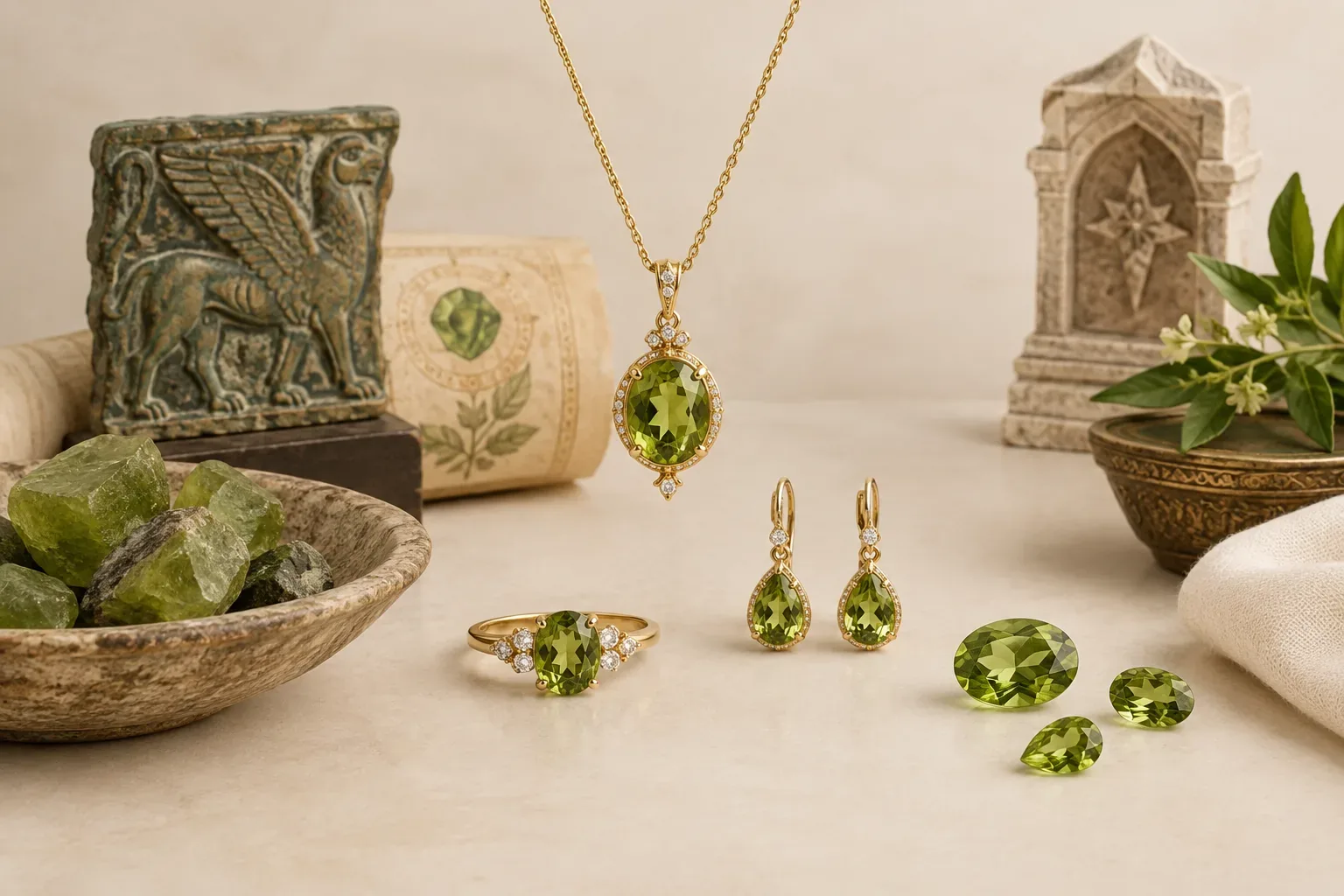
In museum collections and in contemporary retail, peridot most often appears as faceted stones set into rings, earrings, pendants and brooches. The V&A’s materials on gemstones note that cuts and settings change with fashion and technology: earlier examples rely on hand cutting and bezel or closed-back settings, while modern pieces more commonly use precision faceting and open-back settings to show colour.
Design choices affect perceived value. A well-cut peridot set to maximise light return will look brighter than the same stone poorly cut; a larger single peridot on a solitaire ring reads differently from small peridots used as accents in cluster or halo designs. Settings in gold, especially warm yellow or rose tones, are a common modern choice because they can complement the green hues of peridot.
Peridot quality and value factors explained
Colour: The most immediate quality factor is colour. Peridot ranges from a yellow-green to olive or brownish green; stones with a clear, lively green and minimal yellow or brown tone are usually most desirable on the retail market. Colour preference is not universal, however; some historical pieces favour warmer or darker greens depending on period taste.
Clarity: Peridot commonly has good transparency and often shows fewer inclusions than many other coloured gems. Eye-visible inclusions and fractures can reduce value, while a clean appearance to the naked eye generally increases desirability. Clarity standards should be judged relative to peridot’s typical material characteristics rather than compared to other gemstones.
Cut: Cut affects how colour and light are perceived. Proportions, symmetry and polish determine whether a peridot looks lively or dull. A precise, well-proportioned cut that balances colour saturation and light return adds to visual appeal and value.
Carat and size: Larger peridots occur in the market, and size amplifies both price and presence. Peridot’s value per carat typically rises with size, but larger stones with poor colour or heavy inclusions will still be less valuable than smaller, high-quality examples.
Origin and provenance: Where a peridot comes from and the documented history of a particular specimen can influence value. Certain localities yield stones with distinctive colour or clarity; provenance or a credible history of an older piece can add collector interest. Museums note that provenance has long mattered in jewellery collecting.
Treatments and imitations: You should ask whether a stone has been heat-treated, coated, filled or otherwise modified, and whether any imitations are present. The Federal Trade Commission advises buyers to request disclosure of material treatments and to be alert to imitations and lab-grown alternatives. Written disclosure from the seller is the standard protection a buyer should seek.
Practical buying and gifting guidance
Decide first how the piece will be worn and what matters to the recipient: daily wear calls for secure settings and realistic size choices, while a collector’s piece might prioritise provenance and unusual colour. Matching the piece’s durability and size to the wearer’s lifestyle is more important than following market talk about absolute rarity.
When you inspect stones, assess colour in natural light and compare stones side-by-side if possible. Look for a lively, saturated green without overwhelming brown or yellow tones unless the wearer prefers those tones. Check clarity with the naked eye and a jeweller’s loupe when available; ask the seller to point out any inclusions or repairs.
Request written information. Ask whether the stone was treated, whether any enhancements were applied, the country of origin if known and whether the piece carries a lab or retail certificate. The FTC explicitly recommends that sellers disclose treatments and material imitations; obtain that information in writing before purchase.
Consider setting and metal choices in context. Warm golds often flatter peridot’s green, while white metals can make the stone read cooler. For gifting, choose a setting that fits the recipient’s existing jewellery wardrobe and daily habits. A classic pendant or stud earrings is often a safe, versatile gift; a large ring may require exact sizing and careful lifestyle consideration.
Budget with balance. Prioritise the attributes that matter most to your recipient—colour and clarity for visual impact, provenance for historical interest, or size for presence. A mid-sized, well-cut peridot with good colour and no obvious inclusions commonly offers strong value for many buyers.
Care, authentication and aftercare (practical notes)
Ask the seller for care instructions specific to the piece and consult a reputable jeweller for routine maintenance. Documentation of any treatments and a receipt give you leverage for later questions about the stone’s authenticity and condition.
If provenance or rarity is important, consider obtaining an independent laboratory report for a sizeable or costly stone. Documentation supports both resale value and the historical narrative if the piece is part of a collection. Museums and specialists treat provenance as a meaningful part of a gem’s history, and buyers seeking the same depth of information should plan for the cost of independent verification.
How to think about meaning and gift intent
Museums show that gemstones have played many culturally specific roles; that history is useful when you want to match a gift to a culture or period. For personal gifts, the wearer’s associations and the relationship between giver and recipient matter more than generalised claims of universal symbolism.
When gifting, explain why you chose the piece—its colour, its look on the wearer, or a personal connection—rather than relying on unverified symbolic claims. This respectful approach aligns documented cultural history with modern personal meaning without pretending any one reading is universal.
Summary
Peridot quality and value factors revolve around colour, clarity, cut, size and provenance, while documented historical uses appear in museum records as context-dependent rather than universal truths. Follow FTC guidance on disclosure when buying, seek written information about treatments and origin, and choose a setting, size and style that suits the intended wearer’s life and tastes.
Frequently asked questions
What are the most important things to look for when judging peridot quality?
Start with colour—look for a lively green with minimal brown or yellow bias—then assess clarity, cut and size. Ask the seller for information about treatments and origin and request written disclosure.
Do sellers need to disclose treatments to peridot?
Yes. The Federal Trade Commission recommends that sellers disclose material treatments, enhancements and any imitations. Request this information in writing before you buy.
Is provenance important for peridot value?
Provenance can add value, especially for collectors or historic pieces. Documented history or a verifiable source may increase interest and price, but typical retail purchases are valued primarily on colour, clarity, cut and size.
How should I choose a peridot piece to give as a gift?
Match the piece’s scale and style to the recipient’s lifestyle and jewellery wardrobe. For versatility, consider modest-sized pendants or stud earrings; for a statement gift, prioritise a well-cut stone with vivid colour and verified documentation.
When should I get an independent report for a peridot?
Consider an independent laboratory report for larger or expensive stones, for pieces where provenance is important, or when you need third-party confirmation of origin or treatment status.
Sources and further reading
- Bedazzled: A History of Jewellery — Victoria and Albert Museum
- An A-Z of Gemstones — Victoria and Albert Museum
- Buying Gemstones, Diamonds, and Pearls — Federal Trade Commission