Meaning at a glance
Amethyst can be a beautiful and budget-friendly center for an engagement ring if you accept trade-offs in durability and verification; choose protective settings, insist on seller disclosure, and get lab or professional verification when you need to know treatments or origin.
What amethyst is and how that matters for an engagement ring
Amethyst is the purple variety of quartz. As quartz it has a Mohs hardness of about 7 and good toughness for many jewelry uses, but it is softer than traditional engagement stones like diamond, sapphire or ruby. That means amethyst chips and scratches more easily with heavy everyday wear, and the design of the ring should compensate for that by protecting edges and corners.
Beyond hardness, practical buying questions include color saturation (richer, even purple is generally preferred), cut quality, presence of visible inclusions, and whether the stone is natural, heat-treated, lab-grown, or an imitation. The Gemological Institute of America (GIA) explains that treatments, disclosure and detectability affect what you should ask a seller and how you care for gemstones.
Historical evidence and wording you can trust
Popular accounts commonly link amethyst to a range of historical meanings in different periods and places, but authoritative historical claims rest on primary sources and museum documentation. Trade and jewelry publications report that gemstones including amethyst repeatedly return to fashion across eras, yet they summarize trends rather than provide primary historical proof. When encountering claims such as “amethyst was a symbol of X in ancient Y,” check the cited historical source rather than rely on trend coverage.
In short: industry and trend coverage are useful for understanding how amethyst appears in modern jewelry markets, but they are not substitutes for academic or museum citations if you need precise historical attribution. For contemporary market context, trade publications note growing and shifting interest in gemstone engagement rings and sculptural, period-inspired styles.
Documented historical meanings versus modern personal interpretations
Documented historical meanings are claims supported by dated, citable sources such as period texts, inventories, wills, or museum labels. Documented meanings require explicit references and are best verified through academic or museum literature. Popular summaries and trend articles sometimes repeat those claims without citation; treat those as leads to be verified.
Modern personal interpretations are contemporary attributions buyers assign to amethyst—such as personal-sentiment associations, a preference for purple as a birthstone-like connection, or adoption of amethyst for aesthetic or ethical reasons. Those modern meanings are legitimate personal or cultural choices, but they should be presented as personal or contemporary trends rather than proven historical fact.
How amethyst appears in engagement-ring design and jewelry motifs
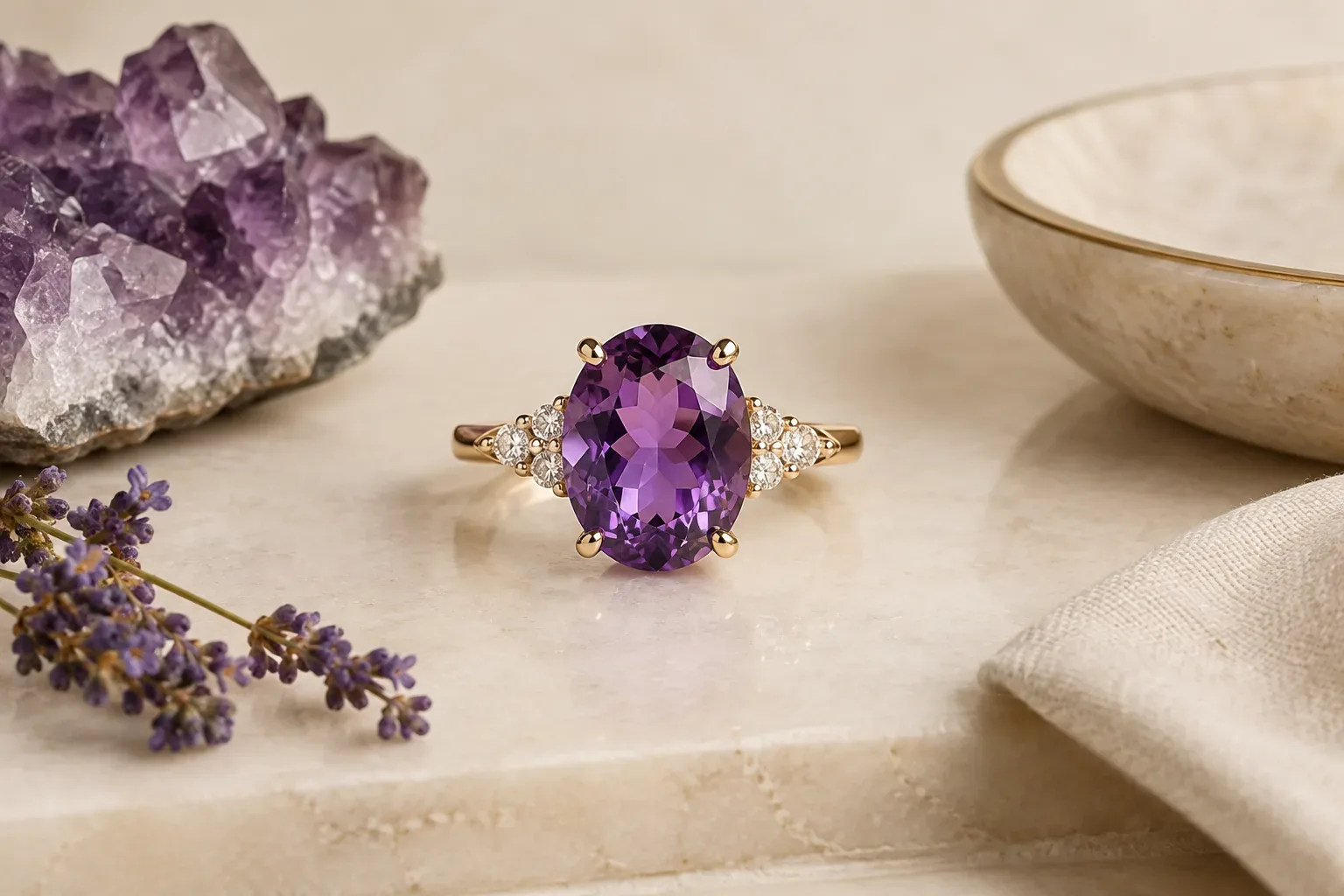
Amethyst shows up across several jewelry motifs: classic solitaires, halo settings where small diamonds or gems surround a purple center, three-stone rings, and vintage- or Art‑Deco–inspired sculptural rings. Trade reporting lists sculptural jewelry and gemstone rings among 2026 trends, which helps explain why amethyst is chosen for engagement pieces as an alternative to diamonds.
Designers also use amethyst as a colored accent in cluster and charm-style rings, or combined with contrasting metals and stones for a modern or vintage look. Because amethyst is more likely to show wear over time than harder gems, jewelers frequently place it in protective settings—bezel frames, partial bezels, or secure prongs with low profiles—to reduce impact risk.
Decision criteria: factors to weigh when choosing amethyst
Begin with lifestyle. If the wearer works with their hands, exercises or swims frequently, or prefers a low-maintenance ring, the softer nature of amethyst argues for a protective setting or choosing the stone for a non‑daily ring. If they want a standout color and wear the ring gently, amethyst can be an expressive and affordable primary stone.
Next, decide on color and cut priorities. Deeper, more saturated purple tends to read as richer and more valuable visually, while lighter or zoning colors can still be attractive at lower price points. Faceting that maximizes color and hides minor inclusions is typical for engagement-grade amethyst.
Finally, treatment and origin matter for price and disclosure. Ask the seller whether the amethyst is natural, heat-treated, or lab-created. The Federal Trade Commission requires clear distinctions among natural, lab‑created, treated, and imitation materials; insist on written disclosure and, for higher-value purchases, obtain a written report or appraisal.
Practical trade-offs—cost, durability, and verifiability
Cost: Amethyst typically costs much less than corundum or diamond of comparable size and eye appeal, allowing a larger center stone for the same budget. That affordability is a deliberate trade-off many buyers accept to prioritize color or size.
Durability: With a Mohs hardness near 7, amethyst resists everyday knocks better than soft stones like opal or pearl, but it is not as scratch- or chip-resistant as sapphire or diamond. Protective settings and occasional re-polishing or re-cutting can extend the useful life of an amethyst ring.
Verifiability: Several important facts cannot be reliably verified by eye. Only a qualified jeweler or gemological laboratory can determine whether an amethyst has been treated, whether it is natural or synthetic, and whether it was sourced from a particular locality with scientific certainty. The GIA describes how treatments and detectability create distinct consumer questions and why laboratory testing matters. The FTC also emphasizes that consumers need clear seller disclosures on these points.
Settings and metals that protect amethyst
Bezel settings are among the most protective options because they wrap metal around the girdle and can shield edges from impacts. Low-profile prong settings with sturdy, rounded prongs and a well-designed gallery can also protect an amethyst while showing more stone surface than a full bezel.
Metals with good durability—platinum, 14K or 18K gold, and palladium—are compatible choices. Harder alloys and secure mounting increase longevity. For active wearers consider a flush-set or halo-protected design so the center stone is less exposed to knocks and abrasion.
Care: cleaning, routine maintenance, and special precautions
Routine cleaning for amethyst is straightforward: warm water, a mild detergent, and a soft brush, followed by gentle drying with a soft cloth. Avoid steam cleaning and harsh chemicals that can affect some treatments or damage settings. The GIA guides consumers to treat gemstone care and treatment disclosure as distinct considerations when maintaining jewelry.
Limit exposure to prolonged direct heat and strong UV light if the seller indicates heat treatment or sensitivity; while amethyst is relatively stable, some color-enhancement processes are heat-sensitive. Have settings and prongs checked annually by a jeweler, and consider re-polishing if persistent scratches appear.
Buying, disclosure, appraisals, and verification—what only a pro or lab can tell you
Ask for written disclosure about whether the amethyst is natural, treated, or lab-grown. The FTC requires clear distinctions and written seller disclosures for gemstones, so reputable sellers will provide this information and may include a lab report for higher-value items.
Only a gemological laboratory can reliably detect certain treatments, confirm natural versus synthetic origin, or issue a geographic-origin statement. A qualified independent appraiser can provide a fair market valuation for insurance. If those facts matter to you—because of resale plans, insurance, or provenance claims—budget for a lab report or professional appraisal.
Gifting guidance and respectful selection conversations
If you are gifting an amethyst engagement ring, discuss expectations and practicalities beforehand when possible. Clarify whether the ring is intended for everyday wear or occasional use, and ask about metal preferences and allergies. Respect tactile and visual preferences—some people prefer a low-profile ring for work, while others prefer an ornate or sculptural design.
When buying without prior consultation, prioritize a flexible return policy, clear written disclosures, and an independent appraisal option. Consider emotionally meaningful choices such as selecting a stone color that references a shared memory or birth month, but present historical or symbolic claims as personal or modern interpretations unless you have primary historical documentation.
Summary and next steps
Amethyst can make a distinctive and beautiful engagement ring choice if you accept its trade-offs: lower hardness than traditional engagement gems, a greater need for protective settings and occasional maintenance, and the need for professional tests if you require confirmation of treatment or origin. Insist on written disclosures, a clear return policy, and a professional appraisal or lab report for higher-value purchases.
For broader context on gemstones and color symbolism, see our Gemstones category and related articles on amethyst meaning, moonstone, and onyx.
Frequently asked questions
Is amethyst durable enough for a daily-wear engagement ring?
Amethyst is quartz with a Mohs hardness of about 7, which is adequate for many rings but softer than sapphire or diamond. For daily wear choose a protective setting (bezel or halo), avoid heavy impact, and plan for periodic check-ups and occasional polishing.
How can I tell if an amethyst is natural, treated, or lab-grown?
Visual inspection alone usually cannot reliably distinguish natural from lab-grown amethyst or detect certain treatments. The Gemological Institute of America explains that some treatments are detectable only with gemological testing. For certainty, ask for written disclosure and a laboratory report or have a qualified gemologist examine the stone.
What should I ask a seller before buying an amethyst engagement ring?
Request written disclosure on whether the stone is natural, treated, or lab-created; ask for origin and treatment details if available; inquire about return and warranty policies; and for higher-value purchases obtain an independent appraisal or lab report. The FTC emphasizes clear written distinctions among gemstone types and treatments.
How do I clean and care for an amethyst ring at home?
Clean with warm water, mild soap, and a soft brush, then dry with a soft cloth. Avoid steam cleaning and harsh chemicals if the seller indicates any heat treatments or sensitivity. Have prongs and settings checked annually by a jeweler.
Are there settings that reduce the chance of chipping or scratching amethyst?
Yes. Bezel settings, low-profile prongs, halos that protect edges, and designs that recess the stone into the ring face reduce exposure to knocks and abrasion and are recommended for softer stones like amethyst.
Sources and further reading
- Imaginaire Digital — Imaginaire Digital
- Professional Jeweller / PRYA Jewellery Search Insights — Professional Jeweller / PRYA Jewellery Search Insights
- Gemological Institute of America — Gemological Institute of America
- Federal Trade Commission — Federal Trade Commission