Meaning at a glance
This amethyst treatment guide explains typical enhancement types applied to colored gems, the buyer decisions and trade-offs that follow, what sellers must disclose, what you can check without a lab, safe care advice, and practical selection and gifting recommendations based on industry guidance.
Historical evidence and how amethyst has been used in jewelry periods
If your search intent is partly historical, know this guide focuses on treatment and buying decisions rather than ancient symbolism. Contemporary industry reporting documents that amethyst and other colored gems appear across modern trends—from sculptural and Art Deco-inspired pieces to birthstone necklaces—where color and cut are primary drivers of design (Professional Jeweller / PRYA Jewellery Search Insights; Imaginaire Digital).
Trade and trend reports name specific jewelry periods and market demand: 2026 visibility and keyword research indicate renewed interest in Art Deco styling, sculptural forms, and birthstone necklaces; within those styles, amethyst is often chosen for its purple hue and affordability compared with other violet gems (Professional Jeweller / PRYA; Imaginaire Digital). For deeper historical claims about ancient cultures, medieval usages, or religious symbolism, consult specialized historical scholarship and catalogues rather than treatment-focused industry and consumer-protection sources.
Documented historical meanings versus modern personal interpretations
Documented meanings drawn from historical primary sources are not the focus of the consumer-facing treatment literature reviewed for this guide. Contemporary jewelry journalism and trend reporting document how amethyst is used and styled but do not establish uniform ancient meanings (Professional Jeweller / PRYA; Imaginaire Digital).
Modern personal interpretations—what buyers or wearers feel a stone symbolizes—are separate from treatment and disclosure questions. Sellers should not conflate personal or anecdotal symbolism with treatment status or value. If the symbolic provenance of a gem matters to you, treat that as a personal preference and ask the seller for provenance documentation or historical research separately from treatment reports.
Common enhancement types you should know about
The gem trade applies several broad classes of treatments to colored gemstones; authoritative gemology guidance groups these into categories such as heating, irradiation, dyeing, filling/coating, and fabrication. These categories affect detectability, durability, and disclosure expectations and are discussed in general by the Gemological Institute of America (Gemological Institute of America).
The Federal Trade Commission requires clear distinctions among natural, lab-created, treated, and imitation materials and expects written seller disclosures when treatments materially affect value or appearance (Federal Trade Commission). Because different treatments have different permanence and care implications, treating the type of enhancement as a material fact is a sound decision rule for shoppers.
Detectability and limits on what a shopper can verify
What you can verify without a qualified jeweler or gemological lab is limited. The most reliable non-lab steps are obtaining a written disclosure from the seller, requesting a returnable trial period and checking for a reputable manufacturer or retailer warranty, and asking for any existing gemological lab reports (Federal Trade Commission; Gemological Institute of America).
Some treatments leave obvious visual clues that a careful buyer can notice with a loupe or magnifier, such as surface residues from dyeing or unnatural color concentrations. Many important treatments, however, are invisible to unaided inspection and require professional instruments or laboratory testing to detect. The GIA explains that detectability varies by treatment and material and that laboratories provide authoritative identification when needed (Gemological Institute of America).
Decision criteria and practical trade-offs for buyers
Decide your priorities first: color intensity, permanence, price, and whether you require an independent lab report. Treated stones often give stronger color at lower cost, while untreated or naturally colored material may carry a premium. The trade-off is between initial value and the buyer’s tolerance for treatments that alter color or stability. Use written disclosure and documentation to make this trade-off explicit (Federal Trade Commission).
For higher-value purchases, insist on an independent laboratory report or an evaluation from a qualified gemologist. For less expensive fashion jewelry, choose sellers with clear return policies and transparent treatment statements. If a seller refuses to disclose treatments in writing or lacks a reasonable return policy, treat that as a material risk to your purchase.
How amethyst appears in jewelry and what that means for treatment risks
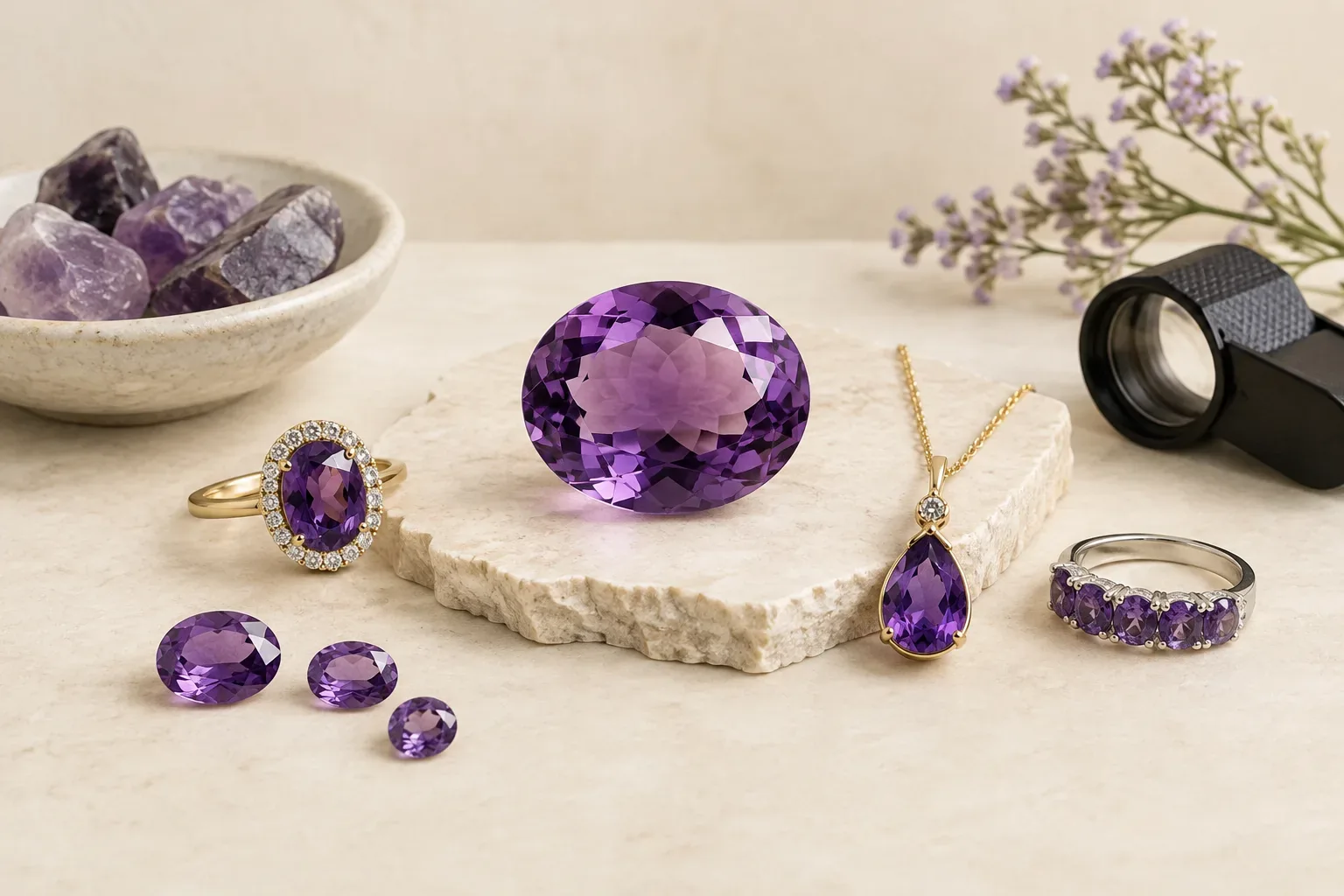
Amethyst appears in a wide range of settings and styles—rings, necklaces, earrings, and sculptural pieces—and is commonly used where a strong purple color is desirable but budget considerations rule out more expensive violet gems. Industry reporting highlights demand for birthstone necklaces, Art Deco revivals, and sculptural designs where cut and color take precedence (Professional Jeweller / PRYA; Imaginaire Digital).
Because amethyst is used across price points, both untreated and treated stones circulate in the market. In lower-priced fashion pieces, sellers may use color-enhanced material; in higher-end settings, buyers should expect and request laboratory-backed disclosures. The style of jewelry can also influence cleaning and wear: rings and bracelets contend with more abrasion and household chemicals than pendant necklaces, so treatment stability matters more in those everyday-wear contexts.
Safe care guidance tied to potential treatments
Treatments can affect durability and cleaning recommendations. The GIA makes clear that treatments, detectability, durability and special care are interrelated and that consumers should follow guidance tailored to the specific stone and its enhancement (Gemological Institute of America). Absent a treatment statement, follow conservative care: avoid prolonged exposure to harsh chemicals, high heat, and extreme temperature changes, and clean gently with mild soap, warm water, and a soft brush.
If your purchase comes with a documented treatment, follow the care instructions tied to that treatment. When in doubt, consult a qualified jeweler for recommended maintenance intervals and for any repair work that could affect a treated surface.
Practical selection and respectful gifting guidance
Selection guidance depends on the recipient and the occasion. For a sentimental or milestone gift where long-term value and provenance matter, prioritize stones with clear written disclosure and, for higher cost pieces, a reputable independent laboratory report. For fashion gifts where color and design are primary, prioritize sellers with transparent treatment policies and fair return terms.
When gifting, be respectful about disclosure: if you know a stone is treated, mention that to the recipient and keep the paperwork with the gift. If the recipient values natural, untreated material for cultural or personal reasons, honor that preference and use the seller’s written statements to confirm the stone’s status. Reliable disclosure protects both buyer and recipient and aligns with Federal Trade Commission guidance on truthful claims (Federal Trade Commission).
What to ask the seller—practical wording
Ask for written answers to: “Has this stone been treated or enhanced? If so, what specific treatment was applied, and is there a lab report?” Request the name of the testing laboratory if a report exists and ask about the seller’s return policy if the report is absent. These are reasonable, evidence-based questions that align with FTC expectations for clear distinctions among natural, lab-created, treated, and imitation materials (Federal Trade Commission).
If the seller provides a lab report, read the report or have an independent jeweler explain it; laboratories vary in the scope of tests they run, and a report’s absence does not prove the stone is untreated. For any treatment claim that materially affects value, insist on written disclosure before purchase.
When to use a laboratory or qualified jeweler
Use an accredited gemological laboratory when the stone’s value justifies the cost of testing or when a confident determination is essential for insurance, resale, or personal assurance. The GIA and similar labs can test for many treatments and provide authoritative identification; however, not all tests are routine and the scope of testing should be agreed in advance (Gemological Institute of America).
For on-the-spot advice—cleaning, mounting risks, or visible surface treatments—a qualified jeweler with gemological training can be a practical intermediary. But remember that only a laboratory can perform certain instrument-based analyses definitively.
Frequently asked questions
Are amethysts commonly treated?
Authority on treatments varies by material, but the Gemological Institute of America notes that multiple classes of treatments exist for colored gems; the Federal Trade Commission requires sellers to disclose treatments that affect value. Treatability depends on market segment and price point, so always ask the seller for written disclosure.
How can I tell if an amethyst is treated without a lab report?
Without lab testing you can request written disclosure and look for obvious signs such as surface residues or uneven color under magnification, but many treatments are invisible without instruments. For definitive identification you need a qualified jeweler or a gemological laboratory (Gemological Institute of America).
Should I ask for a lab report?
Yes for higher-value purchases or when provenance is important. A lab report from an accredited facility provides the most reliable identification of treatments and origins; for lower-cost fashion pieces, strong seller disclosure and a clear return policy may be adequate (Federal Trade Commission).
Do treatments affect how I should clean or wear amethyst?
Potentially. Treatments can change a stone’s stability and cleaning needs. When you receive written treatment information, follow care advice tied to that treatment; otherwise, use conservative care—mild soap, warm water, soft brush—and avoid harsh chemicals and extreme heat (Gemological Institute of America).
What should I do if a seller won’t disclose treatments?
Treat non-disclosure as a material red flag. Ask for written confirmation, request a returnable trial, or walk away. The Federal Trade Commission expects clear distinctions among natural, lab-created, treated, and imitation materials, so lack of disclosure increases the purchase risk.
Sources and further reading
- Imaginaire Digital — Imaginaire Digital
- Professional Jeweller / PRYA Jewellery Search Insights — Professional Jeweller / PRYA Jewellery Search Insights
- Gemological Institute of America — Gemological Institute of America
- Federal Trade Commission — Federal Trade Commission