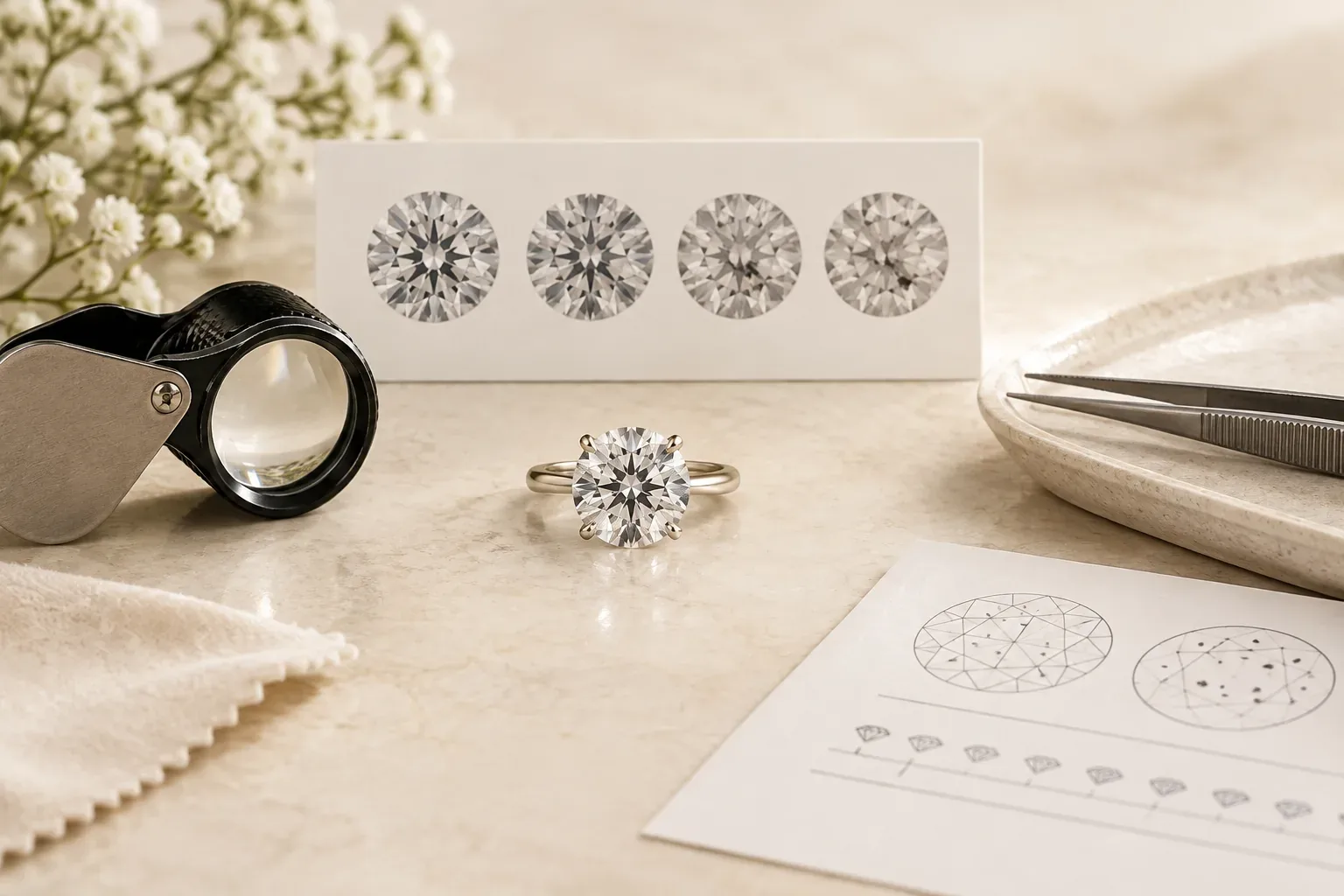
Meaning at a glance
This guide defines 'eye-clean' with evidence-led decision criteria, explains what a buyer can and cannot verify without a qualified jeweler or laboratory, lays out practical trade-offs between clarity and cost, and gives safe care and selection advice.
Direct answer — what this guide will give you
’Eye cleanliness’ is a consumer way to say a diamond shows no inclusions visible to the unaided eye at a normal viewing distance; it is not a formal laboratory grade. This guide explains that definition, identifies the limits of visual checks versus what a gemological laboratory or qualified jeweler can verify, lays out the practical trade-offs between clarity and price, and provides safe cleaning and selection guidance based on evidence about treatments, disclosure, and market demand.
What 'eye-clean' means in practice
In jewelry discussions, ‘eye-clean’ describes a diamond that appears free of visible inclusions when seen without magnification from typical social distances. It is a functional, consumer-focused term rather than a precise technical standard issued by laboratories. Because the phrase relies on human eyesight, lighting, viewing distance, the wearer’s expectations, and the stone’s cut and setting, it remains subjective and situational.
Historical evidence and cultural context — what the approved sources show
The three approved sources used for this guide do not provide a body of historical symbolism specific to the ‘eye-clean’ label. Instead, available evidence focuses on modern market behavior, consumer protection, and gemological practice. Imaginaire Digital’s 2026 search estimates identify strong contemporary demand for engagement rings and related diamond jewelry categories, which helps explain why consumers ask about eye cleanliness today. The Gemological Institute of America (GIA) documents how treatments, detectability, and care affect gemstones. The U.S. Federal Trade Commission (FTC) emphasizes the need for accurate disclosure and clear distinctions among natural, lab-created, treated, and imitation materials. Those three perspectives together locate ‘eye-cleanliness’ as a modern, market-driven concept rather than a historical cultural motif grounded in the textual or archaeological record.
Documented historical meanings versus modern personal interpretation
Because the approved sources do not provide historical symbolism for 'eye-clean' specifically, it is important to separate documented facts from personal meaning. Documented facts supported here include: how treatments affect detectability and durability (GIA), and the regulatory need for clear disclosure of treatments and origin (FTC). Personal and cultural interpretations about what an 'eye-clean' diamond symbolizes—such as purity, perfection, or status—are modern, subjective meanings that may vary by individual, culture, and context and are not established by the sources used for this guide.
How the eye-clean concept appears in jewelry and marketing
Retail listings, sales conversations, and independent reviews often use ‘eye-clean’ to describe diamonds that look clear in common settings such as solitaire rings, three-stone rings, stud earrings, and pendants. Market demand for engagement rings and studs, as reported by Imaginaire Digital, helps explain why retailers emphasize visible clarity: buyers frequently prioritize what the eye sees in everyday wear. The stone’s cut, pavilion angles, and setting can hide or reveal inclusions, so the same clarity grade may appear more or less ‘eye-clean’ depending on design choices. Sellers may also indicate fluorescence, clarity grade range, and whether a stone has undergone clarity-enhancing treatments—each factor affects perceived cleanliness.
Decision criteria and practical trade-offs
When reading an eye cleanliness claim, treat it as a visual assessment, not a full substitute for a grading report. Useful decision criteria include: asking for a current lab report from an accredited gemological laboratory; requesting photographs or videos from several angles under consistent lighting; learning whether the stone has received clarity-enhancing treatments; and considering the setting and metal choice that will affect how inclusions are seen. Trade-offs typically involve clarity grade versus price: lower clarity grades may appear eye-clean at a distance and offer better value, while higher clarity grades reduce the risk of visible inclusions but raise cost. The GIA’s material on detectability and treatments explains why some enhancements are used and why their disclosure matters for long-term durability and care. The FTC’s guidance underlines that sellers must not mislead buyers about treatments or the stone’s origin.
What you can and cannot verify without a lab or qualified jeweler
Shoppers can verify certain things themselves: a visual check for obvious inclusions under normal lighting; asking to see the diamond mounted and unmounted; comparing similar stones side by side; and requesting photos, videos, or a magnified image. However, several facts require professional verification. A laboratory or qualified gemologist is needed to confirm exact clarity grade, to detect many treatments (including some clarity-enhancing procedures), and to determine whether a diamond is natural or lab-grown. The GIA notes that treatments vary in detectability and that some require specialized testing. The FTC also stresses that written disclosure from the seller is essential and that consumers should not rely solely on visual claims when material disclosures are required.
Safe care guidance to keep a diamond looking eye-clean
Daily oils, lotions, dust, and residues quickly reduce a diamond’s apparent cleanliness; regular gentle cleaning restores visual brilliance. Warm water with a mild detergent and a soft brush is safe for most diamonds and settings, and professional ultrasonic or steam cleaning can be appropriate for non-treated, securely set diamonds. If a diamond has received a treatment, consult the seller or a gemology professional before using ultrasonic or steam methods, because some treatments can be sensitive to heat, chemicals, or vibrations. The GIA’s guidance on treatments and care provides authoritative background on detectability and durability related to treated gemstones.
Selection and gifting guidance — practical and respectful choices
When selecting or gifting a diamond described as eye-clean, ask politely for the evidence that supports the claim: recent lab reports, clear images, and written disclosure of any treatments or lab origin. Frame questions around durability and disclosure rather than aesthetic judgment alone to keep discussions respectful. If budget is a concern, consider prioritizing cut and color—well-cut diamonds can appear more brilliant and mask minor inclusions—so you may achieve a visually clean look at lower clarity grades. For heirloom or symbolic gifts, request a qualified appraisal or certificate and preserve any paperwork with the gift to respect the recipient’s future care and insurance needs. Remember that different cultures and recipients place different significance on diamond characteristics; asking about the recipient’s preferences before purchase is a simple way to be considerate.
Practical next steps for shoppers
Start by asking the seller for a recent report from an accredited laboratory if available, and request clear photos or videos of the mounted stone. Compare similar stones under consistent lighting and, if possible, view the diamond in person. If a seller claims a diamond is eye-clean but provides no documentation or refuses to discuss treatments and origin, consider seeking another seller or arranging an independent appraisal. Keep careful records of any reports and disclosures you receive, as the FTC recommends written disclosures for treated, lab-grown, or imitation materials.
Conclusion
‘Eye-clean’ is a useful, everyday shorthand for many buyers who want diamonds that look clear in regular wear. It should be treated as a visual description rather than a certified grade. Use the decision criteria and safe care guidance here to evaluate claims, request proper documentation, and balance trade-offs between clarity and cost. When in doubt about treatments, origin, or exact grading, a qualified jeweler or gemological laboratory provides the definitive verification.
Frequently asked questions
Is 'eye-clean' the same as a clarity grade?
No. 'Eye-clean' is a visual descriptor indicating that inclusions are not visible to the naked eye in normal viewing. A formal clarity grade comes from a qualified laboratory and specifies the size, type, and location of inclusions under magnification.
Can I rely on photos or videos to judge eye cleanliness?
Photos and videos are helpful but can be misleading depending on lighting, camera quality, and editing. Use them as a starting point and request lab reports, multiple angles, and in-person viewing when possible.
What should I ask the seller about treatments?
Ask directly whether the diamond has received any clarity-enhancing or color treatments, request written disclosure, and ask for documentation or laboratory confirmation. The GIA explains that some treatments affect detectability and care, and the FTC requires clear disclosure of treated materials.
Will cleaning a diamond make it look eye-clean if it isn’t?
Cleaning restores brilliance and removes surface residues that can obscure a stone, but cleaning cannot eliminate internal inclusions. Regular gentle cleaning improves appearance but does not change the diamond’s internal clarity.
How can I verify a diamond’s claims without a lab report?
You can perform a visual inspection, compare similar stones, request magnified images, and ask for seller disclosures. However, confirming exact clarity grades, detecting some treatments, and verifying natural versus lab-grown origin require a gemological lab or qualified professional.
Are there budget-friendly ways to get an eye-clean look?
Yes. Prioritize an excellent cut and appropriate color, choose settings that conceal the girdle or pavilion, and consider slightly lower clarity grades that still appear eye-clean—always confirm appearance with photos or in-person viewing before purchase.
Sources and further reading
- Imaginaire Digital — Imaginaire Digital
- Gemological Institute of America — Gemological Institute of America
- Federal Trade Commission — Federal Trade Commission