Meaning at a glance
An east-west setting places an elongated gemstone on its side across the finger for a modern, horizontal look; shoppers should weigh aesthetic fit, finger shape, stone durability and disclosure when choosing one, use documentation to confirm treatments and origin, and consult a qualified jeweler or gemological lab for anything beyond visual checks.
What an east-west setting is and how it reads on the finger
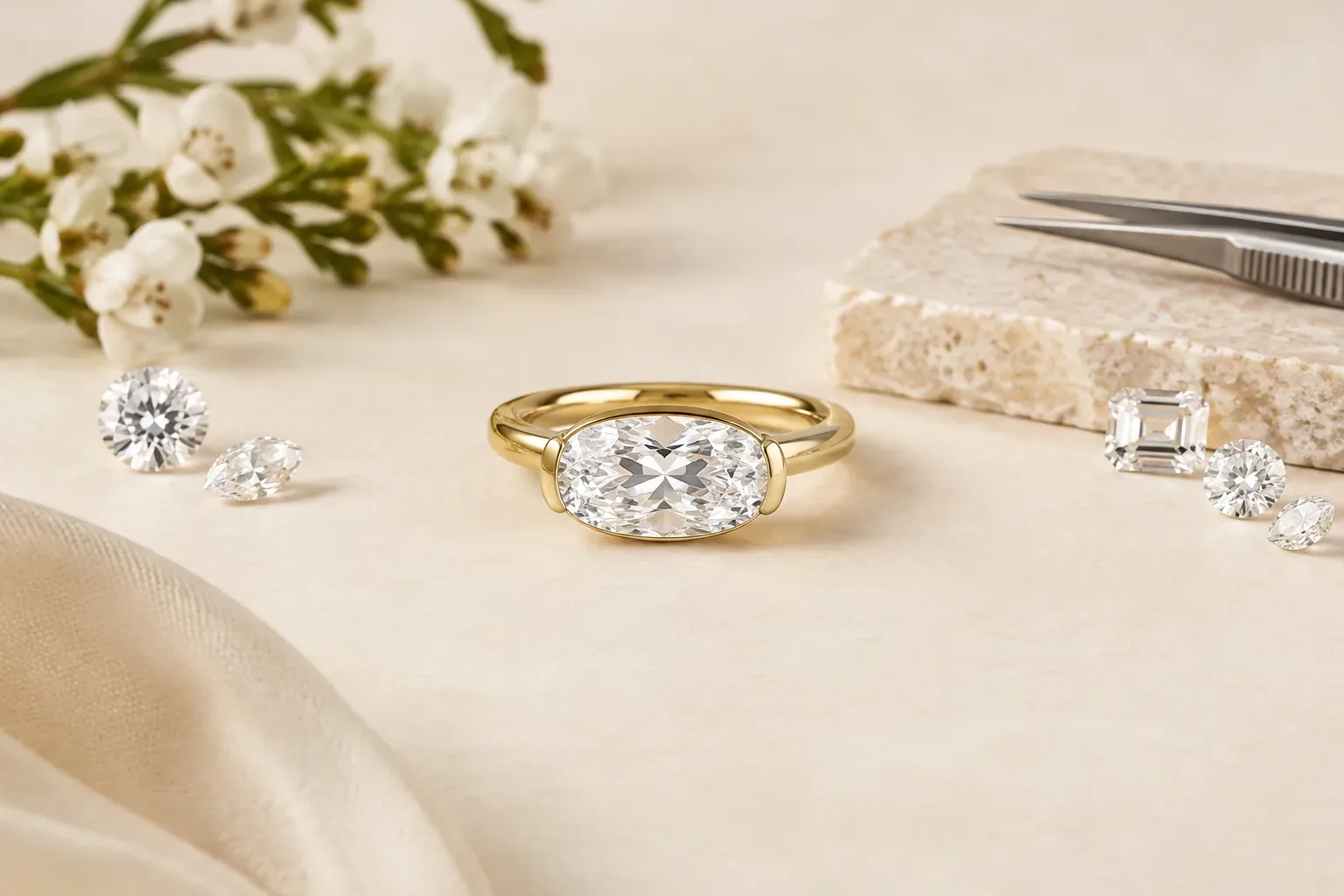
The defining feature of an east-west setting is the gemstone’s orientation: the stone’s long axis runs horizontally across the finger instead of vertically. Jewelers use a range of mounting styles—solitaire bezels, prong settings, halo frames and three-stone arrangements—to secure the stone in that horizontal axis.
Visually, an east-west orientation lengthens the apparent width of the finger and reads as modern or fashion-forward because it departs from the traditional vertical solitaire. Many designers choose east-west layouts for elongated shapes such as ovals, marquises and emerald cuts because the horizontal line becomes the ring’s focal motif.
Historical evidence and cultural context
There is little documented evidence tying the east-west orientation to a longstanding cultural ritual or ancient jewelry tradition in specific historical periods. Records and mainstream gemological references do not identify an established historic practice centered on mounting elongated gems horizontally as a culturally codified sign or rite.
Contemporary sources that track market and design trends identify east-west as a recent and growing design preference rather than a recovered historical practice. For example, Jewelers Mutual’s 2026 trend reporting lists fluid forms, modern stacking and gender-neutral styling among current consumer interests, which helps explain why designers favor directional variations such as east-west placements (Jewelers Mutual). Imaginaire Digital’s 2026 UK search estimates likewise show demand concentration for modern engagement forms including oval engagement rings, reflecting visibility and shopper interest in fashion-forward cuts and settings (Imaginaire Digital).
Documented historical meanings versus modern personal interpretation
Documented historical meanings: there is no established, well-documented historical symbolic meaning specific to an east-west orientation in the academic or trade references consulted for this guide. Historic jewelry symbolism often focused on motifs such as hearts, knots, or specific gemstones with cultural associations, but the horizontal orientation of a stone is not recorded as a widely recognized symbol in primary gemological references.
Modern personal interpretation: today, wearers and designers attach new, personal meanings to the east-west look. Common modern interpretations include a wish for uniqueness, a contemporary aesthetic preference, gender-neutral styling, or a desire to emphasize finger width and hand geometry. Those interpretations are personal and stylistic rather than historically documented; treat them as individual choices, not universal symbolism.
How the motif and gemstone choices appear in jewelry
Designers often pair the east-west orientation with elongated or oval gemstones because those shapes create a clear horizontal line. Ovals, marquises, emerald cuts and even elongated cushions are frequent choices. The setting style—bezel, prong, halo, or tension—affects the ring’s profile and perceived security.
Colored gemstones appear in east-west settings as well, especially sapphires, emeralds and morganite, reflecting current consumer interest in colored stones and versatility. Jewelers Mutual’s 2026 trend overview highlights modern stacking, colored gemstones and versatility as demand drivers, which helps explain the east-west approach appearing across both classic diamonds and vivid colored stones (Jewelers Mutual).
Practical pros and cons
Pros: East-west settings create a distinctive, contemporary look that can make the finger appear wider and balance shorter fingers. They often sit lower on the finger when set in a bezel or low prong, which can reduce snagging. The orientation reads as modern and can pair well with stacking bands and mixed-metal styling.
Cons: Some cuts oriented east-west may show light differently than when oriented vertically, which can slightly alter perceived brilliance in certain cuts. An east-west mount can be less traditional for those seeking a classic solitaire silhouette, and certain glove fits or tools may interact differently with a horizontally set stone. Practical trade-offs include finish and prong placement; a horizontal stone may need different prong geometry for security, which can affect cleaning and resizing options.
Selection criteria: what to consider before you buy
Finger shape and size: The east-west line visually widens the finger, so people with short or broader fingers often find it flattering. Conversely, those seeking to elongate a slender finger may prefer a vertical orientation.
Gemstone cut and brilliance: If you prioritize maximum traditional brilliance from, for example, a round brilliant, east-west is less relevant because that cut is symmetric. For elongated cuts, inspect how the stone interacts with light when placed horizontally, and compare vertical and horizontal orientations in person if possible.
Lifestyle and wear: Consider your daily activities. Although low bezels can reduce snagging, some horizontal prongs may be more exposed depending on design. Think about glove use, manual tasks and whether you prefer a ring that tucks under a work glove or sits proudly above it.
Budget and metal choice: The setting type influences labor cost. Bezel and custom east-west mounts can require more metalwork than a simple vertical prong, so factor craftsmanship into your budget. Choose metals with appropriate strength for the setting, such as platinum for very secure prongs or hard 14k/18k gold for bezels.
Care, treatments and disclosure: safe guidance
Gemstone treatments affect durability and care. The Gemological Institute of America emphasizes that treatments, detectability and durability create distinct consumer questions for gemstones, so ask sellers for full disclosure on any heat, fracture-filling, coating or other treatments (GIA). Treated gems sometimes need gentler cleaning or more frequent inspection.
Regulatory expectations: The Federal Trade Commission requires sellers to provide clear distinctions among natural, lab-created, treated, cultured and imitation materials and to provide written disclosures. Ask for documentation that identifies whether the stone is natural or lab-grown and whether it has undergone any treatments that could affect its appearance or serviceability (Federal Trade Commission).
Routine care: For bezel-set east-west rings, a soft cloth and warm soapy water often suffice for regular cleaning, but avoid ultrasonic cleaners for stones known to be fracture-filled or otherwise treated unless you have written confirmation the stone is safe for that method. Periodic inspection of prongs, especially on horizontally set stones where force may be applied differently, is advisable.
What you can verify without a qualified jeweler or lab
Visual and paperwork checks you can do yourself include confirming the seller’s written disclosures about whether the gem is natural or lab-created, asking for any available gemological report or certificate, checking return policy and warranty, comparing the piece in hand to online photos, and inspecting prong security and setting finish under a loupe.
You can also test practical fit and comfort, wear the ring for a trial period if the seller allows it, and observe how it sits with any intended stacking rings. Verify the metal stamp and ask for care instructions specific to the stated stone type and any declared treatments.
What only a qualified jeweler or gemological laboratory can verify
Certain attributes require expert equipment and certification. A qualified gemological laboratory can confirm a gemstone’s species, whether it is natural or lab-created, identify treatments and provide a grading report for diamonds and many colored stones. The Gemological Institute of America’s guidance makes clear that detectability and disclosure of treatments can be complex, and laboratory testing is the only reliable route to definitive answers about treatments and origin (GIA).
A trained jeweler can also assess structural security beyond your visual inspection, advise on appropriate prong geometry for an east-west mount, and execute precise resizing or soldering without compromising the setting.
When to consult a professional
If you have questions about what treatments a stone has undergone, need an origin report, or want an independent grading certificate, contact a recognized gemological laboratory. If you are buying a high-value piece or commissioning a custom east-west mount, work with an experienced jeweler who can advise on metal choice, prong design and long-term serviceability.
Use the seller’s paperwork as the first line of verification and escalate to laboratory testing when paperwork is absent, contradictory, or when you require a definitive, third-party assessment.
Final thoughts
An east-west engagement ring is primarily a contemporary stylistic choice that offers a distinct horizontal silhouette. Its advantages are visual and personal: it can flatter certain finger shapes and support modern, stackable looks. Its trade-offs are practical and verifiable: differences in light performance for some cuts, setting geometry, and the need for attention to treatments and disclosures.
Follow disclosure best practices, request documentation, inspect mount security and consult a qualified jeweler or gemological laboratory when you need definitive answers about origin or treatments. For shoppers looking to balance modern design with long-term wearability, an informed selection process will deliver the best result.
Frequently asked questions
Does an east-west setting reduce diamond brilliance?
Orientation alone does not change the inherent cut or facets of a stone, but some elongated cuts may reflect light differently when set horizontally versus vertically; compare the same stone in both orientations to judge appearance in person.
Is an east-west setting more likely to snag?
Not inherently; a low bezel east-west setting can be less prone to snagging, while exposed prongs may catch depending on design—inspect prong placement and try the ring with typical clothing or gloves before purchase.
Can I get an east-west mount for any gemstone?
Most elongated or durable gemstones work well in east-west mounts, but softer or treated gems may require special care; ask the seller for treatment disclosures and care instructions and consult the GIA guidance on treatments.
What paperwork should I insist on?
Insist on written disclosures that state whether the gem is natural or lab-created and identify any treatments, a clear return policy and warranty, and, for higher-value purchases, a gemological report from an accredited lab; the FTC expects such clear distinctions.
When should I seek lab testing?
Seek an independent gemological report if origin, treatment status or grading is material to your purchase decision—when paperwork is absent, conflicting, or when you need a third-party, definitive assessment.
Sources and further reading
- Imaginaire Digital — Imaginaire Digital
- Jewelers Mutual — Jewelers Mutual
- Gemological Institute of America — Gemological Institute of America
- Federal Trade Commission — Federal Trade Commission