Meaning at a glance
This checklist defines baguette-cut stones for engagement rings, lists buyer decision criteria and practical trade-offs, explains safe care, and clearly states what a shopper can verify without a qualified jeweler or a gemological laboratory.
Direct answer — what this checklist does
A concise answer: use this baguette cut engagement ring checklist to get clear definitions, weigh decision criteria and trade-offs, confirm safe-care needs, and understand the limits of what you can verify without a certified jeweler or gemological laboratory. The checklist focuses on the specific questions you should ask sellers and the practical choices you’ll face when a baguette cut is part of an engagement ring purchase.
What we mean by 'baguette cut' and why it matters
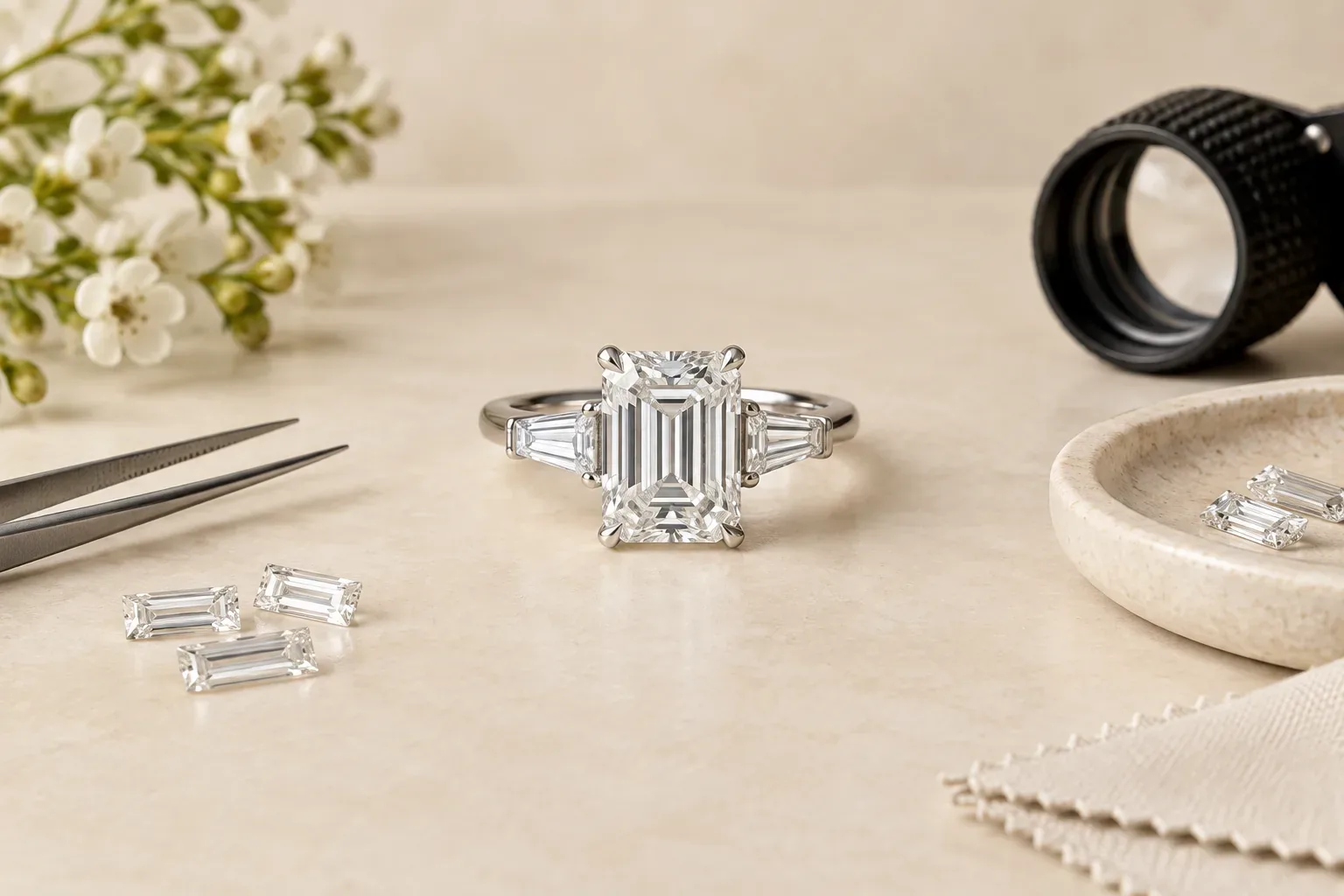
In retail and trade language a baguette cut refers to a rectangular, step-cut stone with long, straight facets that emphasize linear geometry and clarity rather than sparkle. Baguettes commonly appear as straight-edged side stones flanking a center gem, as tapered accents in multi-stone rings, or less often as the center gem in minimalist settings. The shape influences light performance, setting styles, and the kind of protection the stone needs from daily wear.
Historical evidence and what the approved sources say
Among the allowed, approved sources for this article there is no detailed primary historical documentation about symbolic meanings tied specifically to the baguette cut. Contemporary industry analyses emphasize modern demand patterns rather than historical symbolism. For example, 2026 search and market estimates show strong consumer interest in a range of engagement-ring styles and shapes, with broader demand for engagement rings and classic cuts reported in UK metrics (Imaginaire Digital).
Professional guidance from trade organizations highlights how current preferences reflect contemporary tastes: Jewelers Mutual reports 2026 trends emphasizing fluid forms, stacking, colored gemstones, craftsmanship and gender-neutral styling, which helps explain why baguette stones are popular today as clean, architectural accents rather than for any single longstanding symbolic meaning.
Documented historical meanings versus modern personal interpretations
Documented, source-backed historical meanings specifically linked to the baguette cut are not present in the approved evidence set. That absence means any historical claim about a long-standing cultural or ritual meaning for the baguette shape would be speculative unless supported by dedicated primary sources or specialist scholarship.
Modern interpretations—how wearers and givers interpret baguette stones today—are personal and culturally contingent. Contemporary buyers and designers often read baguette accents as minimalist, architectural, or vintage-inspired depending on the setting and the era the design references. These are valid personal meanings but should be distinguished from documented historical claims.
How the baguette cut appears in jewelry
In practice the baguette cut most often appears as side stones in three-stone rings, as shoulders on solitaires, in channel-set eternity bands, and as accent stones that emphasize horizontals or verticals in a design. The long, flat facets create a stepwise reflection that complements a brilliant-cut center by offering contrast rather than sparkle.
Because of the rectangular shape, settings tend to favor channels, bezels, or secure prongs that protect the exposed edges. Jewelers use tapered baguettes to follow a ring’s taper and straight baguettes to create strong linear motifs. The choice of metal, finish, and overall ring geometry will change the visual role of the baguette from subtle support to decisive architectural feature.
Checklist: Questions to ask before buying
What exact role does the baguette play in this design: is it a center stone, a side accent, tapered or straight? The answer affects size, setting strength, and wear characteristics.
What is the gemstone type and origin? Ask whether the stones are natural, lab-created, treated, or simulants and insist on written disclosure. The Federal Trade Commission requires clear distinctions among natural, lab-created, treated and imitation materials, so get this in writing when available.
Are there documented treatments? Many gemstones and diamonds receive treatments that affect durability and care. The Gemological Institute of America notes that treatments, disclosure, detectability and special care are central consumer questions; ask whether any heat treatment, fracture filling, or coating has been applied and if that is disclosed on a report.
Is there a gemological report or certificate for the main stone and for calibrated baguettes if they are significant? A qualified laboratory report is the most reliable way to verify weight, measurements, and certain treatments, though not every baguette will be reported individually.
Can the seller provide measurements and proportions for the baguette(s) and center stone? Length, width, depth, and how the baguette is set tell you a lot about appearance and security.
How is each baguette set and how much edge protection is in place? Ask about prong count, channel quality, and the risk of nibbling or chipping at corners.
What are the trade-offs in clarity and color for side baguettes versus center stones? Baguettes show inclusions more readily due to step facets; sellers often offset this by choosing higher-clarity side stones or positioning inclusions away from visible angles.
What is the seller’s return policy, warranty, and resizing policy? Resizing multi-stone baguette settings can be complex and sometimes irreversible.
What are care recommendations and any limitations on cleaning? Because treatments and stone types vary, confirm whether ultrasonic cleaning or steam is recommended or discouraged—consult a jeweler for stones that may be fracture-filled or otherwise treated.
Will you receive an itemized invoice and a description sufficient for insurance? Ask whether the seller provides an appraisal or replacement-value estimate and whether they recommend specific insurance options.
Practical trade-offs buyers need to weigh
Baguette accents can lower or raise cost depending on whether they are natural or lab-grown and on required clarity and matching. Their step-cut surfaces show inclusions and color more clearly than brilliant cuts, so buyers may pay a premium for cleaner side stones when a flawless appearance is desired.
Baguette sides provide a crisp, architectural look but can be less forgiving of careless wear than round brilliants; buying a setting with good protection will often save repair costs later. Simpler settings may be cheaper but expose edges, while channel or bezel settings protect baguette edges but can be costlier to resize or repair.
Care and safe handling guidance
Follow material-specific care. The Gemological Institute of America emphasizes that treatments and material durability change recommended care routines. For example, some treated stones should not be exposed to ultrasonic cleaning or harsh chemicals; always confirm the stone’s treatment status before using ultrasonic or steam cleaners.
Protect baguette edges during wear by choosing a setting with good edge protection and by removing the ring for heavy manual work. Store rings individually to avoid contact with harder materials and check prongs and channels annually with a qualified jeweler.
Document condition at purchase with photographs and written notes, and update those records after any repair or sizing work. Keep paperwork with certificates and receipts in case of insurance or resale.
What you cannot reliably verify without experts
You cannot reliably detect most internal treatments, origin claims (natural versus lab-grown), or some sophisticated enhancements without either a qualified gemological laboratory report or the assessment of a qualified independent jeweler. The Gemological Institute of America explains that detectability varies by treatment, and the Federal Trade Commission requires accurate written disclosure from sellers, which is your best consumer protection short of laboratory testing.
If a seller claims a stone is untreated, natural, or of a particular origin, request written certification. If certification is absent or ambiguous, plan for a lab report if accurate identification matters to you for value, longevity, or ethical reasons.
Respectful gifting and selection guidance
Approach gifting with respect for the recipient’s style, daily activities, and preferences rather than assumptions about symbolism. If you need to ask questions discreetly, inquire about metal color preferences, whether they wear delicate or bold rings, and if they prefer low or high-profile settings.
Consider both aesthetics and lifestyle when choosing baguette-accented rings. For wearers with active hands, choose settings that protect baguette edges. For those who value a vintage or minimalist look, consider slender baguettes in channel or tapered settings. Jewelers Mutual’s 2026 trends underline that modern customers increasingly value craftsmanship, versatility, and gender-neutral styling—factors worth considering when selecting a gift.
Summary and next steps
Use the checklist above as a working interview script when you speak with sellers: confirm stone type and treatments, request written disclosures and measurements, verify setting protection, and check return and warranty terms. If the answers you receive are incomplete or unverifiable, arrange for a qualified jeweler or a gemological laboratory report before finalizing a significant purchase.
When you pair these practical steps with clear care practices and proper documentation, you can choose a baguette cut engagement ring that meets aesthetic goals while limiting surprise costs and durability risks.
Frequently asked questions
Can I tell if a baguette is natural or lab-grown without a lab report?
No. Visual inspection by a consumer cannot reliably distinguish natural from lab-grown stones. The Federal Trade Commission recommends obtaining written disclosure from the seller, and for certainty a gemological laboratory report is necessary.
Are baguette cuts more likely to chip than brilliant cuts?
Baguette stones can be more exposed at edges and corners because of their rectangular geometry. Proper settings with channels, bezels, or protective prongs reduce chip risk. For active wearers, choose designs that protect edges.
Should I get a lab certificate for side baguettes as well as the center stone?
If the baguettes materially affect value or are uncommon in size or quality, a certificate or itemized report helps. For small calibrated baguettes sellers may not supply individual lab reports, so request clear written descriptions and measurements instead.
What care should I avoid for treated stones used as baguettes?
Treatment types vary and some are sensitive to heat, chemicals or ultrasonic cleaning. The Gemological Institute of America advises checking treatment status and following any specific cleaning restrictions before using ultrasonic or steam cleaners.
How does a baguette affect resizing?
Resizing rings with channel-set or tightly matched baguettes is more complex because the process can disturb the setting or alignment. Confirm the seller’s resizing policy and whether resizing will be done by a trained jeweler.
What paperwork should I insist on at purchase?
Ask for an itemized invoice, any available lab report or seller disclosure about origin and treatments, warranty information, and an appraisal or replacement-value estimate for insurance purposes.
Sources and further reading
- Imaginaire Digital — Imaginaire Digital
- Jewelers Mutual — Jewelers Mutual
- Gemological Institute of America — Gemological Institute of America
- Federal Trade Commission — Federal Trade Commission