Meaning at a glance
Baguette cut engagement ring styling is about choosing the right baguette shape, orientation and setting to match finger width and length while balancing the step-cut’s clarity demands, durability trade-offs, and limits on what a buyer can verify without a gemological lab; ask for written disclosures, a grading report for diamonds, and a secure setting tailored to daily wear.
Quick answer
Styling a baguette cut engagement ring centers on proportion: pick a baguette length and width that visually complements your finger’s width and length, choose tapered or straight baguettes according to whether you want finger-lengthening or balanced coverage, and prioritize settings that protect sharp corners and highlight clarity. Buyers should expect lower sparkle than brilliant cuts, more visible inclusions, specific care needs, and must rely on seller disclosures and laboratory reports to verify treatments or origin—tasks that a consumer cannot reliably perform alone.
What 'baguette cut' means for styling
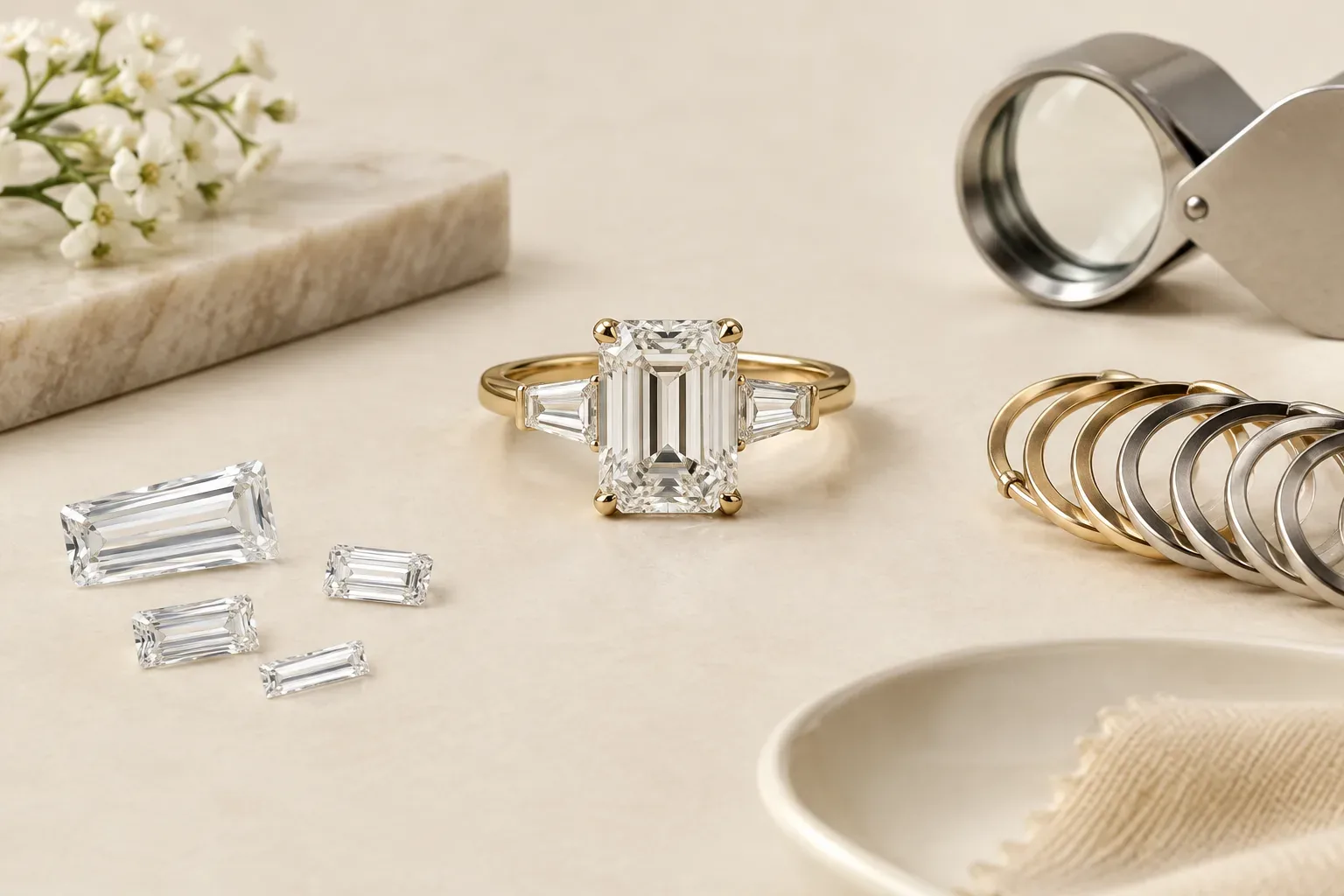
In jewelry terms, a baguette describes a rectangular, step-cut gemstone with straight facets that run parallel to the stone’s edges. Baguettes appear in straight (parallel sides) and tapered (narrower at one end) forms and are used either as primary center stones or as side stones that flank a round or fancy centre. Because the step cut emphasizes broad facets rather than scintillation, baguettes show clarity and color more directly than brilliant cuts do; that stylistic reality should guide decisions about proportion and setting.
Historical evidence and context
The aesthetic logic for straight-edged, geometric stones is often linked to twentieth-century modern movements. Trade commentary that examines contemporary taste traces geometric and linear preferences back to the Art Deco period of the 1920s–1930s in Western jewelry, where clean lines and symmetry were prominent, and notes how those formal choices continue to inform modern designs. Recent industry reporting also documents a continuing appetite for modern, geometric forms as part of current styling trends, which helps explain the baguette’s recurring popularity in engagement rings and bands.
Documented historical meanings versus modern interpretations
There is little reliable documentation that the baguette cut carried a singular symbolic meaning across cultures or periods. Historically, the use of step-cut rectangles has been more a matter of aesthetics and cutting technology than a codified symbol. Modern meanings attached to baguettes—such as associations with elegance, vintage references, or minimalist style—are contemporary, personal or market-driven interpretations rather than universal or historically documented symbols. Treat any symbolic claim as a personal or seller-provided interpretation unless supported by solid provenance from a museum catalogue or specialist study.
How the motif and motif variations appear in jewelry
Designers use baguette cuts in several roles: as side stones flanking a round, oval or emerald center; as tapered shoulders that visually extend a center stone toward the shank; as channel-set bands for low-profile eternity styles; or as a linear graduation in multi-stone rings and bracelets. Straight baguettes produce a crisp, parallel aesthetic that favors symmetry, while tapered baguettes direct the eye and can make a center stone read larger. Metal choice, setting height and the use of bezels or channel settings change how much of the finger the diamond’s visible surface actually covers, not just the gemstone’s nominal carat or millimeter measurements.
Sizing, finger coverage and proportion: practical decision criteria
Start by measuring the visible width of the finger where the ring will sit, not only the ring size number. A simple approach is to place a ribbon or tape across the finger pad at the intended wearing position and note the width; then compare that width visually against the planned stone’s length and the total top view of the ring. For narrow fingers, longer, narrower baguettes or tapered baguettes can create a lengthening effect. For wider fingers or shorter fingers you want to visually balance, choose wider stones, multiple baguettes, or a larger centre stone to increase coverage across the pad. Avoid choosing baguettes that are very short and wide on long, narrow fingers, because they can appear squat and out of proportion.
Practical trade-offs to weigh
Baguettes trade brilliance for clear facet definition. They tend to reveal inclusions and color more readily than brilliant cuts, so clarity and color grades matter more for visible appearance. Tapered baguettes are flattering for creating movement toward a centre stone, but they complicate re-sizing and repair because the stone’s geometry can be integral to the setting. Very low channel settings protect baguettes but can make cleaning harder and trap dirt, which dulls the step facets. Finally, because corners and edges are more exposed, baguettes can chip if not properly set or if worn roughly; choose more protective settings for an everyday engagement ring.
Care, durability and safe handling
Treat baguette stones as you would other faceted gems with attention to exposed corners. Settings with bezels or secure prongs reduce risk of chipping. Routine professional checks of prongs and channel walls are recommended, and insuring the ring or adding it to household insurance is a sound precaution. For gemstones that can be treated, the Gemological Institute of America cautions buyers about treatments, detectability and special care needs; ask whether the stone has been treated and follow any specific cleaning or temperature guidance from the seller. Avoid ultrasonic cleaning for certain treated or fragile stones unless a qualified jeweler confirms it is safe.
What you can and cannot verify without a lab or qualified jeweler
A consumer can visually assess how a baguette sits on the finger, the visual balance between stone and hand, setting security and whether the seller provides written disclosures and a return policy. However, you cannot reliably determine a gemstone’s natural origin, presence of specific treatments, or exact diamond grading without a qualified jeweler’s loupe examination and, for definitive answers, a gemological laboratory report. The Federal Trade Commission emphasizes the need for clear written distinctions among natural, lab-created, treated and imitation materials, so request seller disclosures and independent grading or identification reports for any important purchase.
Selection and gifting guidance (practical and respectful)
Begin a selection conversation by asking about everyday activities and hand use to match setting protection to lifestyle. If you’re buying as a gift without explicit style guidance, choose adaptable settings that accommodate resizing and future re-styling. Request written disclosures, ask for a grading report when buying a diamond, confirm the return policy and insurability, and prefer sellers who will document treatments and origin. If you want the ring to feel personal, consider engraving, a small accent that reflects a shared memory, or selecting a gemstone that is meaningful to the recipient. Respect privacy and surprise preferences: if size or detailed style are uncertain, a temporary or adjustable stand-in ring or an exchange-friendly policy preserves the sentiment without forcing a permanent choice.
Putting the guidance into practice
When you shop, bring a photo of the intended hand or have the person try on comparable shapes. Compare how straight versus tapered baguettes change the perceived width and length of the finger. Ask the seller to demonstrate how the ring looks from top view and profile. Insist on written disclosures for treatments and any lab reports. Prioritize setting security, and consider a slightly more conservative clarity grade for baguettes than you would for a brilliant cut of the same size because inclusions show more readily. Finally, plan for routine inspections and insurance if the ring will be worn daily.
Conclusion
Baguette cut engagement ring styling is a balance of geometry, proportion and practical durability. Use finger measurements and visual trials to choose length and width that flatter the wearer’s hand, select settings that protect edges, and insist on written disclosures and laboratory reports when they matter to authenticity and value. Modern taste trends and documentation around geometric forms explain why the baguette remains popular, but any symbolic meaning is personal rather than universally documented.
Frequently asked questions
Do baguette cuts make fingers look longer or shorter?
Baguette proportions affect perceived finger length: longer, narrower or tapered baguettes tend to create a lengthening effect on narrow fingers, while very short, wide baguettes can appear squat on long fingers. Visual trial and comparing top-view proportions against the visible finger width is the best test.
Are baguette diamonds less sparkly than round brilliants?
Yes. Step-cut baguettes emphasize broad facet planes and clarity over scintillation, so they show less brilliance than round brilliant cuts and reveal inclusions and color more readily.
What settings protect baguette stones best?
Bezel settings, secure prongs that protect corners, and channel settings for rows of baguettes offer better protection against chipping than exposed four-prong settings; however, channels can be harder to clean and may hide dirt, so balance protection with maintenance needs.
Can I tell if a baguette has been treated or is lab-created without a report?
No. The Gemological Institute of America and consumer protection guidance advise that treatments and origin typically require professional testing and written disclosure; ask the seller for lab reports and written statements rather than relying on visual inspection alone.
How should I care for a baguette-cut engagement ring daily?
Have settings checked routinely by a jeweler, avoid harsh impacts, clean according to the gem and setting type (and avoid ultrasonic cleaners for certain treated or fragile stones unless cleared), and insure the piece if it will be worn daily.
Sources and further reading
- Imaginaire Digital — Imaginaire Digital
- Jewelers Mutual — Jewelers Mutual
- Gemological Institute of America — Gemological Institute of America
- Federal Trade Commission — Federal Trade Commission