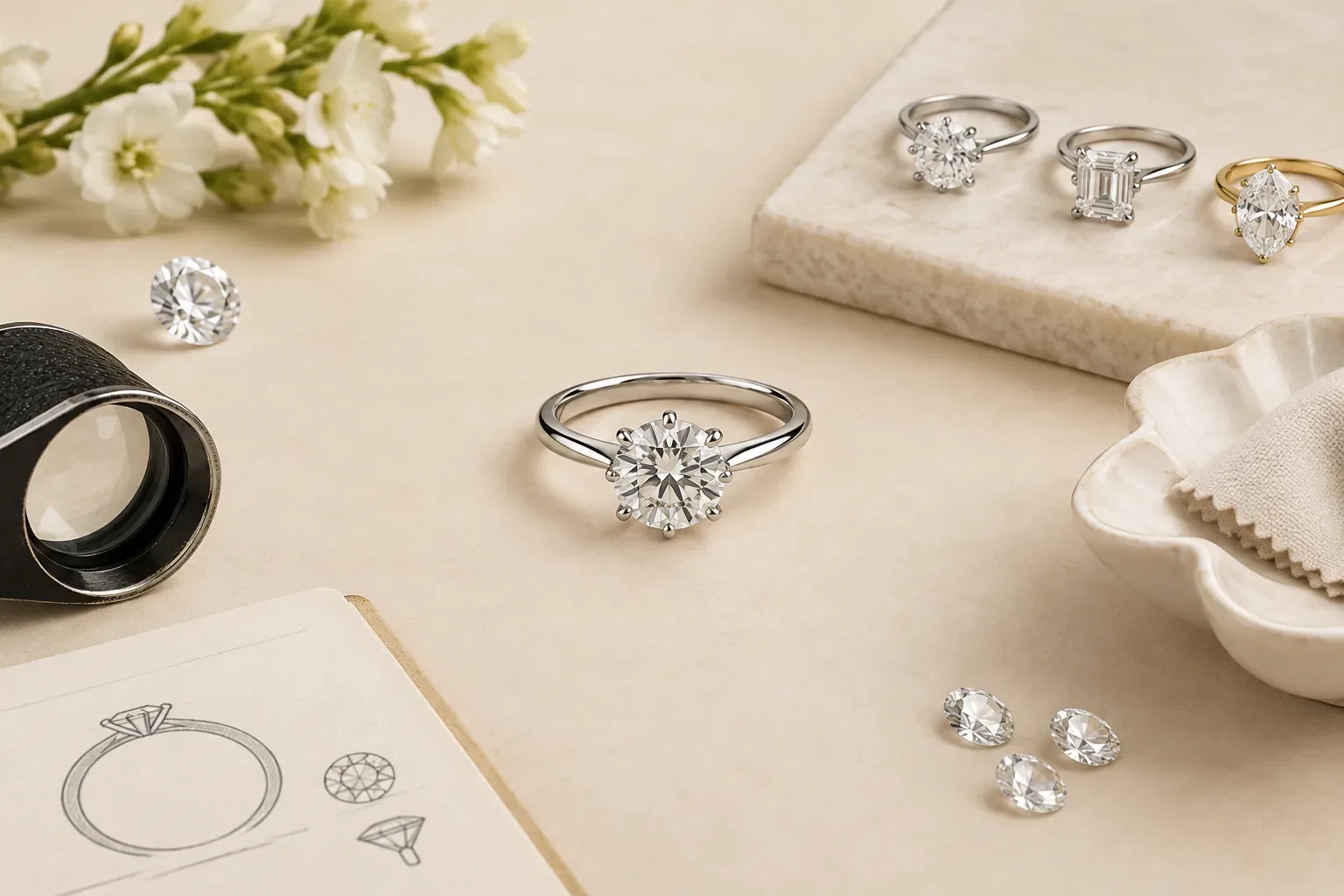
Meaning at a glance
A solitaire setting engagement ring features a single primary gemstone mounted to emphasize that stone; choose it for timeless simplicity, maximal light return, and easy pairing with other jewelry, but expect less surface detail, greater emphasis on the center stone’s quality, and the need to check disclosures for treatments or lab origin through a qualified jeweler or gem lab.
Quick answer
A solitaire setting engagement ring is defined by a single, central gemstone set alone on the band so the gem is the focal point. It suits shoppers who want simple, classic styling, maximum visual impact from one stone, easy matching with wedding bands, and a ring where the center gem’s quality matters more than metalwork. The primary trade-offs are that a solitaire emphasizes the cost and visible qualities of the center stone, offers fewer surface design elements for personalizing the ring, and requires careful verification of gemstone origin and treatments by a qualified jeweler or gemological laboratory.
What a solitaire setting is and why people choose it
The term solitaire in jewelry refers to a single main gemstone set alone on a ring band, without side stones or a heavily decorated head. As a visual concept it makes the stone itself the principal design element, so cut, clarity, color and carat (for diamonds) or analogous qualities for other gems determine the ring’s impact.
Shoppers choose solitaires for reasons including perceived timelessness, ease of pairing with wedding bands or stacked rings, and a preference for minimal metalwork that places emphasis on the gemstone. Contemporary industry reporting shows strong ongoing consumer demand for engagement rings and related categories; current market visibility and search demand remain high for engagement rings and classic stone-forward styles, reflecting sustained interest in single-stone settings (Imaginaire Digital).
Historical evidence and documentary limits
The approved sources provided for this guide do not offer a detailed historical chronology for the solitaire setting across ancient cultures. That means there is limited documented, source-backed evidence in this set about how single-stone rings were used in specific ancient societies or exact origin dates for the solitaire as a named style.
What the sources do document is contemporary market and consumer context and technical concerns that affect buyers today. Industry analysis from Imaginaire Digital and trend reporting from Jewelers Mutual describe active demand and stylistic directions in 2026 that include emphasis on craftsmanship, versatility and fluid or gender-neutral forms rather than detailed historical claims about origin. For questions about treatments, detectability and consumer protection, the Gemological Institute of America and the Federal Trade Commission provide a documented basis for today’s buyer protections and verification limits.
Documented historical meanings versus modern personal interpretations
Because the approved sources do not supply ancient cultural interpretations tied specifically to the solitary single-stone motif, any attribution of symbolic meaning to solitaires in historical societies should be treated as unverified here. In other words, there is no documented historical meaning in the present source set that links the solitaire specifically to a particular ritual or cultural belief.
Modern symbolic readings, by contrast, are widespread and personal. Today people commonly interpret a solitaire engagement ring as a sign of singular commitment, clarity of purpose, or minimalist taste. Those are contemporary, individual or cultural interpretations and not documented historic facts in the materials used for this guide. When assigning symbolic meaning, treat historical documentation and contemporary personal meanings separately and clearly.
How the solitaire motif appears in jewelry design
Designers present a solitaire primarily by how the single stone is mounted and how the metalwork supports or shows the gem. Typical mounting approaches include mounts that expose the stone to light, mounts that surround or protect the stone, and mounts that hold the stone by band pressure; each approach changes the ring’s profile, durability and the way light returns from the gem.
Solitaire rings are made in a wide range of metals and finishes and with center stones that can be diamonds, sapphires, emeralds, moissanite, lab-created gems or other materials. The single-stone format highlights the center stone’s attributes, so choices about shape, cut and proportions have more visible effect than they would on a design that uses multiple stones or heavy metal ornamentation.
Because a solitaire is generally less intricate in metalwork, it is often easier to pair with wedding bands, stacking rings or other jewelry. Industry observers note that modern buyers value versatility, craftsmanship and gender-neutral styling, and solitaire formats align with those preferences because they adapt readily to different combinations (Jewelers Mutual).
Decision criteria: what to check when buying a solitaire engagement ring
Center-stone quality matters most. In a solitaire the entire visual weight is on the center gem, so allocate budget and attention to the stone’s cut and proportions first, then color and clarity for diamonds, or the comparable quality factors for colored gemstones.
Ask for written disclosures. The Federal Trade Commission requires clear consumer information distinguishing natural, lab-created, treated, cultured and imitation materials and written seller disclosures. Request those disclosures in writing and review them before purchase.
Obtain independent verification when needed. For questions about a stone’s natural origin, treatments or durability you cannot confirm visually, rely on a qualified jeweler or a gemological laboratory. The Gemological Institute of America explains that treatments, disclosure and detectability create distinct consumer questions for gemstones; only proper testing by trained technicians and analytical equipment can confirm some characteristics definitively.
Think about lifestyle and durability. Some mounting styles expose a stone to knocks more than others; a shopper who uses their hands heavily or participates in rougher activities should balance light return against practical protection when choosing a mount and metal.
Consider future pairing and personal style. If matching or stacking rings is likely, select profiles and metal colors that pair well with likely future choices. If the solitaire is meant as a lifelong, everyday ring, simple profiles are often the easiest to maintain and insure.
Practical trade-offs and pros and cons
Pros: Solitaires deliver maximum focus on a single gemstone, often look larger for a given carat because the eye is not distracted by side stones, and are typically easier to resize or restore due to simpler metalwork. They also pair well with bands and adapt to changing fashions more readily because the design is understated.
Cons: A solitaire puts pressure on the buyer to spend more on the center stone to achieve a given visual impact, offers fewer opportunities for in-metal personalization such as engraving or side-stone patterning, and can show wear on the stone more readily because there is no surrounding decorative metalwork. Additionally, because the center stone is the main value element, verification of treatments and origin becomes especially important.
Care guidance and verification limits
Care depends on the center stone and the mount. For all gemstones, follow manufacturer and jeweler guidance for routine cleaning, and avoid chemical exposure that could harm certain stones or metal finishes. Because treatments affect durability and cleaning recommendations, ask about any treatments and follow the specific care instructions tied to those treatments.
Verification limits are important to understand before purchase. The Federal Trade Commission advises that consumers receive clear written information about whether a gemstone is natural, lab-created, treated or an imitation. For many questions about treatment detection and origin, only qualified gemological labs or certified professionals can provide definitive answers. The Gemological Institute of America documents that detectability, disclosure and special care concerns make laboratory testing necessary for some buyer questions. Expect to pay for independent grading or identification reports if you require laboratory-confirmed verification.
Who a solitaire setting suits best
A solitaire suits someone who prefers clarity of design, wants a ring that highlights a single stone, or plans to stack or pair the engagement ring with other bands. It also suits buyers who value the ability to re-set the center stone later, since a clear single-stone ring simplifies re-mounting.
Solitaire settings may be less appropriate for shoppers who want elaborate metalwork as the primary aesthetic, those who prefer the perceived added security or visual complexity of side stones, or anyone for whom the budget must be spread across decorative elements as well as the center gem.
Practical buying checklist
Before you buy, confirm the written disclosures about the gemstone’s type and any treatments, ask whether a grading report or identification from a recognized laboratory is available, and get a clear return or adjustment policy. Compare how different mounts change wearability and light performance, and consider whether you will want to stack or pair the ring with other jewelry.
If certification matters, budget for an independent gem lab report and arrange for it through the seller or a trusted independent lab. For consumer protection and to resolve later disputes, keep all paperwork, invoices and disclosures together and photograph the ring from multiple angles when you receive it.
Frequently asked questions
What is a solitaire setting engagement ring?
A solitaire setting engagement ring features one central gemstone set alone on the band so the stone is the visual focus. The term describes the single-stone format rather than a specific mount or metal.
What are the main advantages of a solitaire setting?
Main advantages include a clear emphasis on the center stone, easier pairing with wedding bands, a generally timeless look and often simpler maintenance and resizing compared with heavily decorated rings.
What are common downsides or trade-offs?
Downsides are that the buyer must allocate more of the budget to the center stone to achieve a given impact, there are fewer design details in the metal for personalization, and verification of treatments or origin is particularly important because the value centers on one gem.
How can I verify whether a stone is natural, lab-created or treated?
Request written disclosures from the seller and, for definitive answers, obtain testing from a qualified jeweler or a recognized gemological laboratory. The Federal Trade Commission requires clear disclosure and the Gemological Institute of America explains that some treatment detection and origin questions require laboratory testing.
Does a solitaire setting suit everyone?
No. A solitaire suits people who prefer minimalist or stone-forward design and those who plan to pair the ring with other bands. It may be less suitable for shoppers who want ornate metalwork or who prefer a ring that visually reads as composed of multiple stones.
How should I care for a solitaire engagement ring?
Care depends on the center stone and treatment. Follow the jeweler’s care instructions and avoid chemicals or impacts that could damage the gem or setting. Ask specifically about any treatments because treated gems can require particular cleaning precautions, as noted by the Gemological Institute of America.
Sources and further reading
- Imaginaire Digital — Imaginaire Digital
- Jewelers Mutual — Jewelers Mutual
- Gemological Institute of America — Gemological Institute of America
- Federal Trade Commission — Federal Trade Commission