Meaning at a glance
This guide answers how to pair a baguette-cut ring with a wedding band by defining pairing goals, explaining the evidence-led decision criteria (shape alignment, gap management, and metal selection), outlining practical trade-offs and care, and clarifying what a shopper can verify without a qualified jeweler or gemological laboratory.
What we mean by ‘baguette cut’ and pairing intent
In this guide, ‘baguette cut wedding band pairing’ refers to the design and technical choices involved in combining a ring set where a center or side stone is a baguette-shaped gem and a wedding band is worn adjacent to it. Pairing intent varies: some shoppers aim for a seamless, continuous line; others want contrast or the ability to stack multiple bands. The guidance below focuses on practical, verifiable choices and the trade-offs implied by each approach.
Historical evidence and cultural context
Approved contemporary sources for this topic focus on modern consumer behavior and gem-related disclosure rather than on deep historical symbolic meanings for the baguette shape. Industry reports and trade guidance emphasize current stylistic trends and buyer concerns related to cut, settings, and materials rather than claiming any single historical cultural meaning for the baguette cut.
Jewelers Mutual documents that current demand emphasizes fluid forms, modern stacking, colored gemstones, craftsmanship and gender-neutral styling, which helps explain why baguette stones are often treated as a modern, architectural element in ring design. Imaginaire Digital’s 2026 search analysis shows strong modern consumer interest in engagement and wedding styles that include geometric and contemporary shapes, which supports treating baguette pairing as a current design decision rather than an inherited cultural symbol.
Documented historical meanings versus modern personal interpretation
There is no approved source in this set that attributes a documented pre-modern cultural symbolism uniquely to the baguette cut. Where historical symbolism exists for rings or specific gemstones, those claims are separate and should be supported by specialist historical sources. For the baguette cut specifically, available evidence treats it as a stylistic and technical choice in modern jewelry-making rather than a symbol with a widely documented cultural lineage.
That absence of historical attribution leaves room for modern personal interpretation. Many wearers today assign their own meanings—such as minimalism, architectural elegance, or continuity—based on personal taste. Distinguish these subjective meanings from documented trade or consumer evidence: the former are legitimate personal narratives, the latter are verifiable trends and disclosures noted by industry and regulatory sources.
How the motif and setting appear in jewelry
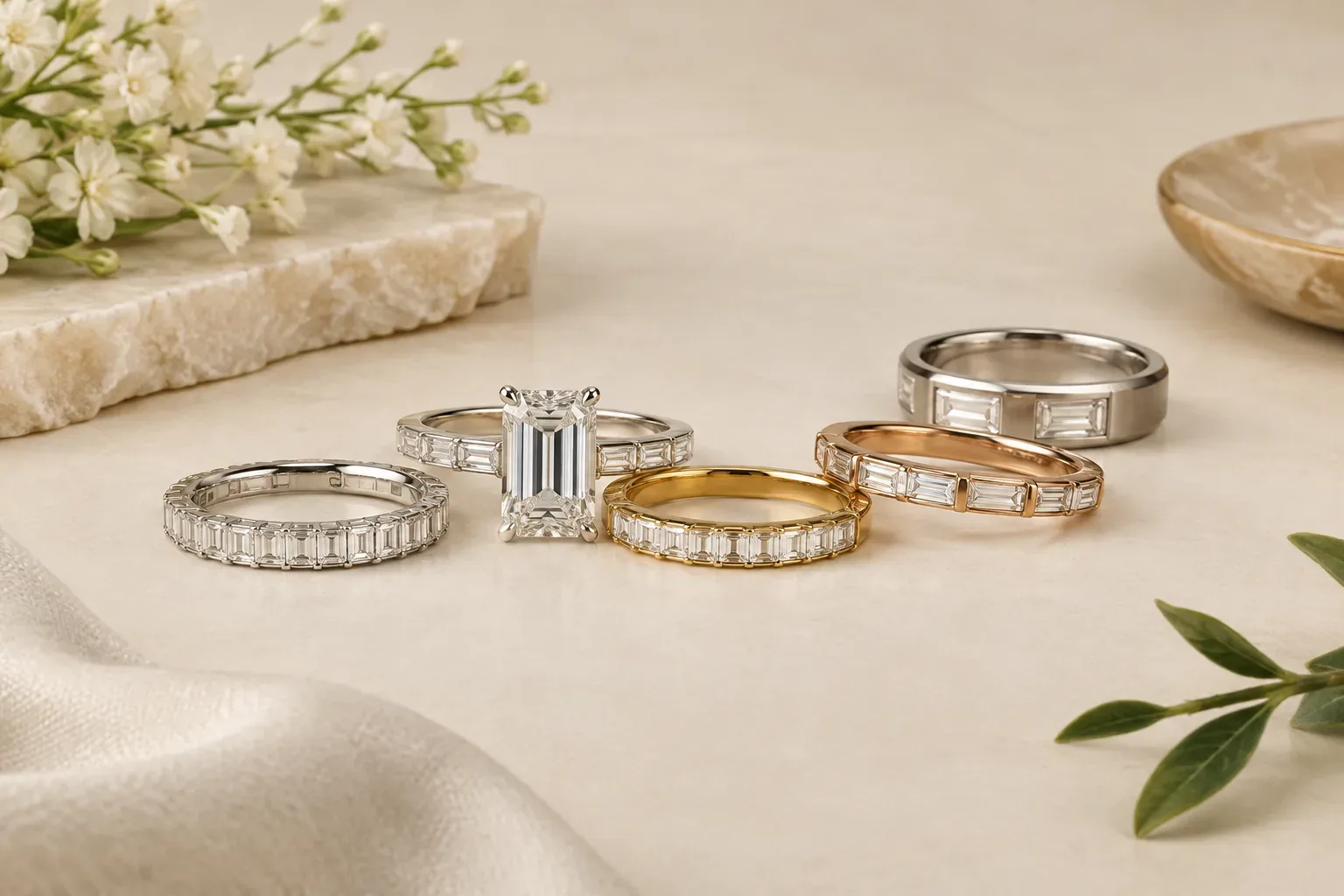
Baguette-cut stones are used as center stones, side stones, or accent stones and are commonly set with channels, bezels, or low prongs to protect their corners. Designers also use tapered baguettes to form graduating shoulders beside a round or oval center stone. The linear profile of straight baguettes lends itself to settings intended to sit closely against a partner band, while tapered baguettes naturally create a small triangular gap unless the band is specifically shaped to fill it.
Because baguettes are step-cut and emphasize clean facets and linear geometry, many rings pair them with straight bands to maintain that architectural look, but some buyers choose contrast—for example, a textured or rounded band to soften the angularity. Market trends documented by industry sources show a strong consumer interest in stacking and modern, versatile styling, which is why many contemporary rings are designed to pair well with multiple band shapes.
Decision criteria: shape, gap, and metal choices
Shape: First identify whether the baguette is straight-sided or tapered. Straight baguettes are simplest to pair with a straight, flat-profile band; tapered baguettes may require a custom-shaped band or a tapered companion to avoid visible gaps. If the baguette sits low in the setting, a low-profile band will be more comfortable and less prone to catching.
Gap: Decide whether you want a flush look or a deliberate gap for contrast or stacking. A flush look usually requires a channel or bar setting and precise sizing so that the mate band registers against the baguette line. A deliberate gap makes cleaning easier and can protect vulnerable baguette corners, but it changes the visual continuity and may allow dirt to collect between rings.
Metal choices: Match metal color and hardness considerations to the lifestyle of the wearer. Platinum is durable and hypoallergenic and is often recommended to protect settings for small step-cut stones, but it is heavier and more costly. Yellow and rose gold show scratches differently than white metals and can warm or cool the perceived color of diamonds or colored gemstones. White gold is a common pairing choice for modern white-metal looks, but remember it may need periodic rhodium plating to maintain its bright white finish. Choose metals that align with the wearer’s everyday activity and the level of maintenance they are willing to accept.
Practical trade-offs and what you can verify
Trade-offs are inevitable. A perfectly flush pairing usually requires either a factory-matched set or a custom jeweler’s adjustment; it can limit future resizing options. A gap protects stones and allows more flexibility for later modification but sacrifices the continuous-line aesthetic. Metal choices involve trade-offs between durability, color, cost and maintenance.
What a shopper can verify without specialized equipment: you can inspect how tightly two rings sit together by trying them on, check for surface matching of metal color and polish, and request seller disclosure about gemstone origin, treatments and whether the item comes with a gemological report. What requires a qualified jeweler or gemological laboratory: identification of treatments that are not self-evident, verification of natural versus lab-created origin for diamonds and colored stones, and precise assessments of stone durability or structural integrity. GIA explains that treatments and detectability raise distinct consumer questions, while the FTC recommends clear written disclosure for natural, lab-created, treated or imitation materials.
Care guidance
Because baguette stones commonly have straight edges and visible corners, avoid settings and band pairings that produce friction or repeated impact at those corners. Remove rings for heavy manual work and for activities that produce dust and grit, which can collect in gaps and channels. Routine cleaning is usually safe with warm water, mild dish soap and a soft brush, but always confirm with the seller whether specific stones or treatments require bespoke care.
For long-term appearance, consider the maintenance needs of the metal. Platinum requires occasional polishing to address surface patina, while white gold may require periodic rhodium re-plating to maintain a bright finish. Insure higher-value rings and get written documentation about any treatments or enhancements; Jewelers Mutual highlights modern consumer preferences for quality craftsmanship and versatile styling and can be a resource for discussing insurance and repair needs with a professional.
Selection and gifting guidance
If you are shopping as a couple, try rings together so you can see the fit and gap in person and assess comfort. If buying as a gift, gather sizing clues and, when possible, request an exchange policy or a slight allowance for resizing. Ask the seller for written disclosures about gemstones, including any treatment history and whether a gemological report accompanies the stones, because the FTC expects those distinctions to be made clear to consumers.
When gifting, consider the recipient’s routine and style: choose a metal that matches other jewelry they frequently wear and a band profile that suits their daily activities. If you want a truly seamless match, consider ordering a matched set or commissioning a jeweler to make a companion band. For budget-conscious shoppers, a polished decision is to prioritize matching color and profile first and defer custom work until a later anniversary when a bespoke stacking band may be added.
Final notes and limits to claims
This guide focuses on practical pairing choices and what the available industry and regulatory sources document about modern trends, consumer needs and disclosure. It does not attribute a universal cultural meaning to the baguette shape because the approved evidence set describes contemporary consumer behavior rather than historic cultural symbolism for this cut. For any technical verification—such as identifying treatment types or confirming natural versus lab-created origin—obtain written lab reports from a recognized gemological laboratory and consult a qualified jeweler for sizing and custom fitting.
Frequently asked questions
Can I resize a wedding band to fit flush with a baguette ring?
Often yes, but it depends on the band’s construction and the baguette setting. Resizing can alter fit and may change the flush relationship; matched sets or custom companion bands are the most reliable way to achieve a perfect flush. For structural or sizing limits and to avoid damaging small stones, consult a qualified jeweler.
Does the metal need to match between the baguette ring and the wedding band?
Matching metal color and finish gives the most seamless appearance, but different metals can create attractive contrast and allow for easier repair or resizing later. Consider the wearer’s allergy profile, maintenance willingness and existing jewelry wardrobe when choosing metals.
How can I verify whether a baguette stone has been treated or is lab-created?
Ask the seller for written disclosure and any accompanying laboratory report. Treatments or lab-grown origins are often detectable only with gemological testing, so a gemological laboratory report is the definitive verification tool. The FTC recommends clear written disclosure about these distinctions.
Is a gap between rings bad for the stones?
A small intentional gap can protect baguette corners from friction and impact and makes cleaning easier. However, larger gaps may trap dirt in channels. Choose the gap size based on comfort, cleaning habits and the level of protection you want for the stones.
What maintenance do different metals require when pairing rings?
Platinum resists wear but develops a patina and may need periodic polishing; white gold may need periodic rhodium re-plating to maintain brightness; yellow and rose gold show scratches differently and can be polished. Maintenance frequency depends on lifestyle; discuss expected care with your jeweler.
Sources and further reading
- Imaginaire Digital — Imaginaire Digital
- Jewelers Mutual — Jewelers Mutual
- Gemological Institute of America — Gemological Institute of America
- Federal Trade Commission — Federal Trade Commission