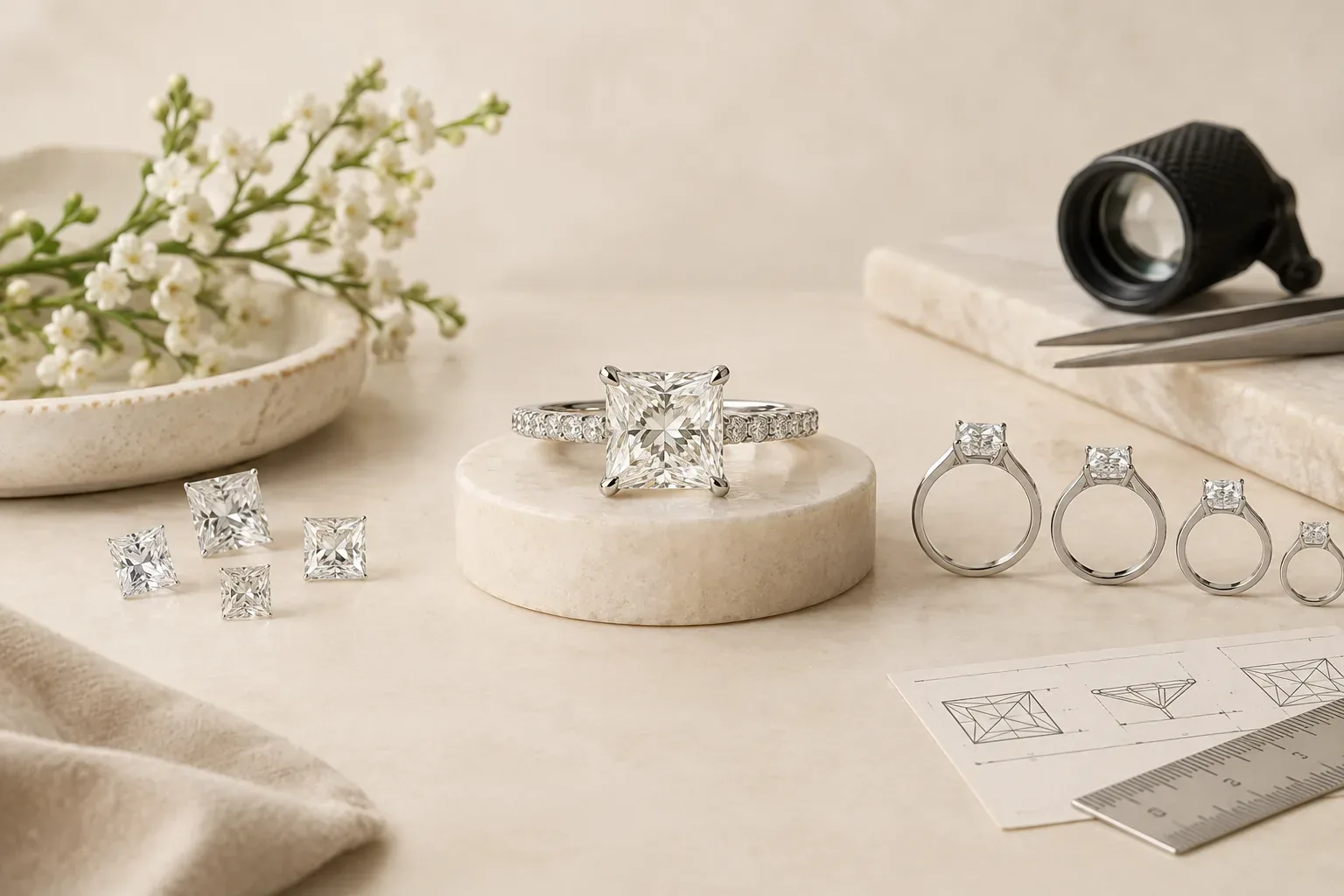
Meaning at a glance
Princess cut engagement ring styling is about choosing a princess-cut center and setting that balance visible finger coverage, durability and personal style; make proportion decisions by comparing stone face to finger width and shank thickness, weigh trade-offs between brilliance and protection, follow care guidance for treated or non-standard gems, and rely on a qualified jeweler or gemological laboratory to verify origin, treatments or exact grading.
Quick answer
Princess cut engagement ring styling means selecting the square-profile princess-cut center and matching setting and band so the visible stone face, shank width and setting height look balanced on the wearer’s finger, while accounting for durability and disclosure limits; practical decisions include comparing the stone’s face size to finger width, choosing protective settings if the wearer is active, and getting treatment, origin or grading verified only by a qualified jeweler or gemological laboratory.
What we mean by 'princess cut engagement ring styling'
In this guide the phrase refers to the combined choices that determine how a princess-cut center appears on a specific hand: the cut and proportions of the stone (face-up size and depth), the setting type (solitaire, halo, bezel, three-stone, channel-set shoulders), shank width and profile, and the overall silhouette created by those choices. Styling covers both aesthetic goals—such as a bold, square focal point versus a compact, low-profile look—and functional trade-offs like facet visibility, protection for vulnerable corners, and how the ring stacks with wedding bands or other rings.
Historical evidence and cultural context (what the sources document)
The approved evidence for this article does not offer a documented historical narrative for the princess cut tied to a particular culture or historical period. Contemporary industry sources used here focus on present-day consumer trends and buyer concerns rather than pre-modern symbolism or cultural origin stories.
Imaginaire Digital’s 2026 visibility report documents where consumer search demand is concentrated in the modern UK market and shows strong interest in engagement rings as a category, while Jewelers Mutual’s 2026 trends overview describes present-day styling priorities such as fluid forms, modern stacking and versatility. These sources therefore support statements about current consumer behavior and styling preferences, not ancient or regional traditions associated with square cuts or modern cuts.
Because there is no verified historical claim about the princess cut in these sources, this guide separates documented contemporary trends from modern personal interpretation rather than asserting historic cultural meanings that the provided evidence does not confirm.
Documented meanings versus modern personal interpretation
Documented meanings in the available evidence relate to how the market and consumers treat engagement rings today: buyers value versatility, clean modern lines and stackability, and they seek clear disclosures about treatments and origins because of consumer-protection guidance. Those contemporary priorities are supported by the Jewelers Mutual and Imaginaire Digital material used for this piece.
By contrast, any symbolic or emotional meaning attributed to the princess cut—such as 'modernity', 'strength', or 'a square’s perceived solidity'—is a personal or cultural interpretation, not a documented universal meaning in the provided sources. Different wearers and cultures may read different significance into shape and style; styling should begin with the recipient’s preferences rather than assumed symbolism.
How the princess cut appears in jewelry (motif, settings, and motifs in practice)
In modern jewelry the princess cut is presented in several common settings that affect finger coverage and proportion. Solitaires highlight the stone face and appear larger when set with minimal metal around the table. Halo settings surround the square face with smaller stones, increasing perceived size but adding visual complexity that changes how much of the wearer’s finger is visually covered by the center. Bezel and partial-bezel settings wrap metal around corners to protect the square corners; this reduces visible face area slightly but increases durability.
Shank choices also change perceived proportion. A narrow, tapered shank keeps attention on the stone and can make a smaller princess cut look larger by contrast, while a wider shank balances bigger stones and provides structural support. Pavé or channel shoulders add sparkle and visual mass at the band, which can change the apparent finger coverage even when the center stone stays the same size.
Stacking and pairing matter: a low-profile setting and matching wedding band will sit more flush and show continuous coverage across the finger, while a higher setting or pronounced basket will create vertical separation and can appear to reduce lateral coverage.
Proportion and finger coverage: how to decide
Begin visually: compare the face of the princess-cut stone to the width of the intended finger where the ring will sit. A stone that spans a significant portion of the visible top of the finger reads as high coverage; a smaller face with a wider shank reads as more band-focused. Decide whether the focal point should be the center stone’s full face or the overall ring silhouette that includes the shank and shoulders.
Consider hand and finger proportions rather than a single universal rule. Longer fingers may carry a wider or taller setting without appearing bulky; shorter fingers often look more balanced with lower profiles and moderate face sizes. The relationship between face size and shank thickness is important: a large face on a very narrow shank can look top-heavy, while a very wide shank with a small face can make the stone appear undersized.
Weigh functional trade-offs. Settings that show more of the stone face—open prongs and high baskets—maximize perceived size and brilliance but expose corners and increase snag risk. Protective choices like bezels or lowered crowns sacrifice a fraction of face-up surface for corner protection and everyday practicality.
Practical selection and gifting guidance
Start by clarifying three priorities with the recipient or your own preferences: visual impact (maximum face-up appearance), daily wear practicality (protection and low profile), and stackability (how the ring will pair with others). Budget constraints will shift those priorities—halos and accent stones increase perceived coverage for a given center size but add cost.
Ask sellers for specific, verifiable information. The Federal Trade Commission advises that consumers should be given clear distinctions among natural, lab-created, treated, cultured and imitation materials and written disclosures about them. Request written confirmation about whether a diamond or gemstone is natural or lab-created and whether it has received any treatments that affect durability or value.
Use the gemstone treatment guidance from the Gemological Institute of America to inform follow-up questions about detectability and special care. For example, some treatments alter durability or require different cleaning approaches; these should be disclosed by the seller and, if necessary, described in care instructions.
When gifting, prioritize a try-on if possible: the same face-up diameter can read very differently on different hands and in different settings. If a try-on is not possible, request precise measurements (face-up diameter or millimeter dimensions for non-round stones) and photos on a model hand or comparison images, and confirm an exchange or resizing policy before purchase.
Care, verification, and limits without experts
Routine care recommendations should consider whether a stone or accent diamonds have been treated. The GIA’s guidance on treatments highlights that detectability, durability and disclosure matter; ask sellers for documentation about any treatments and follow any specialized care instructions those treatments require. General cleaning can usually be done gently with mild soap and water and a soft brush for settings that are not fragile or treated, but follow the seller’s guidance when treatments or softer gemstones are involved.
Critically, certain facts cannot be reliably verified by a buyer alone. The FTC and GIA make clear that origin (natural versus lab-grown), treatment history, and precise grading claims require either vendor documentation from a reputable seller or laboratory reports from recognized gemological laboratories and verification by a qualified jeweler. Ask for lab reports for high-value stones and know that only an independent gemological laboratory or a qualified jeweler using appropriate testing equipment can confirm many technical attributes.
Consider protections beyond routine care. Because modern consumers value durability and versatility, think about insurance and professional inspections for prong integrity and stone security, and discuss routine servicing with the seller or a local jeweler to maintain proportion and fit over time.
Putting it together: a styling checklist
Visually compare stone face to finger width, decide where you want emphasis (stone face or band silhouette), choose a setting that matches that emphasis while balancing protection, request and read written disclosures about treatments and origin, and plan for professional verification for anything that affects value or long-term care. If you prioritize everyday wear and low maintenance, favor protective settings and slightly smaller face-up proportions; if you prioritize maximal visual coverage, choose open settings and consider halo treatments that increase apparent size without dramatically increasing center-carat cost.
Frequently asked questions
How do I know what face size will look good on a particular finger?
Visually compare the face-up surface of the princess cut to the width of the finger where the ring will sit; consider whether you want the stone to dominate the top of the finger or to be part of the overall band silhouette. If unsure, arrange a try-on or request photos of the exact ring on a model hand and confirm an exchange policy before buying.
Does a halo make a princess cut look bigger?
Yes, a halo of smaller stones around a princess-cut center typically increases perceived size and visual coverage without increasing the center stone’s carat weight, but it changes the ring’s style and may raise the overall maintenance needs.
Are princess-cut corners vulnerable and how can I protect them?
Square or pointed corners can catch or chip more easily than rounded stones; protective options include bezel or partial bezel settings, corner prongs, or lower-profile settings that reduce exposure while slightly reducing the visible face area.
What can I verify myself and what requires a jeweler or laboratory?
You can verify written seller disclosures, return and resizing policies, and visible dimensions or photos. Origin, treatment history, and formal grading require testing and documentation from a qualified jeweler or an independent gemological laboratory, as noted by the Federal Trade Commission and GIA.
How should I care for a princess cut engagement ring?
Follow the seller’s care instructions, especially if treatments are disclosed; in general, gently clean with mild soap and water and a soft brush for durable stones and settings, avoid harsh chemicals, and have prongs and settings inspected periodically by a jeweler.
Should I prioritize setting protection or maximum sparkle?
That depends on lifestyle: prioritize protection and a lower profile for daily, active wear or jobs that expose the hands; prioritize open settings for maximum face-up brilliance if the wearer prefers showpiece styling and is comfortable with extra care.
Sources and further reading
- Imaginaire Digital — Imaginaire Digital
- Jewelers Mutual — Jewelers Mutual
- Gemological Institute of America — Gemological Institute of America
- Federal Trade Commission — Federal Trade Commission