Meaning at a glance
Pairing a wedding band with a princess cut engagement ring is a practical choice that depends on the ring’s shoulder shape, whether you want a flush or stacked look, the metal match you prefer, and how much gap you will accept; this guide gives decision criteria, trade-offs, care tips, and what requires a jeweler or lab to verify.
What the evidence covers (and what it does not)
The approved trade and consumer sources cited below document modern market trends, concerns about treatments and disclosure, and consumers’ interest in stacking and gender-neutral styling. They do not provide a detailed archaeological or pre-modern cultural history of specific modern cuts such as the princess cut. Accordingly, this guide treats the princess cut pairing question as a contemporary design and consumer-choice issue in the late 20th and early 21st century marketplace rather than a problem with deep, specific cultural precedent.
Imaginaire Digital’s 2026 UK search analysis shows strong contemporary demand for engagement rings and related search categories, which frames the princess cut pairing question as an active, modern retail concern. Jewelers Mutual’s 2026 trends report documents market interest in fluid forms, stacking and versatility—consumer behaviors that directly shape how people pair wedding bands with engagement rings today. For information about gemstone treatments, disclosure and what can be verified, the Gemological Institute of America and the U.S. Federal Trade Commission are the authoritative references cited here.
Documented history versus modern personal interpretation
Documented history in the approved sources concerns modern retail trends and consumer protections. Imaginaire Digital and Jewelers Mutual describe patterns in 21st-century consumer behavior; they do not claim historical symbolic meanings for particular modern cuts. Any claim that a princess cut has a specific ancient cultural meaning should be treated as a modern interpretation unless supported by primary historical scholarship.
Modern personal interpretations—that is, what wearers mean now when they choose a princess cut and a particular band—are legitimate and varied. Contemporary meanings often reflect a wearer’s aesthetic preference, values (such as modern minimalism or vintage-inspired geometry), and practical needs (durability, ability to stack). Those personal meanings are real for the individuals who choose them but should be distinguished from documented historical symbolism.
How the motif, gemstone and tradition appear in jewelry
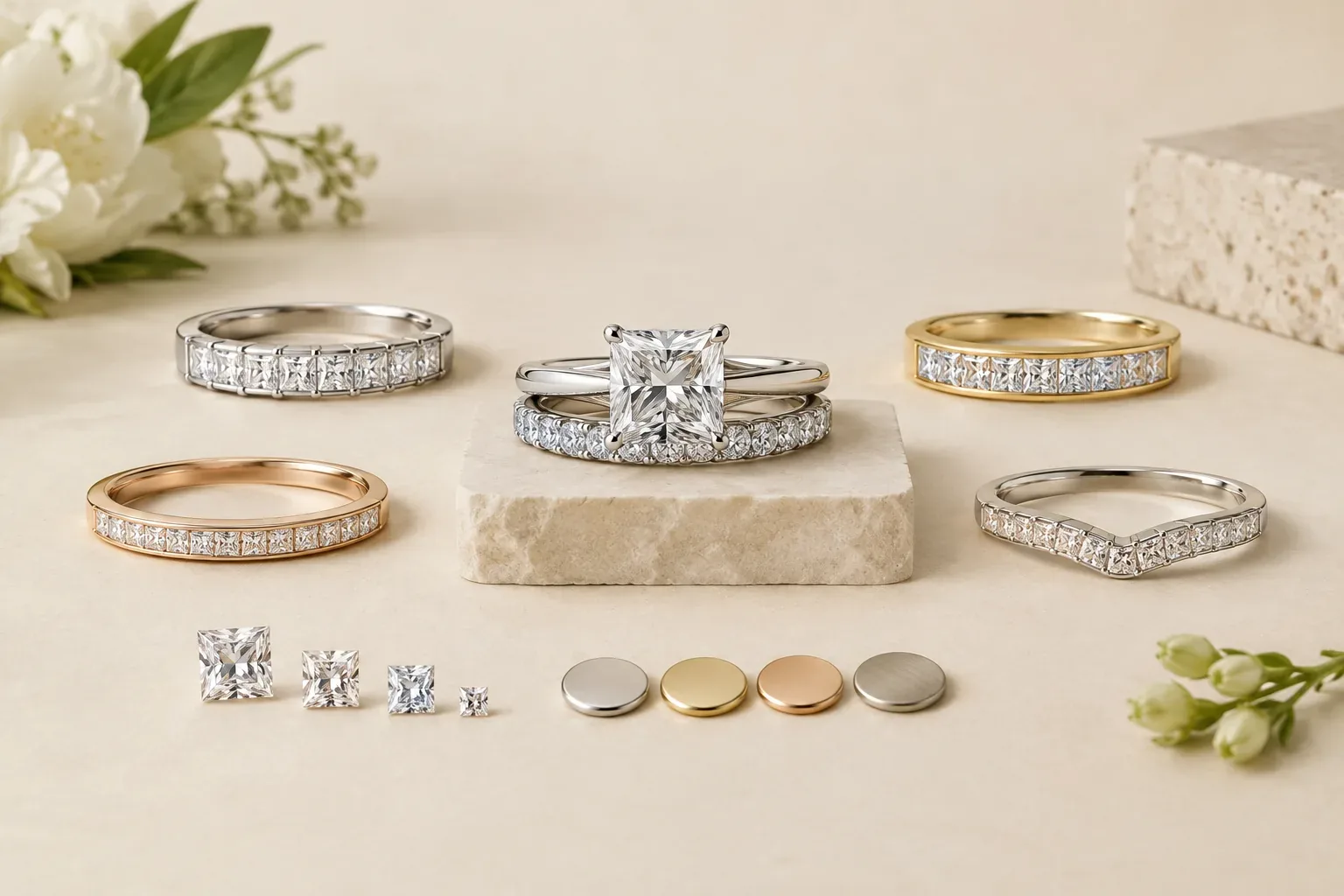
The princess cut is a square or rectangular brilliant-cut faceted center stone commonly set with four or more corner prongs. In modern jewelry practice, the diamond or colored center is often paired with bands designed to either complement its squared silhouette or to contrast it with rounded forms for a layered look. The forms most relevant to pairing are straight bands, contoured/notched bands that follow the ring’s profile, and bands with built-in settings such as channel or bar settings that continue the center stone’s geometry.
Traditions relevant to pairing are contemporary retail conventions: matching metal for continuity, using a wedding band to echo or frame the engagement stone, and designing for future stacking. Jewelers Mutual’s 2026 trend guidance emphasizes modern stacking and versatility, which is why many new rings are sold with matching or complementary band options. Designers will often offer a matched band or suggest a contoured service band when you purchase a princess cut engagement ring.
Shape and gap: practical decision criteria
Start by assessing the engagement ring’s shoulder profile. A princess cut with square, stepped shoulders is easiest to pair with a band that has a matching contour or a slight notch. A tapered or rounded shoulder will usually create a small visible gap with a straight band unless the band is contoured.
Decide how much gap you will accept. If you want zero visible space between rings (a flush or stacked look), choose a custom contoured band or a band that is specifically made to sit under the engagement ring’s setting. If you accept a thin shadow line between the rings, a straight band of the same width or a slim milgrain band can be an attractive, lower-cost option.
Consider long-term maintenance. A perfectly flush pairing can trap dirt and require more frequent cleaning. A tiny visible gap improves airflow and sometimes makes cleaning easier; it can also reduce unwanted contact between prongs and the band.
Metal choices: aesthetics, wear and trade-offs
Match metal for a cohesive look or choose contrast for a contemporary, mixed-metal style. Matching the engagement ring’s metal creates visual continuity and makes repair and resizing timelines simpler because the jeweler can work with one alloy. Contrasting metals—such as a yellow gold band with a white gold or platinum engagement ring—are a deliberate stylistic choice that communicates a layered, eclectic aesthetic and aligns with 2026 trend interest in colored metals and gender-neutral styling noted by Jewelers Mutual.
Consider durability. Platinum is more resistant to surface wear and is often recommended for settings because it displaces metal rather than losing it when it is scratched, but it can develop a patina that some wearers like and others do not. Higher-carat yellow and rose gold are softer and will show wear faster. If your lifestyle is physically active or involves frequent hand work, prioritize harder alloys or choose channel-set bands where the stones are better protected.
Width matters. A wider band minimizes perceived gap and balances a larger princess cut, while a slim band emphasizes the center stone. Width choices are a visual trade-off and also affect comfort and sizing; wider bands fit more snugly and may require a slightly larger finger size.
Setting styles that work with princess cuts
Channel-set and bar-set diamond bands mirror the geometric economy of the princess cut and reduce snagging because the stones sit inside metal channels. This style pairs well where you want sparkle with a neat profile. Pavé and bead-set bands provide lots of surface sparkle but can create texture differences and may not sit perfectly flush against squared shoulders unless the pavé channel is interrupted by a contour.
Contoured or notched plain metal bands are the classic solution for eliminating gaps with square-shouldered rings. If you plan multiple stacking bands in the future, consider buying an engagement ring plus a matched band and reserving the option for additional straight or curved stacks later.
Practical selection and gifting guidance
Measure first. Never buy a second ring to pair with a princess cut without knowing the engagement ring’s exact profile and width. If you can, bring the engagement ring to the jeweler. If you are gifting a matching band and do not have access to the engagement ring, choose a returnable option and keep the receipt.
Ask for matching options. Many jewelers will offer a factory-made matched band or create a custom contoured band. A matched band will reduce uncertainty about gap and width. Custom options add cost but are appropriate when zero-gap pairing is important.
Consider lifestyle and future plans. If the wearer prefers low-maintenance jewelry, choose protected settings (channel, bezel, or bar) and harder metals like platinum or lower-karat white gold alloys. If you expect resizing in the future, discuss alloy limitations—platinum requires different resizing techniques and can be more expensive to alter.
Respect personal meaning. Compliment the recipient’s style: if they regularly wear mixed metals, a contrasting metal band can be a thoughtful choice. If they prefer traditional uniformity, matching metal and finish will be appreciated.
Care, maintenance and verification limits
Care: For everyday wear, clean paired rings regularly with a mild, non-abrasive soap and warm water, and use a soft brush to remove dirt from under stones and between a flush pair of rings. Avoid harsh chemicals and ultrasonic cleaners for certain treatments or fragile settings—consult the jeweler or the gemstone’s treatment guide first.
Maintenance: Bands and settings require periodic inspection—prongs can loosen and channels can develop wear. If you have a flush or contoured fit, ask your jeweler to check for stress where metal elements contact one another since very tight fits can transfer wear.
Verification limits: A shopper cannot reliably verify gemstone treatments, origin, or lab-grown status by sight alone. For questions about treatments, disclosure, or origin, rely on written seller disclosures and, for definitive answers, request a report from a qualified gemological laboratory. The Gemological Institute of America explains the limits of detectability and the importance of disclosure for treatments, and the U.S. Federal Trade Commission requires clear distinctions among natural, lab-created and treated materials in written disclosures.
When to consult a qualified jeweler or a gemological laboratory
Consult a qualified jeweler when you need a custom contour, a secure set for frequent wear, or resizing guidance. A trained bench jeweler can create notches and test fit different band geometries on the actual engagement ring.
Consult a gemological laboratory when you need an authoritative verification of gemstone identity, origin, treatments, or a grading report for insurance. Routine shop-level tests can identify common treatments and synthetic materials, but only a formal laboratory report will provide the level of assurance required for high-value insurance or resale.
Trade-offs summed up
Choosing a contoured band or matched set minimizes visual gaps and is best when you want a clean, intentional look; the trade-offs include higher cost and potentially more maintenance where metals meet. Choosing straight bands or mixed metals offers lower cost and flexibility for stacking, but you will likely accept a visible gap or shape mismatch. Prioritize what matters—appearance, durability, maintenance and the ability to verify gem details—then use the practical checks outlined here to make a confident purchase or gift.
Frequently asked questions
Will a princess cut engagement ring sit flush with a straight wedding band?
Not always. A straight wedding band will sit flush only if the engagement ring has straight, square shoulders and the band width matches. For square-shouldered settings you can often get a near-flush fit, but for tapered or rounded shoulders a contoured or notched band is usually required to eliminate gaps.
Is it better to match metals between the princess cut ring and the wedding band?
Matching metals creates a cohesive look and simplifies repairs and resizing. Contrasting metals are a deliberate style choice and align with modern stacking trends, but they can highlight differences in wear and patina. Choose based on the wearer’s style and lifestyle considerations.
Can I verify whether a diamond is treated or lab-created at home?
No. Visual inspection cannot reliably determine treatments or lab-grown status. For disclosure and baseline information rely on the seller’s written statements; for definitive verification, request testing by a qualified gemological laboratory as recommended by the Gemological Institute of America and the Federal Trade Commission.
What setting styles reduce snagging and protect side stones?
Channel-set and bar-set bands provide good protection because the stones sit inside metal channels. Bezel settings also protect stones but offer a different aesthetic. Pavé and shared-prong settings provide sparkle but have more exposed stone edges that can snag.
How often should paired rings be inspected?
Have a qualified jeweler inspect prongs, channels and the band profile at least once a year, or more often if the wearer uses their hands heavily. Tight, flush pairings may need closer attention because contact areas can show accelerated wear.
Sources and further reading
- Imaginaire Digital — Imaginaire Digital
- Jewelers Mutual — Jewelers Mutual
- Gemological Institute of America — Gemological Institute of America
- Federal Trade Commission — Federal Trade Commission