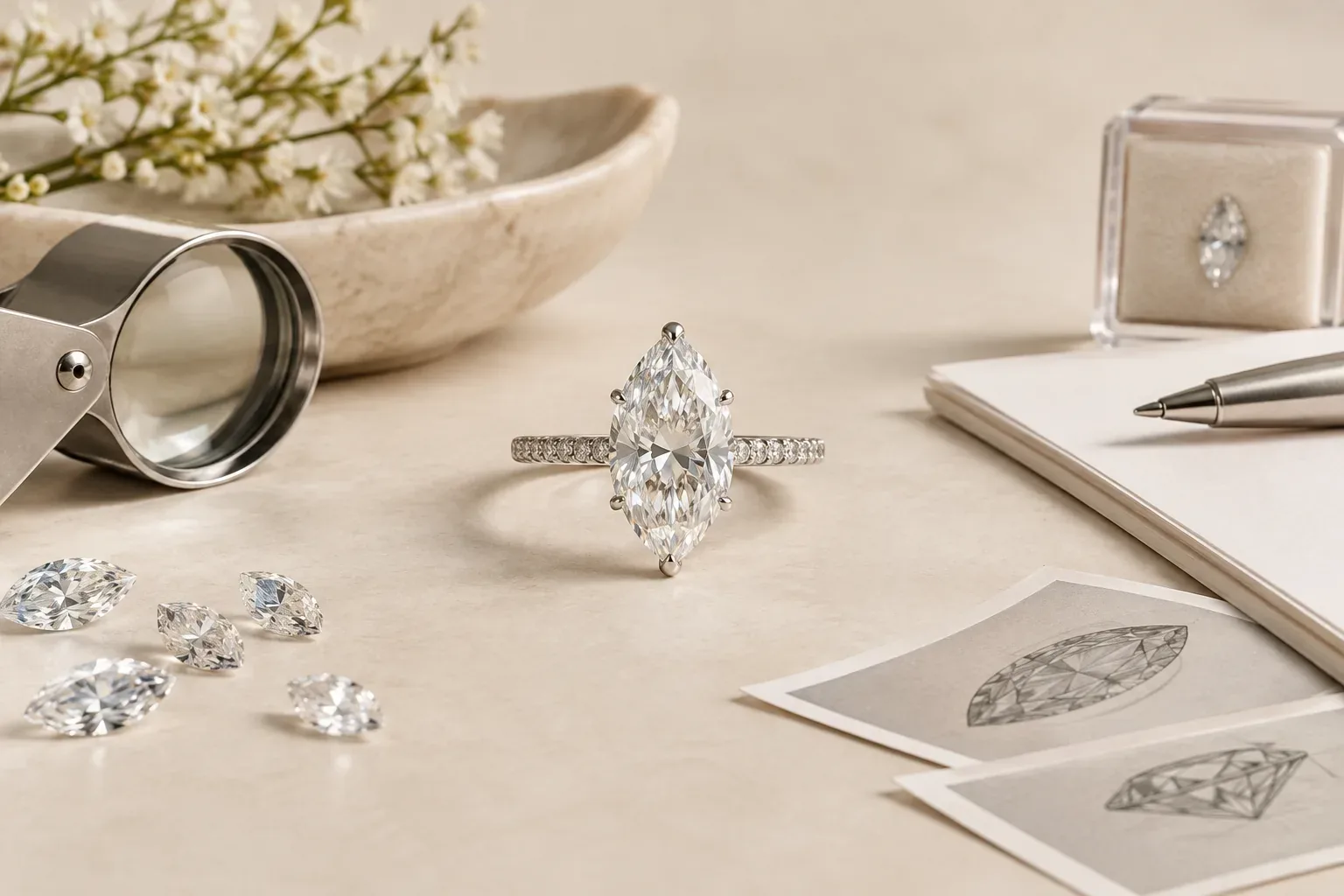
Meaning at a glance
This checklist defines what to check when buying a marquise cut engagement ring: verify written disclosures, ask for a gemological report for identity and treatments, inspect setting and prongs for durability, weigh visual trade-offs like length-to-width ratio and the bow-tie effect, and understand what only a qualified jeweler or laboratory can confirm.
Quick answer
Ask for written identity and treatment disclosures, request a reputable gemological report if the center stone is a diamond or valuable colored gem, inspect the points and setting for protection, consider length-to-width proportions for the finger appearance you want, and confirm return, warranty, and insurance options before you buy. These steps give you what a shopper can reasonably verify and clarify what requires a qualified jeweler or laboratory to confirm.
What this checklist covers
This article is a practical tool for the distinct search intent behind 'marquise cut engagement ring checklist.' It focuses on definitions that matter to a shopper, decision criteria and trade-offs when choosing a marquise center stone and setting, safe care guidance, and clear limits on which claims a consumer can independently verify versus what requires a professional or lab report.
Historical evidence and cultural origins
The approved sources for this article do not provide original historical documentation tying the marquise cut to a particular culture or period. Because those sources focus on contemporary market trends, consumer guidance, and gem treatment disclosure rather than cut histories, this article does not assert a specific cultural origin for the marquise cut that would require independent historical citation.
When you read historical accounts elsewhere, distinguish archival or museum sources that document when a shape first appears from modern popular explanations. For the purposes of purchase decisions, provenance and maker documentation that a seller can show you are far more relevant than broad origin narratives that are not supported by the seller’s paperwork.
Documented historical meanings versus modern personal interpretations
None of the approved sources attach a documented symbolic meaning to the marquise cut from an identifiable historical culture or era. In practice, symbolic meanings—whether they derive from historical claims, family tradition, or personal association—are modern interpretations unless a reliable historical source demonstrates otherwise.
Treat symbolic claims as personal or marketing language unless the seller provides credible provenance or published historical research. If a buyer values an authentic historical connection, request documentation from the seller and, when appropriate, consult academic or museum scholarship outside the scope of a retail listing.
How the marquise shape and its motifs appear in jewelry
In jewelry, the marquise cut is an elongated stone with pointed ends that designers commonly set as a single center stone for engagement rings or as accent stones in halo, side-stone, and vintage-inspired settings. Designers may orient the points along the finger to lengthen appearance or transversely for a different visual effect. The shape is also used for other gemstones and in combinations with halos, pavé shoulders, and East-West settings.
Because modern trends emphasize versatility, fluid forms, and gender-neutral styling, sellers and designers often present the marquise in contemporary mounting styles alongside colored gemstones and mixed-metal designs. These trends in demand and style are described in industry reporting and consumer guidance and can inform your choice of metal, mounting, and ring profile.
Decision criteria and practical trade-offs
Proportion and appearance. The length-to-width ratio strongly affects how elongated or broad the marquise looks on a finger. Different proportions suit different hands and tastes; ask the seller to show proportions in photographs and on a hand model or ring sizing tool so you can judge appearance.
Visual effects. Marquise cuts can display a central dark area often called a bow-tie effect. The visibility of that effect depends on cut quality, light performance, and proportion. Ask to see well-lit photos from multiple angles and, when possible, a video or in-person viewing to assess light return and any dark zone.
Durability. The pointed ends are more exposed than rounded shapes; prong protection at both points is an important feature to inspect. Consider settings that protect the tips, such as V-prongs, and understand that more open settings may require more cautious wear.
Setting choices and style trade-offs. Solitaires show off the marquise silhouette; halo settings make the stone appear larger and can mask small inclusions, while side stones change weight distribution and profile. Each choice affects perceived size, price, and ongoing maintenance.
Budget and spread. An elongated cut often appears larger face-up for a given carat weight compared with more compact shapes. That makes appearance per carat part of your trade-off calculus, but remember that face-up size does not directly indicate quality or identity.
Treatments, disclosures, and what sellers must tell you
Federal consumer guidance recommends clear distinctions among natural, lab-created, treated, and imitation materials and written seller disclosures. Ask the seller for an explicit statement about whether the center stone is natural, lab-grown, or an imitation, and request written information on any treatments or enhancements provided with the sale. Keep written receipts and disclosures as part of your purchase record.
For gemstones and diamonds, the Gemological Institute of America explains that treatments, their detectability, and their implications for durability vary by treatment and gem type. Request details from the seller and ask whether the item has a current, relevant laboratory report that documents identity, treatments, and, if applicable, grading.
What only a qualified jeweler or gemological laboratory can confirm
A trained jeweler or a recognized gemological laboratory can test and confirm gemstone identity, detect many treatments, and provide authoritative grading reports for diamonds and some colored gemstones. While a seller can provide a lab report, only a qualified laboratory can reliably confirm carat weight, precise measurements, diamond grading information, and many treatments.
As a shopper you can reasonably verify written disclosures, inspect the setting and prongs, and compare photos and proportions. You cannot, without laboratory testing, conclusively determine whether a stone is natural or contains certain treatments, or assign an accurate polish, symmetry, fluorescence, or internal grading for a diamond.
Safe care guidance for marquise rings
Because marquise points are exposed, routine care and cautious wearing reduce the risk of chipping. Avoid activities that place lateral impact on the points, and ask the seller or a professional about recommended settings that protect the tips. Regular inspections by a trained jeweler will identify loosening prongs before a stone becomes at risk.
If the stone has known treatments, follow the care guidance for those treatments. Some treatments can make a stone more vulnerable to heat or chemicals; the Gemological Institute of America’s resources on gem treatments outline why disclosure and appropriate care instructions matter. When in doubt, store the ring separately and have prongs checked periodically.
Practical buying and gifting guidance
Before purchase, request all written disclosures, the return policy, warranty or service plan, and any available lab report. Confirm the seller’s credentials and ask for photographs showing the actual ring or stone from multiple angles and in good lighting. If buying to gift without a surprise, verify the correct ring size; if a surprise, confirm the return and resizing policy.
If you value insurance and documented value, ask whether the seller provides a current appraisal or if one can be obtained after purchase. Also discuss mounting options and whether the center stone is interchangeable for future upgrades. Keep records of maintenance and any appraisal updates to support insurance claims and long-term care.
Final checklist you can use in-store or online
Obtain written confirmation of whether the center stone is natural, lab-grown, or imitation and whether any treatments were applied. Ask for a lab report from a reputable laboratory when the stone has material value and request high-resolution images or an in-person viewing to judge proportion, bow-tie effect, and setting quality. Inspect the points and prongs for protection, confirm return and warranty terms, and ask about recommended care for any disclosed treatments. If proof of grading or treatment is important to you, plan to rely on a recognized gem lab or qualified jeweler to confirm those technical details.
Frequently asked questions
Do I need a lab report for a marquise diamond?
A lab report from a recognized gemological laboratory is the most reliable way to confirm diamond identity, detect treatments, and receive standardized grading. For valuable center stones, request a report and verify that the lab is well-known and independent. Sellers should provide written disclosures in any case.
How do I protect the pointed ends of a marquise?
Choose a setting that provides prong protection for both points, such as V-prongs, and have the prongs checked periodically by a qualified jeweler. For everyday wear, consider settings that reduce exposure to lateral knocks and be cautious during manual activities.
Can I tell if a stone has been treated just by looking?
Many treatments are not visible to the unaided eye and require laboratory testing to confirm. The Gemological Institute of America explains that detectability varies by treatment and gem type, so rely on written disclosures and lab reports rather than visual inspection alone.
What should I ask the seller before buying?
Ask whether the stone is natural or lab-grown, whether any treatments were applied, for a copy of any lab report, the return policy and warranty, proof of ring size and resizing options, and for detailed images or a video of the actual ring. Keep all written documentation.
Are marquise rings currently in style?
Industry reporting indicates demand for versatile forms, colored gemstones, and fluid designs, and marquise cuts appear in contemporary and vintage-inspired settings. Trends favor personal style and craftsmanship, so choose the marquise look that matches the wearer’s preferences.
Sources and further reading
- Imaginaire Digital — Imaginaire Digital
- Jewelers Mutual — Jewelers Mutual
- Gemological Institute of America — Gemological Institute of America
- Federal Trade Commission — Federal Trade Commission