Meaning at a glance
Short answer: This princess cut engagement ring buying guide gives clear definitions, practical decision criteria, trade-offs between sparkle and durability, safe care steps, disclosure and treatment considerations, and explains what a shopper cannot verify without a qualified jeweler or gemological laboratory.
What shoppers mean by 'princess cut'
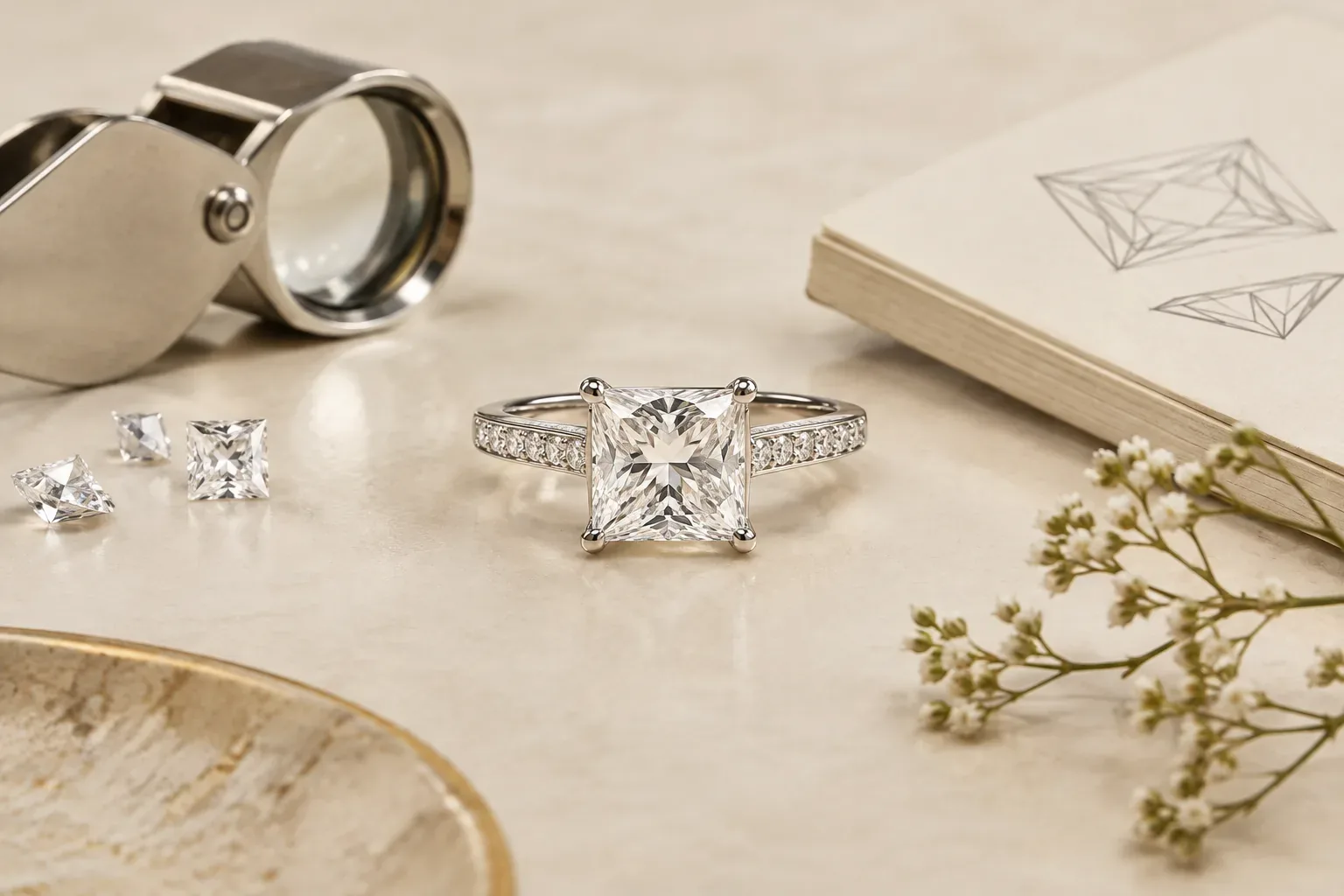
In consumer and retail language, a princess cut refers to a square or nearly square brilliant-style cut that emphasizes faceted brilliance from the top (table) and often shows sharp corners. As used in sales and design, it is presented as a modern alternative to round brilliant cuts with a more geometric profile and a generally higher apparent face-up area for a given carat weight.
Historical evidence and cultural context
When you ask for historical evidence tied to the princess cut specifically, the approved sources for this article do not document an ancient or culturally distinct tradition for that cut. The modern princess cut is a product of 20th-century lapidary innovation and is described and discussed primarily within contemporary jewelry market and trade contexts rather than as part of a long-standing cultural ritual within the sources cited here.
Market and trend publications cited for this guide focus on present-day consumer demand and styling rather than historical symbolism. For example, Jewelers Mutual reports 2026 trends emphasizing fluid forms, modern stacking, colored gemstones, craftsmanship, versatility and gender-neutral styling, which places the princess cut in a contemporary design moment rather than in a discrete historical culture. Likewise, Imaginaire Digital’s 2026 search estimates show strong consumer interest across multiple engagement-ring shapes but do not provide historical cultural claims about the princess cut.
Documented historical meanings versus modern personal interpretations
Because the approved sources do not ascribe an ancient or culture-specific symbolic meaning to the princess cut, any historical meaning you encounter elsewhere is likely a later narrative or marketing interpretation rather than documented tradition within the sources used for this guide. Documented historical meanings for jewelry items typically appear in academic or primary historical sources; those are outside the scope of the evidence approved here.
Modern personal interpretations are common and valid at the individual level. Many people choose a princess cut for reasons such as a preference for clean geometry, a desire for a contemporary look, or a wish for a stone that appears larger face-up at a given carat weight. Jewelers Mutual’s 2026 trend guidance links current consumer interest to modern styling priorities like versatility and craftsmanship, which helps explain why buyers choose cuts such as princess for aesthetic and lifestyle reasons rather than because of a fixed historical symbolism.
How the princess cut appears in jewelry
Designers use the princess cut as a center stone in solitaire rings, halo settings, three-stone rings, and side-stone arrangements. Its square silhouette influences setting choices: four-prong settings that protect corners, bezel-like corners in bezel-set variants, and halos that both protect and visually enlarge the center stone are common design responses to the cut’s geometry.
The princess cut is used for diamonds and for other transparent gemstones that take a brilliant-style faceting pattern. Because the cut concentrates light return through faceting rather than a rounded crown, settings and metal color choices affect perceived brightness and color. Contemporary styling trends noted by Jewelers Mutual and search demand patterns reported by Imaginaire Digital show that buyers often pair princess cuts with modern, minimalist bands or with stacked rings for a layered look.
Pros, cons, and practical trade-offs
Pros: A princess cut typically offers strong brilliance with a modern squared profile and a relatively large face-up appearance for its carat weight, making it a cost-efficient choice for shoppers prioritizing face-up size. The geometric look pairs well with contemporary, minimalist, or architectural settings, which aligns with current demand for modern styling as reported by Jewelers Mutual.
Cons: The cut’s pointed corners are susceptible to chipping if left exposed, so settings that protect corners add to cost and influence style. Because the princess cut deviates from round brilliance, its light performance depends on the quality of the cut; a poorly cut stone can appear duller than an equivalent round stone. Also, visual clarity and color appearance can differ from round cuts, so clarity and color grades matter in ways shoppers should verify with a professional.
Trade-offs: Choosing a princess cut often means balancing appearance versus durability and budget. To protect corners you may select a prong setting with corner prongs or a bezel that changes the ring’s look. Opting for a larger face-up appearance may mean accepting slightly lower symmetry or different light behavior compared with a round brilliant. These are subjective trade-offs best evaluated in person or with high-quality imaging and verified documentation.
Selection and gifting guidance
Start by identifying what matters most: lifestyle (active work or frequent hand use), aesthetic preference (sharp geometry versus soft curves), and budget. If durability is a priority, choose settings that protect corners and consider harder stones and metals with proven wear resistance. Jewelers Mutual’s trend guidance suggests buyers increasingly prioritize craftsmanship and versatility, so look for a setting that feels well-made and adaptable to future style changes.
Ask sellers for clear, written disclosures about whether the stone is natural, lab-created, treated, or an imitation. The Federal Trade Commission requires transparent distinction among these categories and written disclosure of treatments; insist on documentation and read it carefully. If you want documented grading, request a grading report from a reputable laboratory and verify that the report corresponds to the exact stone you will receive.
When gifting, be respectful of personal taste rather than assuming a traditional symbol will suit the recipient. If the purchase is a surprise, gather intelligence discreetly about metal preference, ring size, and lifestyle. If possible, choose a retainer or seller who offers return or resizing options and clear documentation so the recipient can adapt the ring after the gift.
Care, treatments, disclosure, and verification limits
Care: Clean a princess cut with warm water, mild detergent, and a soft brush, taking care around the corners and setting. Avoid harsh chemicals and ultrasonic cleaners for stones and settings that may have inclusions or certain treatments; check the manufacturer or a jeweler for specific guidance tied to the gemstone and any treatments it has received.
Treatments and disclosure: The Gemological Institute of America emphasizes that treatments, their detectability, durability, and required care create distinct consumer questions for gemstones. The FTC requires sellers to disclose whether a gemstone is natural, lab-created, treated, or an imitation, and to provide written information. Insist on these disclosures and on a written statement about any enhancements or treatments the stone has undergone.
Verification limits: A shopper can visually compare cut styles, inspect settings, and read seller-provided reports, but certain claims cannot be verified without specialist equipment or certification. Only a qualified jeweler or a gemological laboratory can reliably determine aspects such as natural versus lab-grown origin when not disclosed, the presence and type of some treatments, and precise color/clarity grading. If those attributes matter to you, plan to obtain an independent evaluation or a grading report from an established laboratory before finalizing a significant purchase.
Putting it together: a practical buying checklist
Decide your priorities (size appearance, brilliance, durability, budget). Choose a setting that protects the princess cut’s corners if durability matters. Request and read written disclosures about origin and treatments as required by the FTC. If formal grading matters, get a laboratory report that matches the exact stone. Consider the seller’s return, resizing and aftercare policies, and ask questions about cleaning and care specific to any treatments disclosed. Finally, if in doubt about a seller’s claims, consult an independent jeweler or gemological laboratory.
Conclusion
A princess cut engagement ring buying guide should help you balance aesthetics, practicality and verification steps. The cut is primarily a modern, stylistic choice rather than a historically documented cultural symbol in the approved sources for this guide. Use written disclosures and reputable grading reports to confirm material and treatment claims, choose protective settings if you need durability, and rely on qualified professionals for any verification beyond surface inspection.
Frequently asked questions
Is a princess cut more likely to chip than other cuts?
The princess cut has sharper corners than rounded cuts, which makes exposed corners more vulnerable if struck. Choosing a setting with corner protection such as corner prongs or a bezel-style design reduces risk; for formal assessment of durability relative to a specific stone, consult a qualified jeweler.
Can I tell if a princess cut is lab-created or treated by looking at it?
No. Visual inspection alone cannot reliably distinguish natural from lab-created stones or detect many treatments. The Federal Trade Commission requires sellers to disclose these attributes in writing, and the Gemological Institute of America explains that laboratory testing is needed to determine many treatments and origins.
Does a princess cut look smaller than a round brilliant of the same carat weight?
Often a princess cut will show a larger face-up appearance than some other cuts at the same carat weight, but perceived size depends on table size, depth, and setting. Viewing the actual stone or high-quality images is important before purchase.
What setting types work best for princess cuts?
Settings that protect the corners are recommended, such as four corner prongs or partially-bezel designs. Halo settings can also protect corners while increasing visual size, but the best choice depends on taste and lifestyle.
Should I get a laboratory grading report for a princess cut diamond?
If clarity, color, origin, or precise grading matter to you, a laboratory grading report from an established laboratory is advisable. Such reports and independent assessments can verify attributes that a seller’s description alone cannot conclusively prove.
How should I clean and care for a princess cut ring?
Clean with warm water, mild detergent, and a soft brush, taking care around corners and settings. Avoid harsh chemicals and consult a jeweler before using ultrasonic cleaners if the stone or setting may have inclusions or certain treatments.
Sources and further reading
- Imaginaire Digital — Imaginaire Digital
- Jewelers Mutual — Jewelers Mutual
- Gemological Institute of America — Gemological Institute of America
- Federal Trade Commission — Federal Trade Commission