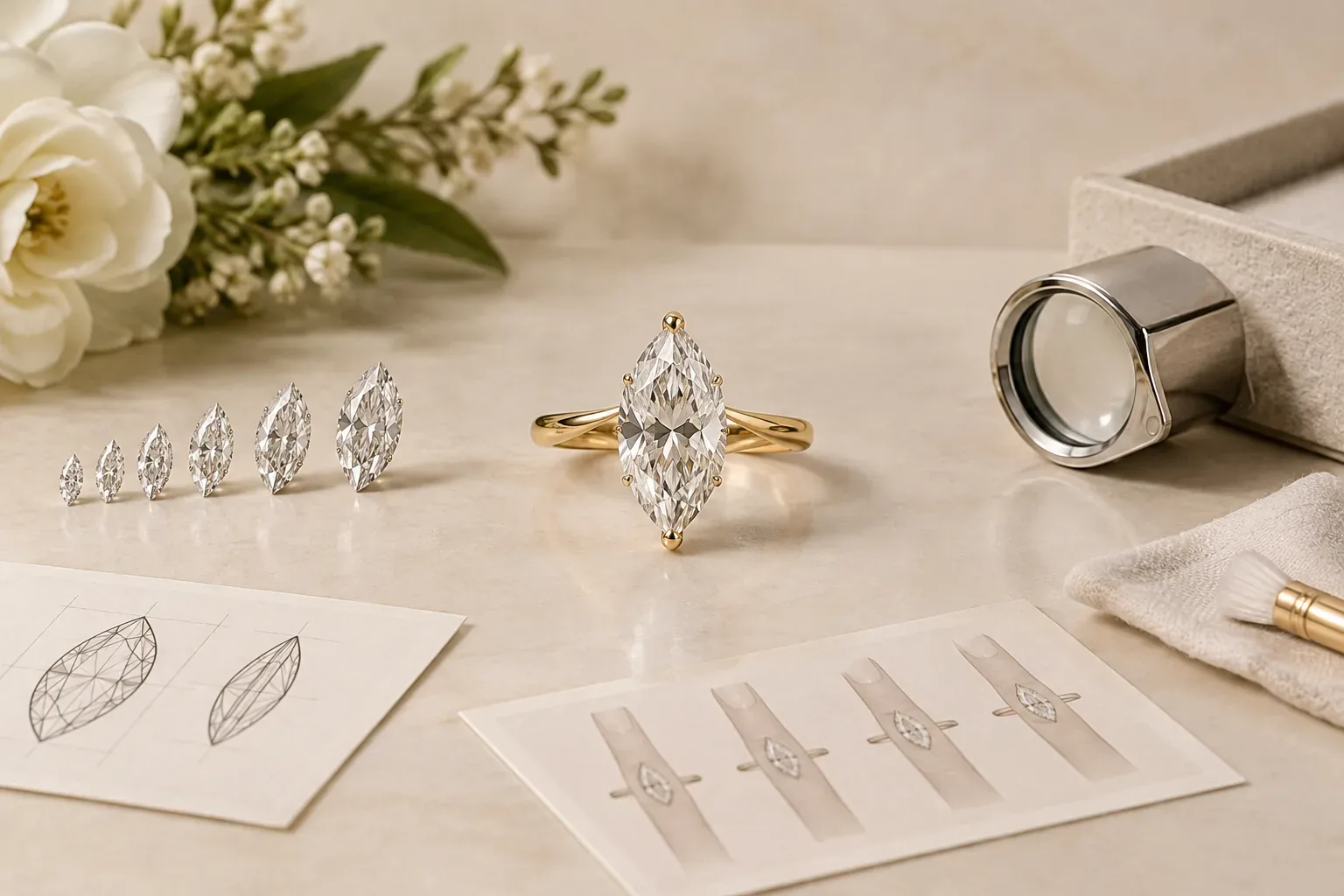
Meaning at a glance
Marquise cut engagement ring styling is about balancing the stone’s length and width to suit finger length and desired coverage, choosing settings that protect the pointed ends while adjusting perceived size, and confirming material disclosures and durability with sellers or a gemological lab before purchase.
What the historical record shows (and what it does not)
Readers often ask for precise cultural or historical meanings attached to the marquise shape. The approved sources for this guide do not document a verified cultural origin or an authoritative historic symbolic meaning for the marquise cut. Contemporary trend and professional resources used here focus on current market demand, styling trends, durability and disclosure rather than historical folklore.
For example, market and trend reporting from Imaginaire Digital and Jewelers Mutual addresses present-day consumer preferences and styling directions without ascribing a verified historical symbolism to the marquise form. Because those sources do not record a clear historical narrative for the cut, any commonly repeated origin stories or symbolic attributions that you encounter outside this guide should be treated as modern interpretation or unverified lore unless they are corroborated by a specialist historian or a primary historical source.
Documented meanings versus modern personal interpretations
Because our approved sources do not supply a documented cultural meaning for the marquise cut, the guide separates two categories of claim: documented facts you can verify, and personal or contemporary interpretations you may choose for an engagement ring.
Documented facts you can and should verify include the stone’s identity (natural, lab-created, treated or imitation), any treatments it has undergone, the metal and finish of the setting, and measureable proportions and grades like weight and dimensions. These are matters of evidence and disclosure governed by the Federal Trade Commission guidance on buying gemstones, diamonds and pearls and by gemological standards referenced by organizations such as the Gemological Institute of America.
By contrast, things like “the marquise means aristocratic romance” or “the shape represents a boat, star, or eye” are modern, personal or cultural interpretations. They can be meaningful to the giver and wearer, but they are not recorded as an incontrovertible historical fact in the sources for this article.
How the marquise motif appears in jewelry
In practice the marquise appears as an elongated, navette-like faceted shape in center stones and in complementary side stones. Jewelers use the same elongated silhouette in both diamonds and colored gemstones, and design choices emphasize or counterbalance that length with setting details such as halos, tapered baguettes, or cluster arrangements.
Styling trends affect how the marquise is set. Recent professional commentary highlights a market preference for fluid forms and versatile, modern stacking looks; the marquise’s long profile can read as contemporary in single-stone solitaire styles or vintage in ornate settings, depending on the mount. Where oval engagement rings are explicitly mentioned in market data as popular, buyers often consider marquise as an alternative elongated silhouette that produces a different visual effect.
Finger coverage and proportion: the design principles
Finger coverage from a marquise center depends primarily on two controllable variables: how long the stone is relative to its width, and how long the wearer’s finger is in relation to the stone. A longer, narrower marquise reads more dramatic and covers more of the finger’s length; a shorter, broader marquise appears more compact and covers less of the finger.
Settings change perceived coverage. A low-profile, cathedral or semi-bezel setting will make the stone appear integrated with the finger, while a raised prong mount increases visible length. A halo adds apparent size and can make a slightly shorter stone appear to cover more finger area, while side stones can either reinforce the elongated look or soften it, depending on their shape and orientation.
Proportion also affects optical artifacts. Elongated cuts can create a bow-tie shadow across the center in certain light and faceting styles; wider proportions and specific faceting patterns reduce this effect, while very narrow marquises may exaggerate it. Because the look changes with light, a physical try-on is critical.
Practical trade-offs to consider
If your priority is maximum finger coverage, you will trade off some ease of wear and potentially increase the ring’s susceptibility to knocks because longer stones project farther from the hand. If you value a comfortable, durable setting, you may select a slightly shorter, sturdier shape or a protective setting that hides the very tips under prongs or a bezel.
If you want the largest apparent size for a given carat weight, the elongated marquise silhouette can make the stone appear larger across the finger than a round stone of the same weight, but perception varies by wearer. However, perceived size is different from technical value: carat weight, clarity, color and cut quality remain the measures professionals use to determine price and should be confirmed in writing.
What you can and should verify before buying
Certain facts require written verification or a laboratory report. Confirm whether a diamond is natural or lab-grown and whether a stone has undergone treatments such as clarity enhancement or color treatment; the Federal Trade Commission advises obtaining clear written disclosure from sellers about these distinctions. For diamonds, a reputable gemological laboratory report will state measured dimensions, weights and grading information and is the most reliable way to confirm what cannot be judged by sight.
Ask the seller for the stone’s exact dimensions and, if available, the length-to-width ratio and any lab report so you can understand proportion-driven appearance. Request written disclosure about metal type, plating and finish. If insurer or repair considerations matter, ask about prong protection for the marquise tips and about recommended settings for active lifestyles.
Care and longevity: safe handling and treatment considerations
General care guidance is shaped by material durability and by common treatments. The Gemological Institute of America explains that treatments affect a gemstone’s durability and care needs, so you should learn whether a gem has been treated and follow any special care instructions. Typical protective steps include removing the ring for heavy manual work, avoiding harsh chemicals, and having prongs inspected periodically to ensure pointed ends remain secure.
For routine protection, keep the marquise away from knocks to the two points and choose settings that shelter those tips when function or lifestyle increases risk. Consider insuring a valuable engagement ring; Jewelers Mutual’s trend reporting underscores growing attention to craftsmanship, repairability and durable design within current buying patterns, which aligns with selecting practical, protective mounts.
Selection and gifting guidance: respectful and practical advice
When selecting a marquise engagement ring for someone else, prioritize a conversation or discrete investigation of their everyday habits, preferred metal and whether they prefer an elongated or compact stone profile. If you cannot ask directly, consider choosing a setting that is versatile—one that looks elegant for formal wear but is sufficiently protective for daily life.
Respect personal meaning. Because no single documented historical meaning is established in the approved sources, encourage the recipient to ascribe their own meaning if that is important to them. Present the ring with written disclosures and, if available, any accompanying lab report so they can verify and insure the piece themselves. This approach aligns with FTC guidance that consumers receive clear information and with modern buying preferences emphasizing craftsmanship and versatility reported by industry sources.
Final checklist before purchase
Before you finalize a marquise purchase, confirm these evidence-based items in writing: the gemstone’s identity and any treatments (FTC), the presence of a gemological lab report for diamonds if applicable, precise dimensions and the seller’s return policy. Also inspect the setting for practical protection of the marquise points and consider how the stone’s visual length will sit on the intended finger under normal lighting and activity.
Remember that contemporary trend reporting highlights a demand for fluid, versatile designs, but personal taste and lifestyle should guide the final decision. Nothing in the available professional or market sources replaces an in-person try-on or a qualified jeweler or gemological laboratory’s technical examination.
Frequently asked questions
Will a marquise cut make my finger look longer?
An elongated marquise generally creates the optical impression of a longer finger because of its length-to-width silhouette, but the effect depends on the stone’s actual length, the wearer’s finger proportions and the setting. Try the ring on or view precise dimensions to assess how it will read in real life.
Are marquise points fragile?
The two pointed ends of a marquise are more exposed than rounded cuts and can catch or chip if not protected. Choosing a setting with secure prongs or partial bezel protection at the points and having prongs inspected periodically reduces risk.
Can I verify whether my marquise diamond is treated or lab-grown?
Yes. Ask the seller for written disclosure about treatments and whether the diamond is natural or lab-grown; for diamonds, a gemological laboratory report is the most reliable verification available to consumers.
How should I care for a marquise engagement ring?
Follow general gemstone care practices: remove the ring for heavy manual work, avoid harsh chemicals, clean with appropriate methods for the specific gem and metal, and have a jeweler check prongs regularly. If the gem has documented treatments, follow any specific care recommendations provided by the lab or seller.
Is a marquise suitable for everyday wear?
A marquise can be worn daily when mounted in a protective, well-made setting and when the wearer’s lifestyle is considered. If the wearer frequently performs hands-on tasks, choose a more guarded setting or a shorter, sturdier profile to reduce risk.
What documentation should I get with the ring?
Obtain clear written disclosures about the gemstone’s identity and any treatments (FTC guidance), the metal content and finish, and, for diamonds, a gemological lab report when available. Keep receipts, warranties and any appraisal or insurance documentation in a safe place.
Sources and further reading
- Imaginaire Digital — Imaginaire Digital
- Jewelers Mutual — Jewelers Mutual
- Gemological Institute of America — Gemological Institute of America
- Federal Trade Commission — Federal Trade Commission