Meaning at a glance
This guide defines pear cut engagement ring styling, gives decision criteria for finger coverage and proportion, separates documented history from modern interpretation, explains how the pear motif appears in settings and gemstones, and offers practical selection, gifting and verification guidance—with safe-care pointers and clear limits on what requires a qualified jeweler or gem lab.
Quick answer
Pear cut engagement ring styling balances three decisions: the visual length versus width of the pear shape, the setting and surrounding details that affect perceived coverage, and the wearer’s hand proportions and lifestyle. For a longer, slimming effect choose an elongated pear and minimal shoulder decoration; for greater surface coverage choose a fuller width or a halo setting. Verify material identity and treatment disclosures with paperwork from the seller or an independent lab; durability and special-care needs depend on the stone and its treatments.
What the historical record says (and what it doesn’t)
Among the approved sources used for this article there is no detailed historical account of when or where the pear cut first appeared. Because the sources in this brief focus on contemporary search trends and consumer issues rather than antique cutting histories, we cannot responsibly attribute a precise culture or period for the origin of the pear cut within this article.
Broadly speaking, teardrop and pear-shaped motifs have appeared in decorative arts from many cultures across many periods; these motif-level observations are generic and not the same as documented gem-cutting history. When you encounter claims about a single origin or specific historical symbolism for the pear cut, treat those as interpretations or marketing narratives unless they are supported by dedicated historical research from jewelry historians or museum records.
Documented meanings versus modern personal interpretations
Because the approved sources do not provide primary historical meanings tied to particular cultures or eras for the pear cut, any specific historical symbolism presented without clear archival citation should be treated as modern interpretation. Contemporary wearers and designers often attach personal meanings—such as a teardrop symbolizing emotion, or a tapered point representing forward motion—but these are modern, individual associations rather than verified historical facts.
Separating the two helps when selecting a ring: documented facts you can rely on include seller disclosures about materials and treatments, and lab reports for gemstones; personal meaning is what you and the recipient assign to the shape and style. The consumer protections and disclosure responsibilities discussed by the Federal Trade Commission apply to what sellers must tell you about a gem’s origin and treatment, which is a separate category from jewelry symbolism.
How the pear motif and gemstones appear in jewelry
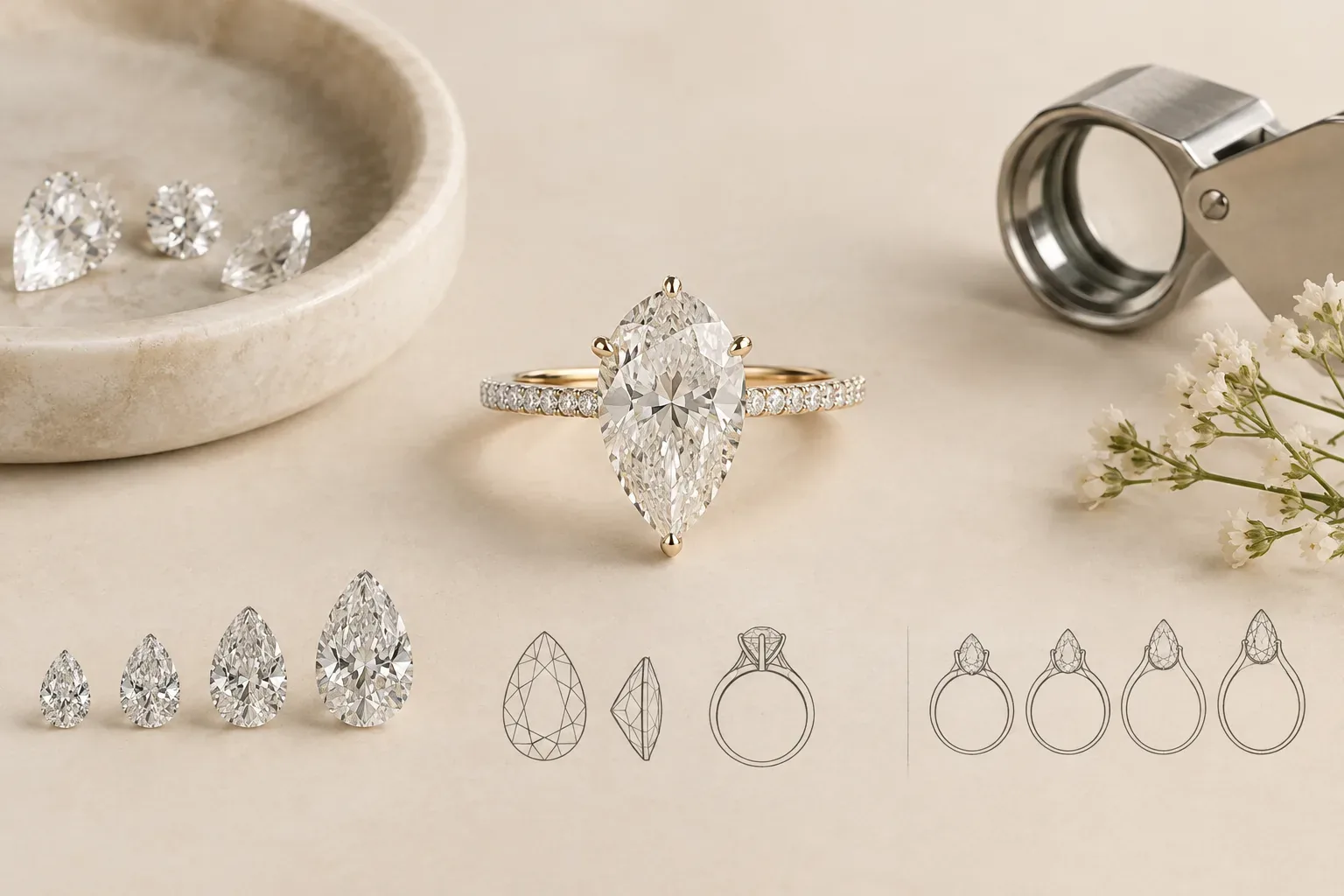
In contemporary jewelry the pear cut most often appears as the center stone of an engagement ring, offered in diamond, lab-created diamond simulants, and colored gemstones such as sapphire, emerald or morganite. The pear’s tapered point and rounded end create directional emphasis: the narrow tip can point toward or away from the wearer’s hand, changing how the finger reads visually.
Settings modify perceived coverage. A solitaire pear shows the stone’s full silhouette and tends to look longer on the finger, while a halo or cluster setting increases apparent surface area and brightness. Side stones, split shanks, and pavé shoulders change the balance between centre-to-finger coverage and overall sparkle. Designers also use bezel versus prong settings to trade off between a smoother, snag-resistant silhouette and maximum light return.
Finger coverage and proportion: decision criteria and practical trade-offs
Start with the wearer’s hand proportions and the intended visual effect. Pear shapes with more length than width tend to visually elongate the finger; broader pears fill more of the finger’s visible width and are perceived as greater coverage. Nail length and typical hand gestures also affect how large a stone appears in daily life.
Consider the trade-off between presence and comfort. A larger, wider pear increases visual coverage but can be heavier and more likely to catch on fabrics when set high or in prongs. Halo settings increase apparent size and sparkle with a smaller center stone but add metal and additional stones that raise the risk of snagging and increase maintenance needs.
Think about point orientation and practicality. Point-up pears (tip toward the fingertip) emphasize length; point-down pears (tip toward the hand) create a different, often more vintage look. The tip requires secure prong protection because an exposed point is vulnerable to chipping, especially in harder-to-protect settings.
Balance aesthetic priorities with daily use. If the wearer works with their hands, favor lower-profile settings, sturdy prongs or bezels, and slightly smaller palms-facing profiles. If the priority is maximum finger coverage for formal wear, a higher-profile setting, halo, or a wider pear may be acceptable.
Practical selection and respectful gifting guidance
Start the conversation around lifestyle and style preferences before buying. If you cannot ask directly, use subtle research: note the recipient’s current jewelry (slim or bold bands, yellow, white or rose metal), observe whether they favor minimalist or ornate pieces, and check their ring size discreetly when possible.
When choosing settings, prioritize secure mountings for pointed stones and consider a modest halo or bezel for recipients who prefer low maintenance. For those who like the look of a large pear but prefer lighter jewelry, a halo around a smaller center stone gives the appearance of size without the full weight or cost of a larger carat.
Respect cultural and personal meanings by asking when uncertain. Because shape symbolism is personal, avoid assuming that a pear cut conveys specific emotions to every person. If you intend the ring as a meaningful gift, a short conversation about what styles mean to the recipient makes the gift respectful and better received.
When gifting, provide documented disclosures and the original paperwork. Give the buyer a written receipt, any gem reports the seller provided, and clear guidance about care and insurance. The Federal Trade Commission advises that consumers have a right to clear information distinguishing natural, lab-created, treated, and imitation materials; supplying or requesting that information is part of responsible gifting.
Care, treatment, and limits on what you can verify
Treatments and durability affect daily care. The Gemological Institute of America explains that gemstone treatments, their detectability, and their implications for durability and care vary by material and treatment type. Before exposing a pear cut ring to heat, ultrasonic cleaning, or harsh chemicals, check the specific care recommendations for the gemstone and whether it has been treated.
Ask the seller for written disclosures and lab reports. The Federal Trade Commission recommends obtaining written confirmation about whether a stone is natural, lab-created, treated, or an imitation. For diamonds and some other gems, an independent gemological laboratory report provides objective measurements and identification that a lay buyer cannot reliably establish alone.
Know what requires a jeweler or gem lab. You can verify certain practical features at purchase—visual proportions, setting security, ring size, and documented paperwork. However, you cannot conclusively verify treatment types, origin, or precise grading of a gemstone without an independent gemological laboratory report or a qualified appraiser. For complex questions about durability under specific conditions or the presence of subtle treatments, consult a gemologist or send the stone to a recognized lab.
Bringing it together: a checklist for shoppers
Decide on the visual goal first: do you want lengthening, maximum face-up coverage, everyday wearability, or a balance of those? Match the pear’s silhouette and setting to that goal rather than selecting a shape in isolation. Prioritize secure settings for pointed tips, request written seller disclosures about treatments and origin, and get a lab report if verifying the stone’s identity and grading is important to you. For care, follow the specific guidance for the stone and any disclosed treatments and consider insurance for valuable pieces.
Conclusion
Pear cut engagement ring styling is ultimately a conversation between proportion, setting, lifestyle and personal meaning. Use visual decision criteria to balance length versus width and to weigh halo versus solitaire and prong versus bezel trade-offs. Rely on seller disclosures and independent reports for material facts, and treat historical or symbolic claims as personal or modern interpretations unless you can trace them to specialist historical sources.
Frequently asked questions
Does a pear cut make the finger look longer?
A pear cut with an elongated silhouette generally gives a lengthening visual effect, while a broader pear increases apparent coverage. This is a styling principle rather than an empirical rule and depends on the stone’s exact proportions, the setting, nail shape and finger proportions.
Should the pear point face toward or away from the fingertip?
Point-up orientation (tip toward the fingertip) emphasizes length and a contemporary look, while point-down often reads as vintage or distinctive. Practical considerations include which orientation feels comfortable and whether the point will be adequately protected by prongs.
How do settings change perceived size?
Halo and cluster settings increase face-up appearance and perceived coverage without requiring a larger center stone. Solitaires show the true silhouette of the pear. Bezel settings provide a smoother, lower profile but may reduce visible light return relative to prongs.
What documentation should I get when buying a pear cut ring?
Request written disclosures about whether the stone is natural, lab-created, treated, or an imitation, and get any available independent laboratory reports. The Federal Trade Commission recommends these disclosures, and a lab report is the only reliable way to verify certain attributes like treatment status and precise grading.
Can I clean a pear cut ring at home?
Cleaning depends on the gemstone and any treatments it received. The Gemological Institute of America advises checking treatment information before using heat, steam, ultrasonic cleaners or harsh chemicals, and following the seller’s care recommendations. When in doubt, seek professional cleaning advice from a jeweler.
Sources and further reading
- Imaginaire Digital — Imaginaire Digital
- Jewelers Mutual — Jewelers Mutual
- Gemological Institute of America — Gemological Institute of America
- Federal Trade Commission — Federal Trade Commission