Meaning at a glance
This guide defines pear cut pairing choices, explains the visible and measurable decision criteria (shape orientation, gap tolerance, band contouring, width and metal), lays out practical trade-offs (appearance vs comfort, continuity vs stackability), gives safe care steps, and clarifies which gemstone and treatment claims need a qualified jeweler or gemological laboratory to verify.
What we mean by a pear cut and by ‘pairing’
A pear cut—commonly described in trade and retail language as a teardrop or droplet shape—combines a rounded end and a tapered point. Pairing, in this guide, refers to the visual and physical relationship between an existing pear cut engagement ring and a wedding band worn on the same finger: whether the band sits flush to the engagement ring, leaves a small gap, or is stacked separately.
Key measurable decision criteria covered here are the pear’s orientation on the finger, the width and profile of both rings, any notches or contours, and metal choice. These criteria determine fit, comfort, and the overall silhouette when the rings are viewed together.
Historical evidence and cultural context
Available evidence in the approved references focuses on contemporary consumer behavior and product trends rather than long-form histories of specific gemstone shapes. Industry trend reporting shows a modern demand for fluid forms and stacking versatility, which frames how pear cuts are now paired with bands (Jewelers Mutual).
Search and retail visibility data from the United Kingdom demonstrate continued strong interest in engagement rings and related styles, which contextualizes why pear cut pairing is a current shopper question (Imaginaire Digital). Neither of those sources provides primary historical claims about ancient symbolism attached to the pear shape, so cultural attributions beyond recent trends are not documented in the approved evidence.
Documented meanings versus modern personal interpretations
The approved sources do not assign a single historical symbolic meaning to pear-shaped gems across cultures. Statements about symbolism that treat the shape as universally meaningful are modern personal interpretations rather than documented historical facts in the provided references.
When shoppers attach meaning—such as 'teardrop for resilience' or 'point for direction'—those are valid personal or contemporary symbolic choices but should be labeled as personal interpretation. The Federal Trade Commission emphasizes clear disclosure of material and treatment facts for gemstones; symbolic meanings are distinct from factual claims about origin or treatment and do not carry the same obligation for verification (Federal Trade Commission).
How the pear motif and gemstones appear in jewelry
Pear cuts appear as center stones in solitaire, halo, and three-stone engagement settings and as accent stones in pendants and earrings. Jewelry designs exploit the pear’s asymmetry to create directional visual lines that can elongate the finger when the point faces toward or away from the hand.
Manufacturers mount pear stones using prongs, bezels, and partial bezels, and they often build ring bands with complementary contours or with notches to reduce gaps. Modern design trends emphasize versatility and stackability, so many contemporary wedding bands are made with subtle contours that accommodate pear shapes or are intentionally slim for flexible stacking (Jewelers Mutual).
Shape and gap decisions: contoured bands, shadow bands, and slim stacks
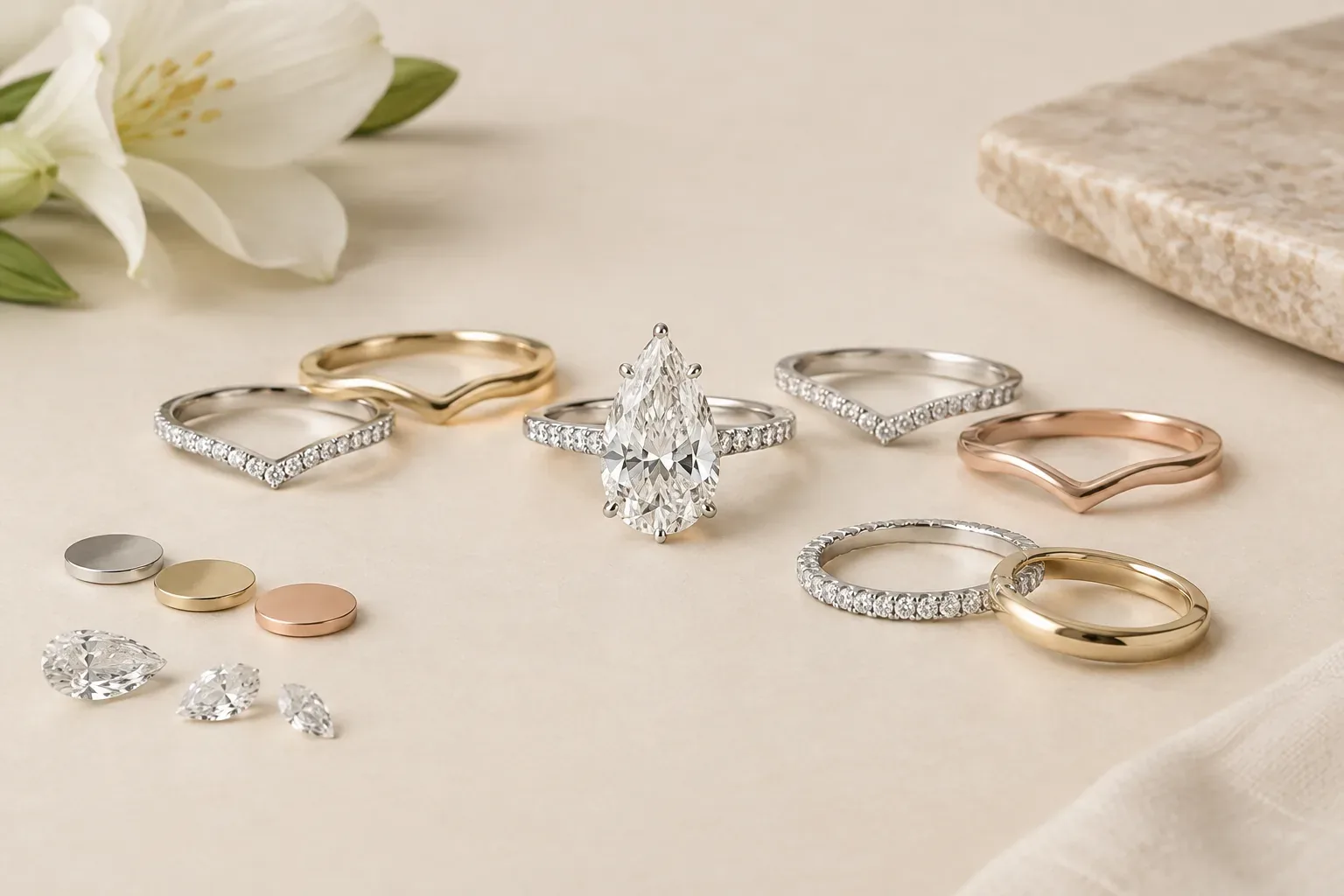
If you want a flush look, request a contoured or fitted band made to the engagement ring’s profile. Contoured bands are cut to follow the pear’s rounded and tapered outline, minimizing visible gaps at the crown and point. The trade-off is reduced flexibility if you later change rings or resize the engagement setting.
A shadow band is slightly recessed to cup the engagement ring without fully matching the profile; this reduces light-catching gaps while remaining easier to replace. The practical trade-off is that a shadow band can collect dirt in the recess and may need more frequent cleaning.
Slim stacking bands are the most versatile option: they leave a small, deliberate gap and allow you to wear additional rings. Their trade-off is that they do not give a continuous visual silhouette and can visually shorten the pear’s elongating effect on the finger.
Metal choices and finish: matching, mixing, and durability
Matching metals—using the same karat and finish for both rings—gives the most cohesive appearance and reduces visual contrast at the meeting point. If your engagement ring is a traditional white metal, matching in platinum or white gold preserves continuity; matching also simplifies future polishing and maintenance.
Mixing metals is a viable stylistic choice and reflects current consumer interest in gender-neutral and mixed-metal styling (Jewelers Mutual). If you mix metals, consider contrast intentionally: a yellow gold band can highlight the pear silhouette against a white-metal setting, but expect visible color contrast at the join and accept that polishing and repairs may yield slightly different patinas over time.
Durability considerations affect metal choice. Platinum is denser and more scratch-resistant than many gold alloys; 14k gold tends to be harder than 18k gold. If you prioritize daily wear and minimal deformation around a contoured fit, choose a more durable metal and discuss options with a jeweler.
Width, profile, and proportion guidance
Proportion matters: a very wide band next to a delicate pear setting can overwhelm the stone, while a very narrow band may appear weak beside a larger pear. As a guideline, choose a band width within one to two millimeters of the engagement ring’s band width to keep the visual balance intact, or intentionally select a much narrower profile for stacking versatility.
Profile—flat, domed, or beveled—affects how snugly rings sit together. A low-profile, slightly domed band often mates well with prong-set pear rings because it follows the engagement ring’s curve without adding height that can snag. Low-profile bands also tend to be more comfortable for everyday wear.
Trade-offs and practical considerations
If you require frequent resizing for fit changes, choose a simpler, less tightly matched band. Contoured custom bands are more costly to resize and to rematch if the engagement ring is altered. Conversely, if you prioritize a seamless one-piece look for photographs or ceremonies, invest in a custom-matched contoured band.
Comfort is another trade-off: extreme contouring and tight fits can trap moisture or irritate skin for some wearers. Ask to try proposed combinations on your finger for extended periods when possible, rather than relying on a brief fitting in bright store lighting.
Care, treatments and what requires professional verification
Gem treatments, disclosure and detectability matter for both longevity and consumer expectations. The Gemological Institute of America outlines that treatments and durability vary by material and that some treatments require laboratory-grade testing to detect reliably (Gemological Institute of America).
The Federal Trade Commission advises consumers to seek clear seller disclosure on whether a gemstone is natural, lab-created, treated, cultured, or imitation, and to ask for documentation in writing (Federal Trade Commission).
You can visually inspect setting tightness and surface wear at home, but verification of a stone’s origin or specific treatment (for example, heat treatment or fracture filling) requires a qualified jeweler or a gemological laboratory report. Similarly, precise metal alloy content or karat claims are best confirmed by assay or by documentation from the vendor.
Practical selection and gifting guidance
Start with the recipient’s lifestyle and daily habits. If the wearer uses their hands a lot, favor durable metals and lower-profile bands. If the wearer prefers options, pick a slim stacking band so they can add or remove bands over time. Jewelers Mutual notes current preference for versatile, gender-neutral styling, which supports choosing bands that work across different looks and occasions (Jewelers Mutual).
When gifting, be respectful about size and return policies. If you are unsure of ring size, choose a vendor with an easy exchange or resizing policy and keep receipts and certification. Personalize with an engraved message if that suits the recipient’s taste, but avoid assuming symbolic meanings—ask whether they prefer inscriptions, motifs, or no engraving.
If you need a seamless look for ceremony photos, plan for a custom contoured band well before the event to allow for fitting and any adjustments. If budget limits custom matching, consider a shadow or slim band that achieves a polished look at lower cost.
Short summary and next steps
Pairing a pear cut engagement ring with a wedding band boils down to three decisions: shape (contoured vs slim), gap tolerance (flush vs intentional gap), and metal choice (match vs mix). Each choice carries trade-offs in appearance, comfort, cost, and future flexibility.
Consult a reputable jeweler to measure fit, to discuss metal durability and styling, and to request any necessary laboratory reports for gemstone origin or treatment. Use seller disclosures and, where appropriate, professional lab testing to confirm non-visual claims (Federal Trade Commission; Gemological Institute of America).
Frequently asked questions
Do pear cut rings need a special wedding band?
Not necessarily. You can choose a contoured band made to fit the pear profile for a flush look, a shadow band to reduce the gap, or a slim stacking band for flexibility. Contoured bands reduce visible gaps but are less flexible for later ring changes or resizing.
Can I mix metals with a pear cut engagement ring?
Yes. Mixing metals is a common stylistic choice and aligns with current trends for versatile and gender-neutral styling, but expect visible contrast and potential differences in wear and patina over time.
How wide should my wedding band be next to a pear engagement ring?
As a practical guideline, choose a band width within one to two millimeters of the engagement ring’s band width for balance, or pick a much narrower band if you want stacking versatility. Exact proportions are a matter of personal taste and finger proportions.
How do I verify if the pear stone is natural or treated?
Verification of a stone’s origin or specific treatments requires a qualified jeweler or a gemological laboratory report. The Federal Trade Commission advises requesting written disclosure from the seller, and the Gemological Institute of America explains that some treatments are detectable only with laboratory equipment.
Will a contoured band make resizing harder?
Yes. Custom contoured or fitted bands that match an engagement ring’s profile can be more complicated and costly to resize or alter compared with simple, non-contoured bands.
Sources and further reading
- Imaginaire Digital — Imaginaire Digital
- Jewelers Mutual — Jewelers Mutual
- Gemological Institute of America — Gemological Institute of America
- Federal Trade Commission — Federal Trade Commission