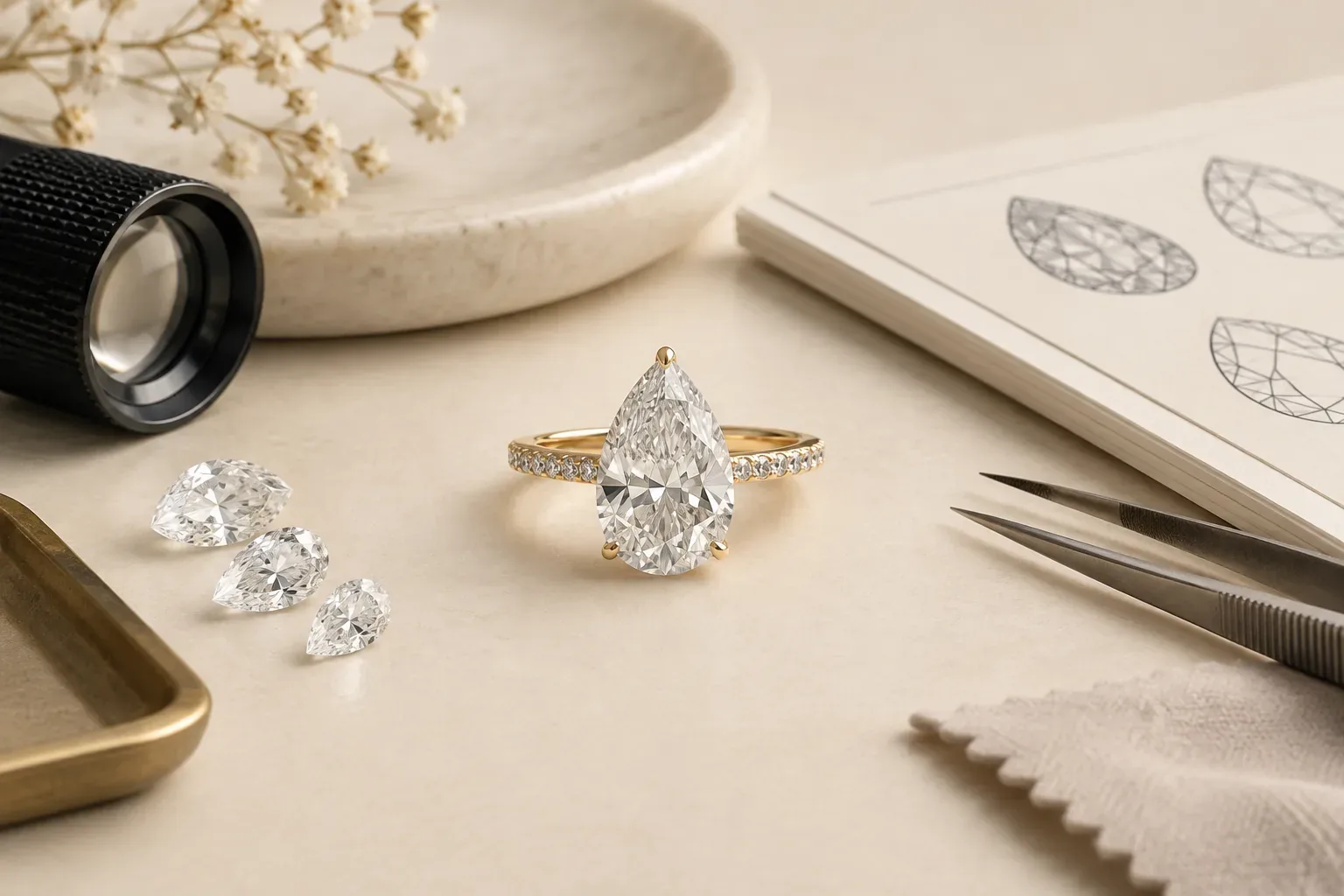
Meaning at a glance
A pear cut engagement ring checklist should define the pear cut and your desired proportions, confirm certification and disclosures, evaluate setting protection and wearability, weigh stylistic trade-offs like length-to-width and the bow-tie effect, and clarify which facts require a qualified jeweler or gemological laboratory to verify.
What the historical evidence shows (and what it does not)
Among the approved sources for this guide there is no primary documentation that assigns a fixed historical or cross-cultural meaning to the pear (teardrop) cut. The supplied professional and consumer sources focus on contemporary marketplace behavior, consumer protections, gemstone treatment and disclosure, and 2026 design trends rather than ancient symbolism.
Because these sources do not record specific cultural uses or dated origins for the pear shape, any firm historical claim about a particular culture or period would require specialist academic or museum citations beyond the sources listed here. If historical provenance or symbolism matters to you, request provenance documentation from the seller and consult museum or academic literature for that specific cultural context.
Documented history versus modern personal interpretation
Documented historical meanings are not supplied in the approved sources. The Federal Trade Commission, the Gemological Institute of America, Jewelers Mutual, and market reports from Imaginaire Digital concentrate on consumer disclosure, treatments and detectability, insurance and trends, and search demand rather than cataloguing historical symbolism.
Modern personal interpretations of the pear shape are common in today’s market: buyers and wearers often describe the shape as elegant, elongating to the finger, or expressive of individuality. Those interpretations are contemporary and subjective; they are personal meanings rather than verified cultural facts. Treat such symbolic statements as stylistic preference rather than universal or historically proven meaning.
How the pear motif and gemstones appear in jewelry today
Market reporting for 2026 highlights demand for fluid forms, versatility and craftsmanship, which helps explain why pear cuts appear frequently in engagement rings that emphasize elongation and asymmetry. Pear‑cut stones are used as center stones in solitaire settings, surrounded by halos, set as side stones, or paired in drop earrings and pendants where the tapered end creates a drop or directional line that complements fluid styles.
Because the pear retains an elongated silhouette, designers and buyers select its orientation (point up or down, vertical or east‑west) and setting style to change visual effect and wearability. Settings that protect the pointed tip, such as V‑prongs or bezel caps, are popular because they balance the stylistic advantage of the shape with practical protection.
Pear cut engagement ring checklist: questions to ask before you buy
Shape and proportions: Ask the seller for the length‑to‑width ratio and clear photos from multiple angles. A longer ratio produces a more elongated teardrop; a shorter ratio looks fuller. Request close images or video to judge whether the profile matches the style you want.
Bow‑tie effect and light performance: Request photos taken with the stone set and, if possible, a short video to see light return and any dark bow‑tie shadow across the center. Decide whether you find a slight bow‑tie acceptable or prefer a stone that minimizes it.
Symmetry and point integrity: Ask how the cutter finished the pointed end and whether the setting will protect that point. Confirm whether a V‑prong or bezel cap is recommended by the jeweler for protection and whether the ring design exposes the point to potential knocks.
Certification and documentation: Request a copy of any gemological report or grade certificate and confirm the issuing laboratory or grading body. Ask what the grades are for the stone (cut, clarity, color, carat) and whether the seller will provide matching paperwork at delivery.
Natural, lab‑created, treated or imitation: Ask explicitly whether the stone is natural, lab‑grown, treated, or an imitation, and request written disclosure. The Federal Trade Commission advises that sellers give clear distinctions among these categories and provide written disclosures.
Treatment disclosure and detectability: Ask what treatments, if any, the stone has undergone and whether the treatment is stable under normal wear and cleaning. The Gemological Institute of America explains that treatments, detectability and disclosure matter for durability and value; some treatments require expert testing to detect.
Setting type and maintenance needs: Ask which setting and prong style the jeweler suggests for longevity, and what maintenance steps the setting will need. Confirm whether the ring size can be resized without compromising the setting or a side stone arrangement.
Metal and finish: Confirm the metal type and karat or plating details, ask about hypoallergenic options if needed, and ask about finishing and plating durability. Discuss how the chosen metal will visually interact with the stone’s color grade and any side stones.
Insurance, appraisals and return policy: Ask whether the seller provides an independent appraisal, what kind of post‑purchase warranty or service plan exists, and what the return or exchange policy is if the ring does not meet expectations.
Fit and finger orientation: Ask the jeweler if you can try a similar pear ring or a mockup to test how the shape sits on the specific finger and hand shape, and whether you prefer point‑up or point‑down on that finger.
Practical trade‑offs and selection guidance
Longer pears visually elongate the finger but can appear slimmer in the middle; rounder pears look fuller and can hide inclusions better. Decide which visual effect you prefer and balance that against carat weight and budget because an elongated outline may make a stone look larger than its carat weight suggests.
A pronounced bow‑tie can reduce visible brightness in the center; some buyers accept a small bow‑tie in exchange for size and shape, while others prioritize even light performance and will pay more or search longer for a cut that minimizes it.
Protection of the pointed tip is a practical concern. V‑prongs, bezel caps or protective settings cost more or constrain design options but reduce the risk of chipping. If durability and frequent hand use are priorities, ask the jeweler about reinforced settings or a protective design.
Safe care guidance
Routine cleaning at home can typically be done with a mild detergent, warm water and a soft brush, but confirm specific instructions for the gemstone and any treatments. The Gemological Institute of America notes that treatments and durability vary, so confirm whether ultrasonic or steam cleaning is safe for the particular stone and treatment.
Have prongs, settings and mounts inspected periodically by a qualified jeweler to reduce the chance of losing a pointed tip or side stones. Jewelers Mutual’s 2026 guidance on trends also stresses craftsmanship and maintenance as important elements buyers consider when choosing durable, wearable designs.
Carry insurance for high‑value purchases and document the ring with photos and paperwork. Jewelers Mutual recommends matching coverage and service plans to how often the piece will be worn and the wearer’s lifestyle.
What only a qualified jeweler or gemological laboratory can verify
You can visually inspect proportions, ask for paperwork, and test basic wearability yourself, but you cannot reliably determine the stone’s natural versus lab‑grown origin, many types of treatments, or an independent grade without an accredited gem lab report or a qualified jeweler’s testing equipment. The Gemological Institute of America explains that detectability and disclosure around treatments require expert testing.
The Federal Trade Commission requires written disclosures about natural, lab‑created, treated and imitation materials; however, enforcement of disclosure and the scientific confirmation of certain treatments or origin require laboratory analysis. For true authentication and grading, request a current certificate from a recognized lab and consider an independent verification if provenance is critical to you.
Final purchase and gifting guidance
When gifting, confirm sizing policies, return or exchange windows and whether the seller offers anonymous gifting or in‑store pickup. Ask about engraving timelines and any hold times needed for resizing or setting adjustments.
Ask the seller for clear, written disclosures and a watchlist of recommended care steps. If you plan to insure immediately, request an appraisal or valuation that your insurer accepts. If you are buying remotely, make sure all key commitments — certification, treatments, return policy and warranty — are included in writing before you pay.
Where to read more on related topics
For more gift selection advice and symbolic considerations see our Jewelry Guides and related pieces on choosing meaningful jewelry and symbols for new beginnings.
If you want to learn how to research the meaning of a jewelry symbol specifically, consult our step‑by‑step guide to researching jewelry symbols.
Frequently asked questions
What is the single most important document to request when buying a pear cut engagement ring?
Request a current gemological report or certificate from a recognized laboratory or an independent appraisal. That paperwork documents the stone’s grading and any laboratory findings and is the clearest objective evidence a buyer can use when comparing rings.
Can I tell if a pear cut diamond has been treated just by looking at it?
No. Many treatments are not discernible to the unaided eye. The Gemological Institute of America advises buyers that detectability of treatments often requires laboratory testing or specialist equipment, and sellers should provide written disclosure of any treatments.
What should I ask about the pointed tip of a pear cut before purchasing?
Ask whether the setting uses a V‑prong or bezel cap to protect the tip, whether the point will be exposed in the chosen design, and what repair or maintenance is recommended to reduce the risk of chipping.
How do I balance length‑to‑width ratio with budget?
Longer proportions can make a stone appear larger face‑up, while rounder proportions can look fuller. Decide which visual effect you prefer and ask sellers to show stones with similar carat weights in different ratios so you can compare appearance versus price.
Are there routine care steps specific to pear cuts?
Basic care is similar to other faceted gemstones: avoid hard knocks, clean with mild detergent and a soft brush if safe for the stone and its treatment, and have settings inspected regularly by a qualified jeweler. Confirm cleaning safety with the seller based on any known treatments.
What can only a gemological laboratory confirm?
A gemological laboratory can confirm natural versus lab‑created origin, detect many treatments, provide an independent grading report for cut, clarity, color and carat weight, and identify enhancements or repair history that are not reliably visible to consumers.
Sources and further reading
- Imaginaire Digital — Imaginaire Digital
- Jewelers Mutual — Jewelers Mutual
- Gemological Institute of America — Gemological Institute of America
- Federal Trade Commission — Federal Trade Commission