Meaning at a glance
Valhalla is Odin’s hall for selected battle-slain in medieval Norse tradition, but it represents only part of a more varied Norse afterlife; modern jewelry may express remembrance or courage without implying one ancient symbol.
What the medieval sources say — which culture and period?
When people today reference Valhalla they are most often drawing on medieval Norse literature compiled in Iceland between the 12th and 14th centuries. The poems and prose now collected as the Eddas and related sagas preserve older oral traditions, and editions such as the Uppsala Edda, as made available by the Viking Society for Northern Research, are central texts for this material.
The surviving corpus reflects beliefs of Norse-speaking populations of Scandinavia and Iceland during the Viking Age and early medieval period, filtered through later Christian-era manuscript compilers. The National Museum of Denmark has compiled source collections from the Viking Age that show diverse funerary practices and afterlife ideas across the region, underscoring that Valhalla was only one named destination among several in Norse thought.
Museum catalogues and exhibitions, such as material presented by the Swedish History Museum, also emphasize that the figure of Odin and halls like Valhalla were associated in part with elite and aristocratic ideals of warrior culture rather than representing a uniform popular religious doctrine across all social groups and times.
Documented historical meanings versus modern interpretations
Documented historical meanings: medieval textual evidence identifies Valhalla as a hall ruled by Odin that receives a selection of warriors who die in battle. This portrayal is preserved in the texts compiled in the medieval Icelandic manuscript tradition and presented in editions such as the Uppsala Edda (Viking Society for Northern Research). The archaeological and documentary record, as summarized by institutions including the National Museum of Denmark, shows a range of funerary practices and beliefs about the afterlife; Valhalla is therefore best understood as one element within a varied cosmology rather than a single destination for all.
Modern interpretations: contemporary makers and wearers of 'Valhalla' jewelry often use the name and imagery to suggest valor, remembrance for someone who has died, love of Viking-era culture, or aesthetic affinity with warrior imagery. Some commercial products fuse Norse motifs with modern symbols or with creative reconstructions that are not directly attested in medieval sources. The Swedish History Museum and other scholarly bodies advise that modern uses should not be read as faithful reproductions of a single ancient symbol but as contemporary meanings layered onto fragments of the past.
How Valhalla-related motifs and symbols appear in jewelry
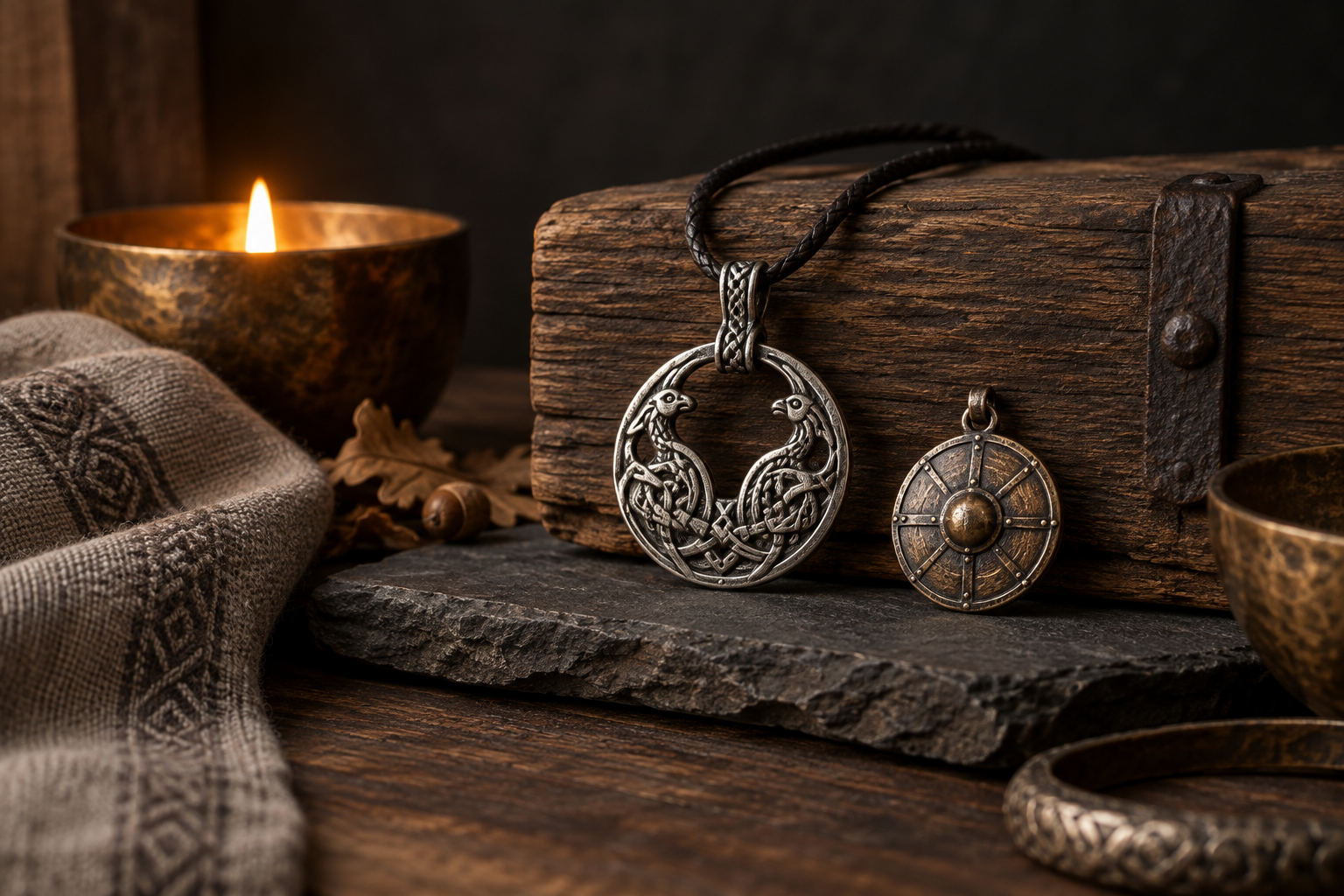
Because 'Valhalla' itself is a place-name rather than a single icon, jewelry makers signal the idea through associated motifs rather than one definitive emblem. Common motifs include depictions of helmets, spears, ravens, wolves, Valkyries in stylized form, and runic inscriptions. Many of these elements derive from broader Norse mythic repertoire rather than from a discrete 'Valhalla symbol' in the archaeological record.
Ravens and wolves are often used because they are linked to Odin in medieval texts; the image of Valkyries—female figures who choose the slain on battlefields—appears in the Eddic poems and is sometimes used on pendants, bracelets, or engraved rings to suggest the selection of warriors for an honored afterlife. Jewelry-makers also draw on martial items such as sword or shield motifs to evoke warrior identity and the battlefield context associated with Valhalla in the medieval sources.
Gemstones are typically selected for aesthetic or symbolic resonance rather than for direct historical linkage to Valhalla. Dark stones such as onyx or garnet can be used to convey solemnity or remembrance, while materials like silver and bronze reference the metals visible in Viking Age finds. Contemporary makers may also combine materials and motifs creatively—for example, a raven pendant set with a dark garnet or an engraved band referencing a Valkyrie—that communicate a modern interpretation rather than a documented ancient practice.
Design details and authenticity considerations
Reproductions based on archaeological finds are often catalogued by museums and scholarly publications; the National Museum of Denmark's compilations of Viking Age sources and material culture provide useful baselines for what types of jewelry and iconography are attested. When a piece claims to be 'authentic Viking' or to represent Valhalla specifically, check whether it is a direct reproduction of a known find or an imaginative design inspired by medieval texts.
Runic inscriptions appear on some genuine Viking Age objects, but runes were used for many purposes and their presence does not automatically indicate a 'Valhalla' connection. Likewise, helmets and weapons are common motifs of warrior culture that may be used symbolically in modern jewelry without a tight historical precedent for labeling them as 'Valhalla symbols.'
Practical and respectful selection or gifting guidance
If you select Valhalla-themed jewelry as a gift, be intentional about the message you want to convey. For a memento of courage or remembrance, choose designs that emphasize respectful symbolism—such as a pendant with a raven or a ring engraved with a personal dedication—rather than aggressive or politicized imagery. Keep in mind that Valhalla references a tradition tied to specific historical cultures; for recipients with Scandinavian heritage or an active interest in Norse studies, noting the piece’s inspiration and whether it’s a creative design or a reproduction helps maintain cultural respect.
For memorial or commemorative gifting, select materials and inscriptions that align with the recipient's values. Darker stones and matte metals can create a solemn tone appropriate to remembrance, while a small, discreet Valkyrie motif may read as honoring rather than glorifying violence. If you seek historically grounded designs, look for makers who cite museum sources or published Edda translations in their descriptions, since institutions such as the Swedish History Museum and National Museum of Denmark catalogues are standard references for responsible reproductions.
Avoid attributing universal religious significance. Not all Norse people historically would have conceived of the afterlife in terms of Valhalla, so presenting a Valhalla-themed piece as 'the' Norse afterlife symbol can misrepresent the historical diversity documented in the sources. A short explanatory note attached to the gift that distinguishes medieval textual sources from modern meanings can be both informative and respectful.
Summary and final considerations
In short, the Valhalla jewelry meaning most reliably traces back to medieval Norse literature in which Valhalla is Odin’s hall for certain battle-slain, but this figure sits within a broader, diverse set of afterlife beliefs. Modern jewelry draws on the martial, funerary, and mythic associations of those texts to communicate remembrance, valor, or cultural interest. Museums and scholarly editions such as the Uppsala Edda (Viking Society for Northern Research), the National Museum of Denmark’s source collections, and material and interpretive work at the Swedish History Museum are useful references when assessing how historically grounded a modern piece is.
Choosing or gifting Valhalla-themed jewelry benefits from clarity about whether a design is a historical reproduction or a contemporary artistic interpretation, and from sensitivity to the varied and contextual meanings of Norse afterlife ideas.
Frequently asked questions
What does Valhalla symbolize in medieval Norse sources?
In medieval Norse literature, Valhalla is described as Odin’s hall that receives certain warriors who die in battle; it is one named afterlife destination within a wider set of Norse beliefs rather than a universal end for all the dead.
Does wearing Valhalla jewelry mean I’m claiming the old Norse religion?
Not necessarily. Many people wear Valhalla-themed jewelry to honor bravery, remember someone who died, or express interest in Norse myth. If you wish to express religious belief specifically, it helps to be explicit about that context rather than assuming the jewelry communicates it by itself.
Are there authentic 'Valhalla' symbols from the Viking Age?
There is no single archaeological object labeled 'Valhalla symbol'; the concept is a place-name in medieval texts. Makers typically use associated motifs—ravens, Valkyries, weapons, runes—to suggest Valhalla, but these are broader elements of Norse iconography rather than a discrete ancient emblem for Valhalla.
How can I choose a respectful Valhalla-themed gift?
Choose designs that clarify whether they are historically based or modern interpretations, opt for subdued materials and inscriptions for memorial uses, and include a short note explaining the piece’s inspiration to avoid misrepresenting historical beliefs.
Where can I find reputable background information on Valhalla and Viking afterlife beliefs?
Scholarly editions of the Eddas (for example, collections made available by the Viking Society for Northern Research) and museum publications such as those from the Swedish History Museum and the National Museum of Denmark are reliable starting points for historical context.
Sources and further reading
- The Aesir – the gods of the aristocracy — Swedish History Museum
- The Uppsala Edda: DG 11 4to — Viking Society for Northern Research
- Sources of the Viking Age — National Museum of Denmark