Meaning at a glance
Gungnir is Odin's spear in medieval Norse tradition, while archaeological spear pendants and spear imagery belong to a wider material culture; contemporary jewelry meanings are modern interpretations, not universal historical facts.
What the medieval sources say
The evidence that Gungnir is Odin’s spear comes from medieval Old Norse manuscripts and their later study. Material published by the Viking Society for Northern Research, including editions of medieval Eddaic material preserved in the Uppsala manuscript tradition, treats Gungnir as the name of Odin’s spear in the literary corpus. Those manuscript texts are our principal written witnesses for names and deeds of the Norse gods as they reached medieval Iceland and later scholarship.
Archaeology and the spear motif: separate evidence
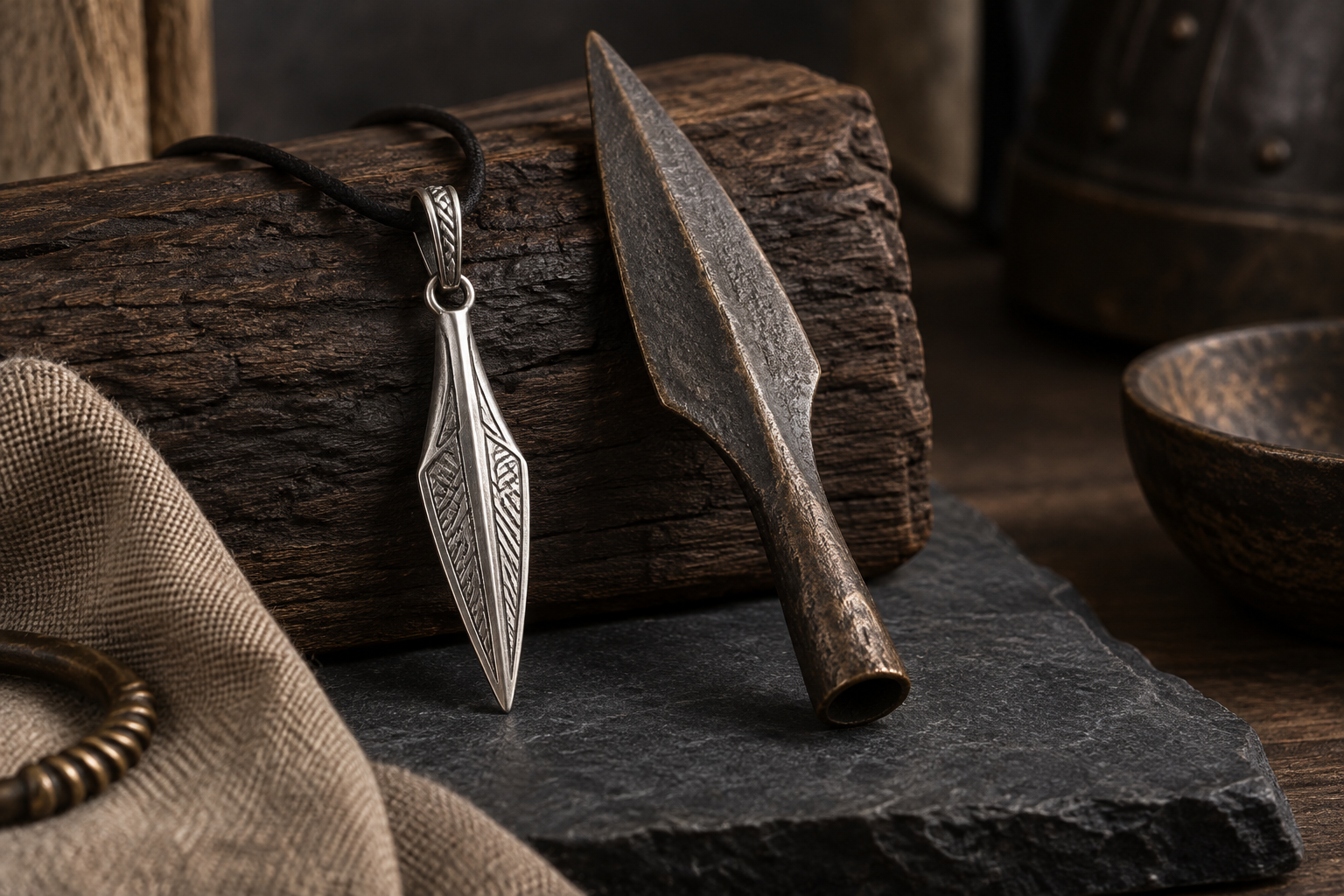
Objects recovered from graves, hoards, and settlement sites show that spears and spear imagery were common elements in the material culture of Scandinavia and neighboring regions. The Swedish History Museum emphasizes that archaeological collections and museum interpretations are necessary to understand how weapons and symbols functioned in different places and times. Small spear-shaped pendants and stylized weapon motifs appear in many archaeological assemblages, but the presence of a spear image does not by itself identify a textual name such as Gungnir or link an object to a specific myth without clear context.
Chronology and cultural context
When we speak of Gungnir, we are referring to a figure in medieval Norse literary tradition as transmitted in manuscripts. The literary attestations and the archaeological record are related but distinct kinds of evidence. Museums and academic editions treat both sources—texts and objects—as complementary: texts provide names and narrative roles, while objects provide material context. Interpreting a spear pendant therefore requires attention to where and when it was made, how it was used, and whether later traditions associated a literary name with similar imagery.
Documented historical meanings vs. modern interpretations
Documented historical meanings: Medieval textual sources name Gungnir as Odin’s spear; that attribution is a textual fact in the tradition preserved in those manuscripts. Archaeological display and scholarly descriptions show that spears and spear symbols had social and martial significance across many communities, as the Swedish History Museum demonstrates when it contextualizes finds in exhibitions and object records.
Modern interpretations: Jewelry designers, wearers, and popular culture often ascribe meanings such as protection, authority, precision, or relationship symbolism to Gungnir-themed jewelry. These contemporary meanings are modern readings informed by the literary image of Odin and by present-day values. They are valid as personal or modern cultural meanings but should not be presented as direct continuations of a single, uniform ancient belief.
How the Gungnir motif appears in jewelry today
Contemporary jewelry makers interpret the spear motif in several ways. Some pieces are literal spearhead or elongated pendant shapes intended to evoke a spear tip. Others use stylized or abstracted designs that reference weapon forms or Nordic aesthetics without reproducing a specific artifact. Designers sometimes combine spear motifs with runic-style engraving, ravens, or other Odin-associated imagery; these combinations are modern compositions inspired by literary and archaeological themes rather than direct archaeological replicas.
Materials commonly used in modern Gungnir-inspired pieces include sterling silver, bronze or bronze finishes, and occasionally stones set as accents. Historically, Norse jewellery employed silver and bronze frequently, which is why contemporary makers often choose similar metals for stylistic continuity. Whether a piece is mass-produced, hand-forged by a metalsmith, or cast from an archaeological replica affects both its appearance and how responsibly it references the past.
Selecting or gifting Gungnir-themed jewelry—practical, respectful guidance
Choose with context in mind: Before buying or gifting, consider why the recipient might value a Gungnir motif. If they study or practice aspects of Norse tradition, a historically informed piece from a maker who cites sources may be meaningful. If the interest is aesthetic, a contemporary design that references the spear motif without implying religious or cultural appropriation is often the safest choice.
Ask about provenance and maker claims: If a piece is marketed as an "authentic" Viking or archaeological replica, look for maker notes or museum collaboration. Reputable descriptions will explain which historic objects inspired a design and whether the piece is a creative interpretation or a direct copy of a find. The Swedish History Museum and similar institutions can be a resource for comparison when a seller cites a specific type of find.
Be mindful of belief and identity: Not all uses of Norse symbols carry the same meaning for everyone. Some individuals and groups adopt these symbols for modern religious purposes; others wear them as cultural, aesthetic, or historical references. When gifting, be sensitive to the recipient’s beliefs and to how the symbol might be received in their community.
Care and display: Metals common in these designs require routine care to avoid tarnish or corrosion. If the piece references archaeological material, consider including a short note about the design’s inspiration—this adds educational value and respects the distinction between historic objects and contemporary jewelry.
Design ethics and cultural respect
Designers and buyers should distinguish between creative inspiration and misrepresentation. Labeling a modern design as "inspired by Gungnir" or "evoking Odin’s spear" is accurate when the maker intends a literary reference. Conversely, claiming direct ritual power or a universal ancient meaning risks conflating modern practice with medieval textual traditions. The museums and editions cited in this article model how to present evidence-based context: identify sources, explain limits, and avoid unverified ancestral claims.
Final summary
Gungnir’s identity as Odin’s spear is anchored in medieval Norse textual tradition; archaeological spear imagery is a separate but related body of evidence that requires careful contextual interpretation. Modern jewelry that references Gungnir draws on both strands—literary reputation and material form—but the symbolic meanings assigned by contemporary wearers are modern creations. Selecting or gifting such jewelry benefits from honest labels, attention to provenance, and respect for the varied ways people relate to Norse myth and material culture.
Frequently asked questions
Does Gungnir appear in archaeological finds?
The name Gungnir is a feature of medieval Norse literature; archaeological finds include spearheads and spear-shaped ornaments, but the objects themselves are not labeled with literary names in the same way manuscripts name mythic objects. Museums such as the Swedish History Museum separate the textual tradition from the material evidence when interpreting finds.
Does Gungnir have a single, fixed meaning?
No single, fixed meaning applies. In medieval texts Gungnir is named as Odin’s spear, but modern jewelry wearers and designers assign a variety of contemporary meanings—protection, authority, decisiveness, or personal commitment—that are modern interpretations rather than uniform ancient beliefs.
Is it appropriate to wear Gungnir jewelry if I am not Norse or Heathen?
Wearing Gungnir-inspired jewelry for aesthetic or historical interest is common and can be appropriate, provided the wearer is mindful of context and respectful of living traditions. If the piece is intended as a religious symbol, check how that symbol is understood by the community you are engaging with and avoid misrepresenting its history.
How can I tell if a Gungnir-style piece is historically informed or just decorative?
Look for clear seller or maker notes. A historically informed piece will typically state the archaeological or textual inspiration, cite comparable finds or manuscript references, and describe which elements are modern additions. Decorative items will emphasize design and aesthetics without claiming direct historical equivalence.
Should I expect a museum replica to carry the same symbolic meaning as a modern design?
No. A museum replica aims to reproduce an object’s form and context as found, while a modern design often blends inspiration and contemporary symbolism. The museum’s interpretation focuses on evidence and context rather than prescribing modern meanings.
Sources and further reading
- The Uppsala Edda: DG 11 4to — Viking Society for Northern Research
- The Aesir – the gods of the aristocracy — Swedish History Museum
- The sources for what we know — Swedish History Museum