Meaning at a glance
In medieval Norse sources Freyja is associated with love, fertility, war, seidr, cats, a falcon form and the necklace Brisingamen; modern jewelry often borrows these motifs, but labeling an artifact or design as 'Freyja' requires care because Viking Age identifications are frequently interpretive.
Historical evidence and chronology
Medieval Norse textual and material sources form the basis for identifying Freyja’s associations. The Swedish History Museum summarizes the medieval tradition linking Freyja to fertility, love and wartime aspects, and notes her connection to cats, a falcon form, and Brisingamen. The Uppsala Edda edition published by the Viking Society for Northern Research preserves parts of the Norse mythic corpus where Freyja appears and where elements such as shape‑changing and magical practice are attested. The National Museum of Denmark’s compilation Sources of the Viking Age collects the kinds of written and archaeological evidence researchers use to reconstruct Viking Age beliefs and to point out where interpretation is necessary.
These sources together indicate that much of what we accept as Freyja’s iconography—her association with love and fertility, her practice of seidr (a form of Old Norse magic), her links to a necklace called Brisingamen, and her connections with cats and a falcon cloak or falcon form—comes from medieval literature and later compilations of myth, rather than from a single, contemporaneous pictorial canon.
Documented meanings versus modern interpretation
Documented medieval meanings come primarily from the textual tradition preserved in manuscripts and from archaeological contexts that can be securely dated and described. According to the Swedish History Museum and the texts collected in the Uppsala Edda, Freyja is explicitly named in source material as connected to love, fertility, and seidr, and she is associated with Brisingamen in myth. These are grounded in medieval literary evidence and later medieval interpretations of earlier oral traditions.
Modern personal and commercial interpretations expand on, adapt, or symbolize that material for contemporary use. The National Museum of Denmark and the Swedish History Museum both caution that identifying a Viking Age object as 'Freyja' is frequently interpretive. A pendant with a female figure, for example, can be read in multiple ways by archaeologists and designers. Contemporary jewelers and wearers may assign meanings—romantic, feminist, pagan devotional, aesthetic—that are valid for modern contexts but should not be presented as direct medieval fact without qualification.
How each Freyja motif appears in jewelry
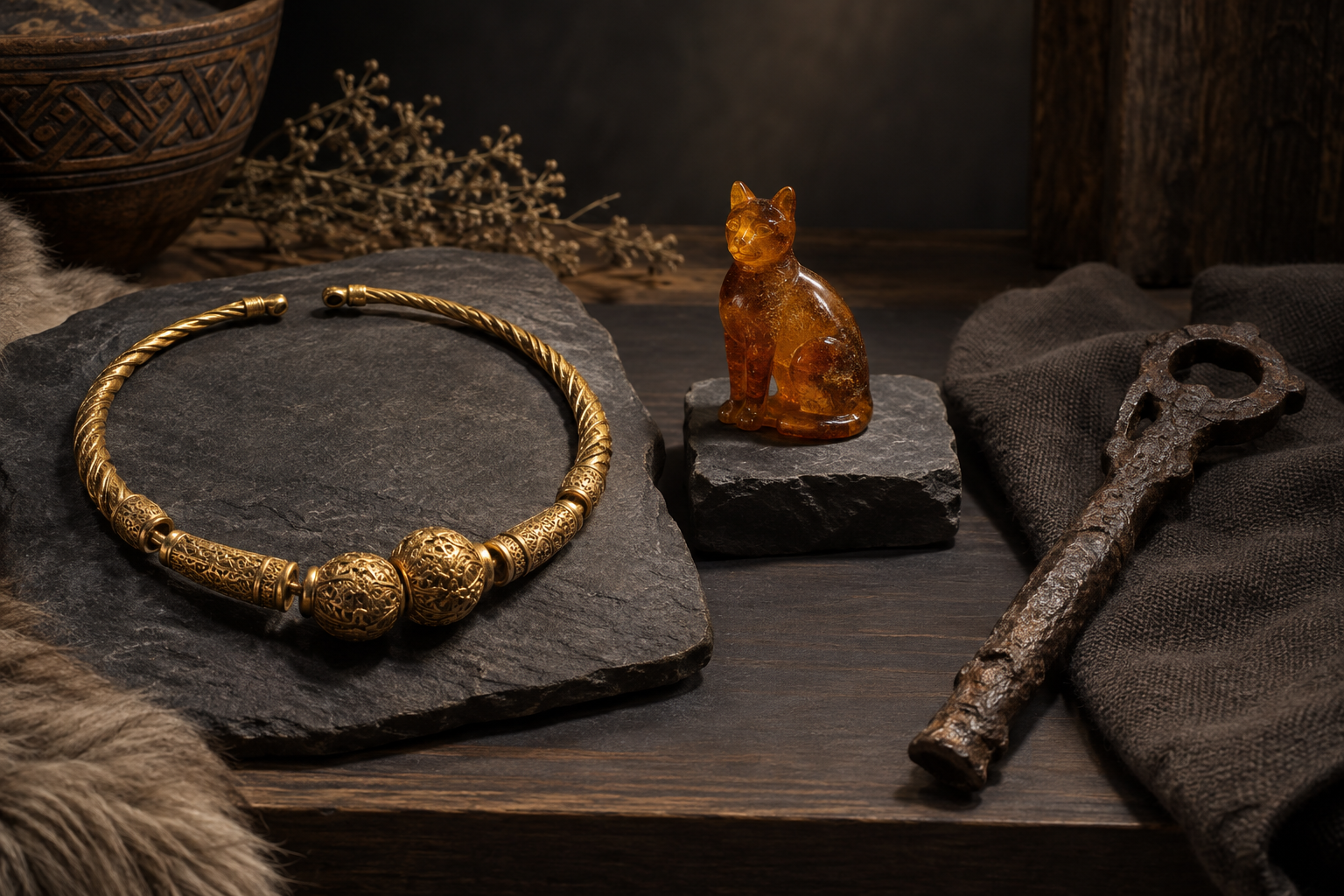
Cats: Medieval sources associate Freyja with cats, and in modern jewelry the motif appears as cat‑headed pendants, stylized cat figures, or cat imagery paired with feminine silhouettes. Makers may use small cat charms as a direct, legible nod to the mythic detail. When a piece references cats as a Freyja motif, it is usually a modern symbolic choice rather than a replication of a specific Viking Age object.
Falcon imagery and feathered cloaks: The falcon form or feather cloak that allows transformation in myth is evoked in jewelry as stylized feather motifs, small falcon‑wing pendants, or cloaked‑figure silhouettes. Designers sometimes use layered metalwork to suggest plumage. Because the underlying medieval texts describe shape‑changing and feathered garments, contemporary falcon pieces intentionally recall that narrative rather than reproducing an archaeological original.
Brisingamen: Brisingamen is the necklace associated with Freyja in the medieval tradition. Contemporary jewelry often treats Brisingamen as inspiration for elaborate necklaces, torc‑like collars, or gemstone‑set pendants styled to look sumptuous. Museum descriptions link the name and concept to the myths, but exact form and materials of the legendary necklace are not fixed by surviving artifacts, so modern Brisingamen pieces are reconstructions or creative interpretations rather than copies of a documented historical object.
Seidr and magical practice: Seidr—a set of ritual practices and magical techniques recorded in the medieval sources and associated with Freyja—is represented in modern jewelry through symbolic devices: runic inscriptions, staffs or rod motifs, knotwork intended to suggest spell‑binding, and other evocative forms. Jewelry makers often combine runes or symbolic knots with pendants referencing Brisingamen or animal motifs to suggest Freyja’s role as a practising seidr‑woman. The link between seidr imagery and jewelry is modern and symbolic, based on textual mentions of the practice rather than on a clear archaeological type that can be labeled unambiguously as seidr equipment.
Gemstones, materials and stylistic notes
Modern Freyja‑inspired jewelry uses a wide range of metals and gems. Designers often choose warm metals such as gold or bronze tones to suggest luxury and fertility, and gemstones—especially amber, garnet, and other warm‑colored stones—are frequently paired with Brisingamen‑style designs for visual effect. These material choices are contemporary aesthetic decisions informed by the idea of Brisingamen as a celebrated necklace in the myths; they are not direct evidence of the exact materials of a singular historical object.
When makers aim for archaeological responsibility they will clarify which elements are historic (for example, a design based on a specific Viking Age pendant) and which are interpretive (a modern Brisingamen pendant inspired by myth). The Swedish History Museum and the National Museum of Denmark both advocate transparency: label reproductions as reconstructions or inspired by myth rather than as original Viking artifacts.
Practical, respectful selection and gifting guidance
Be explicit about intent when buying or gifting. If you choose a piece because it is 'inspired by Freyja' or 'based on Norse myth,' look for makers who state that clearly. Avoid sellers who claim that a modern design is an authentic Viking artifact unless there is museum provenance to support that claim. The National Museum of Denmark and the Swedish History Museum recommend responsible labeling and accurate provenance statements.
Match motif to meaning thoughtfully. For someone who values fertility or love symbolism, a Brisingamen‑style necklace or a piece that explicitly references Freyja’s association with fertility can be appropriate. For a recipient interested in magic or reconstructionist spiritual practice, a pendant incorporating runic motifs or a staff symbol may be meaningful, provided the maker and wearer understand the modern nature of the symbolism.
Consider craftsmanship and materials. Choose metals and gemstones that suit the wearer’s skin sensitivity and lifestyle. Solid metals and securely set stones increase longevity. If you want a piece that reads as historically informed, commission a maker who cites specific archaeological parallels or academic sources and who will not market the item as an unearthed relic.
Respect living practices. Some contemporary pagans or Heathen practitioners hold Freyja as a devotional figure. If you gift Freyja‑inspired jewelry to someone who practices a modern Norse religion, ask about preferences and avoid commodifying sacred symbols. Conversely, if the recipient has no religious interest, treat the piece as symbolic or aesthetic and avoid asserting religious authenticity.
Label and document. If the piece is intended as a conversation starter about Viking Age belief and material culture, include a short card with attribution: note which aspects are medieval (e.g., 'Freyja is associated with Brisingamen and seidr in medieval Norse texts, per the Swedish History Museum and the Uppsala Edda') and which are contemporary design choices. This both educates and prevents misrepresentation.
Frequently asked questions
Are cats historically a symbol of Freyja?
Medieval Norse texts and modern museum summaries link Freyja with cats; the Swedish History Museum notes this association. In jewelry the cat motif is a modern way to reference that medieval detail.
What is Brisingamen and is there an original necklace to copy?
Brisingamen is the legendary necklace associated with Freyja in medieval tradition. Museums and textual editions attest to its place in myth, but there is no single documented Viking Age 'Brisingamen' relic to reproduce exactly; modern Brisingamen pieces are reconstructions or creative interpretations.
Does seidr appear on Viking Age jewelry?
Seidr is a magical practice described in medieval sources and associated with Freyja, but there is no unambiguous archaeological type labeled 'seidr jewelry.' Contemporary pieces evoke seidr with runes, staff motifs, or knotwork as symbolic references.
Can a Viking Age pendant be confidently identified as Freyja?
Scholars and museums caution that labeling a Viking Age object as Freyja is often interpretive. The National Museum of Denmark and the Swedish History Museum recommend careful provenance and transparent descriptions when objects are linked to specific deities.
Which gemstones are appropriate for Freyja‑inspired jewelry?
Modern designers often choose warm tones such as amber, garnet or gold settings to evoke fertility and luxury associated with Brisingamen in myth. These choices are contemporary aesthetics inspired by the stories rather than direct evidence of historical materials.
How do I gift Freyja‑inspired jewelry respectfully?
Choose a maker who labels work as 'inspired by' if it is not a documented replica, respect the recipient’s spiritual views, prioritize quality and provenance, and include a brief note clarifying which elements are medieval and which are modern interpretations.
Sources and further reading
- Freyja – goddess of fertility and war — Swedish History Museum
- The Uppsala Edda: DG 11 4to — Viking Society for Northern Research
- Sources of the Viking Age — National Museum of Denmark