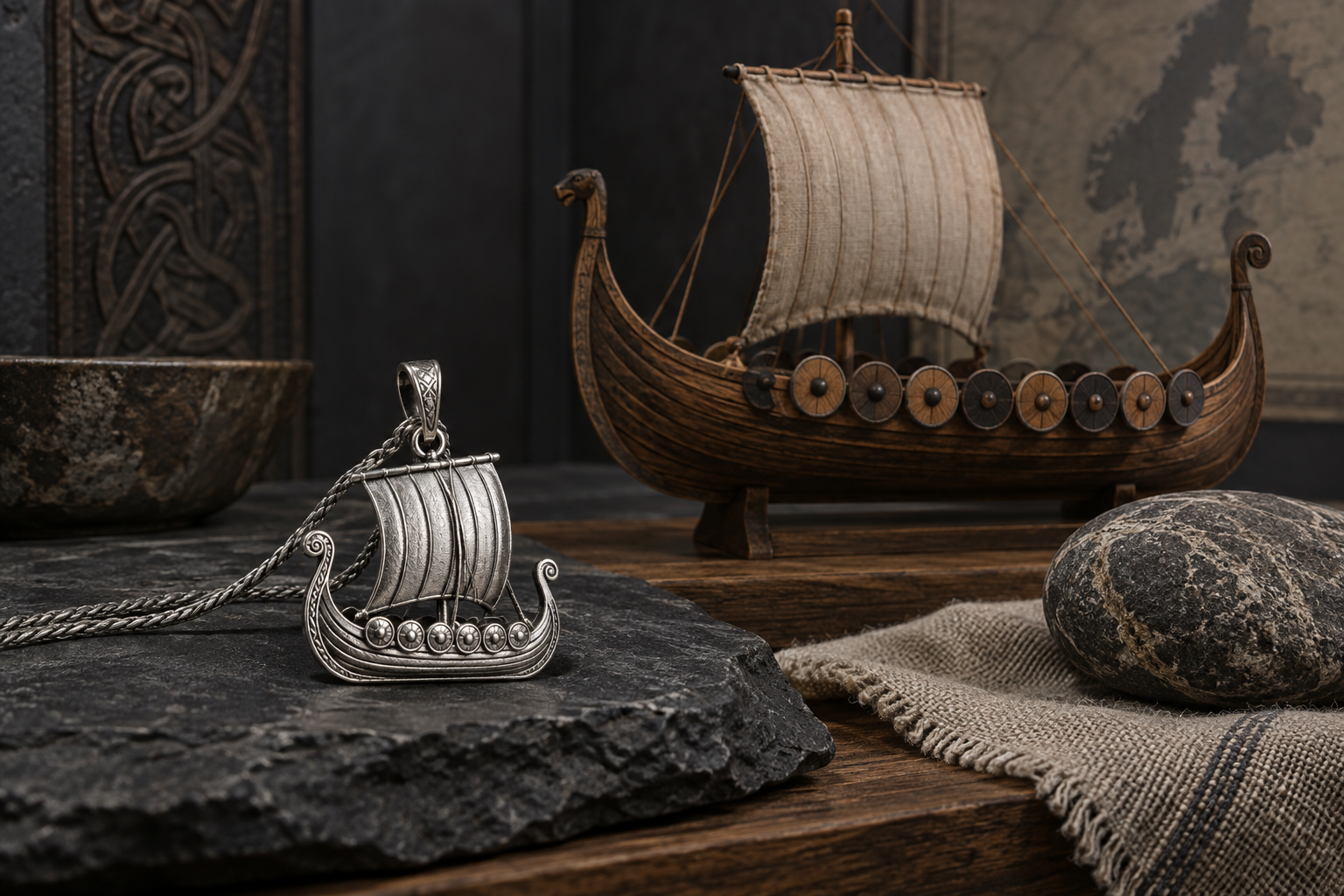
Meaning at a glance
Ships were central to Viking Age travel, trade, conflict, and some burials, but there is no evidence that a ship pendant had one universal meaning; modern interpretations such as journey, protection, or resilience are contemporary readings, not documented Viking definitions.
Historical evidence and chronology
Archaeologists and museum scholars identify the Viking Age broadly as the period when people from Scandinavia used oceangoing and coastal ships for long-distance movement. The National Museum of Denmark describes how ships underpinned travel across seas and rivers and facilitated economic exchange and expeditions. The same museum’s account of trade during the Viking period emphasizes ships as the practical means by which people moved goods and connected networks.
The Swedish History Museum explains the nature of the evidence we have for the period—burials, hoards, runic inscriptions, and material culture—and how those items contribute to cautious interpretations of Viking beliefs and practices. Together these institutional sources show that ships were a functional and symbolic part of life in Scandinavian societies of the Viking Age, and that the archaeological record must be read carefully: some ship-related objects appear in funerary contexts, some in everyday trade-related contexts, and many survive only as fragments or later depictions.
Which cultures and periods are we discussing?
When we speak of "Viking ship" imagery we are referring to material and documentary traditions from the Scandinavian world associated with what historians call the Viking Age. Museum treatments and archaeological reports referenced here are specific to finds and scholarship in Denmark, Sweden, and related North Atlantic contexts. These sources cover items and practices dated and interpreted by those institutions; they do not—as a set—claim a single pan-Scandinavian ritual meaning for ship motifs at every time or place.
Documented historical meanings versus modern personal interpretations
The historical record shows ships were essential to mobility, trade, and, in some contexts, funerary display. For example, museum collections and archaeological descriptions record ship burials and ship parts placed with the dead in particular instances, which indicates that ships sometimes carried funerary or commemorative importance for specific communities or individuals. The National Museum of Denmark and the Swedish History Museum both emphasize the centrality of ships in practical and ceremonial life without endorsing a single standardized symbolic meaning for ship imagery.
Contemporary sellers, designers, and wearers often attach personal or modern symbolic meanings to ship motifs—journey, exploration, resilience, homecoming, or maritime heritage. Those contemporary meanings are valuable to individuals but should be labeled as modern interpretations. The museums cited here support reading historical evidence carefully and distinguishing documented practices (what archaeologists actually found and recorded) from later symbolic attributions.
How the ship motif and related traditions appear in jewelry
Archaeological and museum records show that ship imagery appears in Scandinavian material culture in a number of contexts, including funerary goods, decorative metalwork, and small-scale objects preserved in hoards or graves. The motif also appears in later manuscript art and on rune stones, which influence modern visual language. In jewelry specifically, modern pieces that reference Viking ship imagery include pendants shaped like ships, engraved or cast representations of whale-prows or longship profiles, and decorative panels inspired by archaeological ornament. These modern jewelry forms draw on a longue durée of ship imagery but are reconstructions or designs made for contemporary tastes.
When gemstones or materials are present in modern ship-themed jewelry, those choices reflect current aesthetics and supply chains rather than a single historic convention. Museums emphasize that many original objects were made from materials available at the time—metals and organic materials whose survival is uneven—and that modern gem settings are a contemporary layer of meaning placed on an ancient motif.
Design cues to look for if you want historically informed pieces
If your interest is historical authenticity, look for designs that reference known archaeological forms and reputable makers who document their sources. Museum catalogs and academic overviews often show examples of ship-related finds and can guide aesthetic choices without claiming those designs carried uniform meanings. Be aware that full authenticity is impossible: original repairs, organic materials, and archaeological patina cannot be fully reproduced by modern manufacture.
Respectful use of the motif includes clear labeling of what is historical and what is contemporary interpretation. Museums steer users toward learning from the finds rather than assuming one preserved object defines practice across time and place. Selecting a piece that cites a museum exhibit or a particular archaeological example is one way to ground a purchase in documented evidence.
Practical and respectful selection or gifting guidance
Choose a maker who provides provenance and explains which historical elements informed the design. A description that distinguishes "inspired by a 9th‑century ship-prow motif" from claims that a pendant "guarantees safe passage" will help keep modern meaning separate from historical evidence. If gifting to someone with Scandinavian ancestry, ask whether they prefer pieces that highlight family or community heritage or whether they find such motifs sensitive.
Consider scale, material, and context. A delicate pendant is a personal symbol; a larger, statement piece may be read publicly as an identity marker. Think about how the recipient wants to relate to history: do they want an educational note or card that explains the archaeological basis and modern interpretation? Including a short explanatory card—sourced to museum pages or catalog entries—can communicate respect for the artifact’s cultural context and the difference between documented history and contemporary meaning.
Avoid marketing language that claims the pendant restores or transfers ancient rites or power. Museums encourage learning from finds rather than making universal claims. Finally, consider donating to or supporting museums and archaeological projects that study the period; such gestures help preserve the contexts that give motifs their documented meanings.
Summary
Ships were central to travel, trade, conflict, and the memory of the dead in the Scandinavian world during the Viking Age, according to the National Museum of Denmark and the Swedish History Museum. That centrality explains why ship imagery recurs in the material record and why modern jewelers and wearers adopt ship motifs today. However, surviving evidence does not support a single universal meaning for a ship pendant in the Viking Age; contemporary symbolic readings are modern choices layered on top of a varied historical record.
Frequently asked questions
Did Viking people wear ship-shaped pendants with a shared meaning?
No single, documented, shared meaning for ship-shaped pendants is recorded. Museums and archaeological sources show that ships were important in travel, trade, and some funerary contexts, but surviving evidence does not support a universal symbolic definition for a pendant. Modern meanings are contemporary interpretations.
Were ships used in Viking burials?
Yes, museums and archaeological reports record instances where ships or ship parts were used in burials or grave contexts, indicating that ships could have funerary or commemorative significance in specific cases. This does not imply every ship motif had the same role across regions or periods.
Is it respectful to wear Viking ship jewelry today?
Wearing ship-themed jewelry can be respectful if designers and buyers acknowledge the difference between historical evidence and modern symbolism, avoid claiming ancient rites or guarantees, and consider the cultural meaning to recipients. Citing museum sources or including an explanatory note helps maintain respect.
What should I look for if I want a historically informed piece?
Look for makers who document their inspiration and cite archaeological examples or museum exhibits. Seek clear labeling that distinguishes which elements are reconstructed or purely modern, and prefer sellers who reference reputable museum sources for design cues.
Do museum sources say ship motifs mean "journey" or "protection" historically?
No; museum sources confirm ships were central to practical and ceremonial life, but they do not provide a single historical definition such as "journey" or "protection" for ship motifs. Those are contemporary symbolic readings.
Can I gift ship jewelry to someone with Scandinavian heritage?
You can, but do so thoughtfully: ask about preferences, include context or an explanatory card if the piece draws on archaeological forms, and avoid making universal claims about meaning or heritage.
Sources and further reading
- The ships of the Vikings — National Museum of Denmark
- Trade in the Viking period — National Museum of Denmark
- The sources for what we know — Swedish History Museum