Meaning at a glance
Archaeological finds show that pairs of brooches, strings of beads, and metal dress fittings were practical parts of many Viking-age women's outfits and can indicate aspects of dress, status, and connections, but burial evidence is not a universal social code and must be interpreted cautiously.
What the archaeological record actually shows
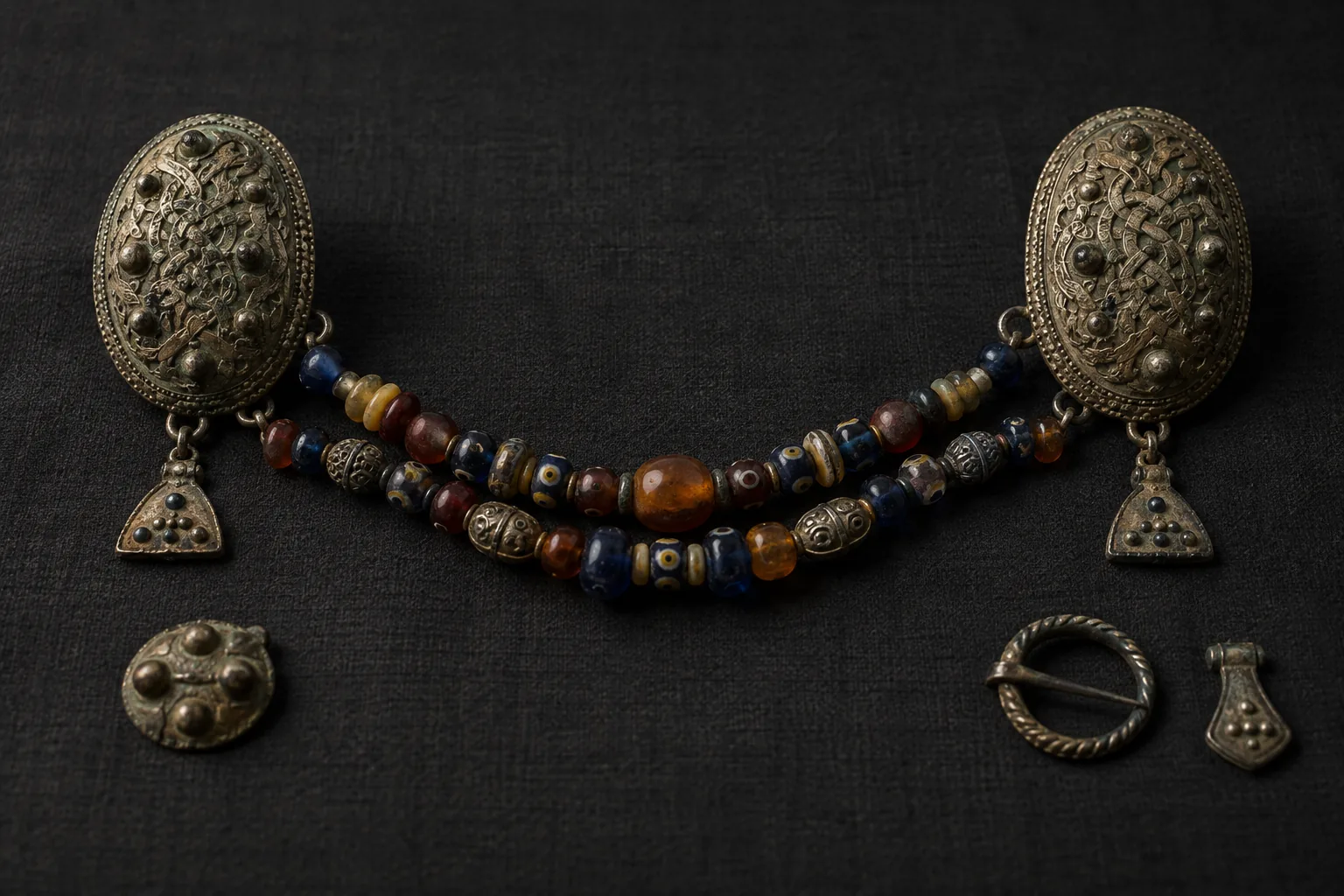
Archaeological material recovered from graves and settlement contexts forms the basis for most reconstructions of female dress in the Viking Age (roughly late eighth to eleventh centuries). The National Museum of Denmark outlines how metal fittings, brooches and bead strings regularly appear with female skeletons and in household contexts and are therefore central to how archaeologists reconstruct clothing and ornament in the period. The British Museum’s cataloguing of individual finds, including the characteristic oval brooch type, supplies close material detail about manufacture, decoration and how particular objects fit into dress systems.
From Denmark, Scandinavia and sites across the British Isles and the North Atlantic, excavations show repeated patterns: brooches used at the shoulders to fasten layered garments, strings of beads worn at the chest or around the neck, and extra pendants or pins used as dress fittings. The British Museum’s description of the Viking oval brooch emphasizes its role as a functional fastening and a decorated element on women’s dress. These patterns are common enough to be regarded as reliable archaeological signals that certain object types are associated with women’s clothing in many Viking-period contexts.
Which cultures and periods are we talking about
When we say “Viking women's jewelry” we mean material from the Viking Age as documented in Scandinavian and North Atlantic archaeology and in contemporary finds now held by institutions such as the National Museum of Denmark and the British Museum. The Viking Age spans multiple regional cultures—Danish, Norwegian, Swedish and their overseas contacts in the British Isles, Iceland and beyond—and practices varied over time and place. The pattern of paired brooches and bead strings is strongest in certain regions and cemetery assemblages; it is not a single uniform costume across every community within that wider chronological and geographical frame.
Documented historical functions and meanings (what the evidence supports)
The primary, documented function of many metal brooches and dress fittings is structural: they fasten garments. Museum descriptions make this clear. The oval brooch, often recovered in pairs from female burials and described by the British Museum, is an archetypal example. Its size and form suit placement on the upper chest or shoulders where it held an apron or overdress in place. The National Museum of Denmark’s overview likewise shows how beads and other fittings recur in contexts interpreted as women’s dress.
Beyond fastening, objects carried information about personal networks and access to materials. Beads made of amber, glass and occasionally semi-precious stones appear frequently in grave assemblages. The presence of imported materials or distinctive metalwork can indicate trade connections, long-distance exchange or local elaboration of continental styles. These are evidence-based inferences grounded in material composition, manufacture and find contexts rather than claims about a single symbolic meaning shared by all people.
Where archaeology ends and modern interpretation begins
The archaeological record tells us what was made, worn and buried; it does not hand down comprehensive statements of social rules or private beliefs. Both the National Museum of Denmark and the British Museum caution against treating burial assemblages as a simple mirror of everyday behaviour. Grave goods reflect decisions by the living as well as long-term practices, and preservation biases mean that textiles and some organic fittings are underrepresented. As a result, it is unsafe to claim universal social meanings—such as asserting that a specific brooch type always signified marital status—unless that claim is explicitly supported by multiple lines of contextual evidence.
Modern communities and individuals also assign new meanings to Viking-style jewelry. Contemporary wearers may use replicas and historic-inspired pieces to express heritage, aesthetic preference, or interest in a reconstructed past. Those modern interpretations are valid personal or cultural expressions today, but they must be distinguished from the functions and signals archaeologists infer from the surviving material record.
How motifs, gemstones and traditions appear in Viking women's jewelry
Motifs on metalwork range from geometric patterning to stylized animal interlace; these decorative programs appear on brooches, penannular rings, and dress fittings. The British Museum’s catalogs and display materials describe examples of decorated oval brooches where the ornamentation forms part of the object’s visual identity. Decoration could be achieved through casting, inlay, or applied detail and often reflects regional metalworking traditions.
Gemstones and organic materials appear most visibly as beads. The National Museum of Denmark describes bead strings composed of amber and glass as frequent finds in female graves. Amber, abundant in the Baltic region, appears in both local and traded contexts, while glass beads reflect technical networks that extended into central and western Europe. Such materials often occur in multiple-strand necklaces or strings worn with the apron dress and are visually prominent in burial assemblages.
Dress systems: brooches, beads and how they worked together
Archaeologists reconstruct a common ensemble for many Viking women that combines an under-robe or tunic, an apron or overdress, shoulder brooches and bead necklaces. The shoulder brooches—often recovered as matching pairs—held the apron or overdress in place while bead strings and pendants decorated the chest area. Museum accounts present these components as complementary parts of a dress system rather than isolated pieces; the brooches provide the functional anchor while beads and pendants supply visual emphasis and material value.
This ensemble varies by region and over time. Some women used smaller brooches and more beadwork; others employed elaborate metal collars or additional pins. Archaeological understanding improves when scholars combine object typology, burial placement, and surviving textile impressions to produce clothing reconstructions, a practice highlighted by both the National Museum of Denmark and the British Museum.
Practical and respectful guidance for choosing or gifting Viking-style jewelry
Choose historically grounded designs if your aim is authenticity. Consult museum resources and reputable publications to match object types to the right period and region. If you want a piece based on oval brooches or bead strings, look for makers who describe the reference type (for example, “Viking oval brooch inspired by finds in British Museum collections”) and who use appropriate metals and finishes. Provenance and accurate labelling are signs of a responsible seller.
Be mindful of symbolic claims. Avoid buying or gifting items that are marketed with unfounded assertions about universal meanings such as guaranteed fertility, marital status or magical protection, unless the seller cites explicit archaeological evidence. Respectful gifting also considers the recipient’s identity; wearing a historically styled piece because it connects to family history or personal interest is different from claiming cultural ownership of living traditions that have their own present-day meanings.
Consider materials and care. Amber and glass beads require gentle handling; silver will tarnish and benefits from periodic cleaning. For wearable comfort, check fastenings and sizes; reproductions of brooches are often made with modern pin mechanisms and may vary from archaeological originals. When in doubt, ask museums’ online collections or specialist makers for advice on materials and maintenance.
Summary and how to read Viking women's jewelry responsibly
Viking women’s brooches, bead strings and dress fittings are rich sources of information about clothing, material culture and connections across the North Sea and Baltic worlds. Evidence assembled by institutions such as the National Museum of Denmark and the British Museum supports practical conclusions about how garments were fastened and decorated, and about trade in materials. At the same time, these objects do not produce single, universal social messages and must not be treated as a complete social rule based only on burial assemblages.
Use museum-backed descriptions when you want historical accuracy, separate archaeological function from modern symbolic overlays, and choose or gift pieces with respect for provenance and present-day meanings. That approach honours both the archaeological record and contemporary people who wear and reinterpret Viking-inspired jewelry today.
Frequently asked questions
Did all Viking women wear brooch pairs?
No. Paired brooches are common in many Viking-age female graves and settlement finds, but they are not universal across all regions and contexts. Museums such as the National Museum of Denmark and the British Museum present brooch pairs as a recurring dress element in many assemblages, not a blanket rule for every woman in the period.
What did brooches actually do in Viking dress?
Archaeological evidence shows brooches primarily functioned as fastenings for layered garments such as apron dresses and overdresses. Brooches were also decorative and could signal access to particular materials or craftsmanship, but their documented practical role in holding clothing in place is foundational to how museums interpret them.
Were the beads in Viking necklaces gemstones?
Beads found in Viking-age contexts include amber, glass and sometimes other traded materials. The National Museum of Denmark highlights amber and glass as common bead materials. While some beads are made of or contain semi-precious substances, many are worked glass or amber rather than cut gemstones in the modern jewelry sense.
Can I wear Viking-style jewelry today without being disrespectful?
Yes—wearing historically inspired jewelry is a common way to express interest in history or heritage. Choose responsibly made pieces, avoid marketing that makes universal cultural claims without evidence, and be attentive to living cultural contexts. Accurate descriptions and respectful acknowledgement of the difference between archaeological evidence and modern symbolism are good practices.
How can I tell an authentic archaeological piece from a modern replica?
Authentic finds are curated in museums or documented through excavation reports and usually carry provenance details. Modern replicas are sold commercially and should be clearly labeled as reproductions. If you are considering a purchase, ask the seller for provenance, materials and whether the item was made to museum-documented types; consult museum collections online for comparison.
Sources and further reading
- Clothes and jewellery — National Museum of Denmark
- Viking oval brooch — The British Museum
- Vikings gallery activities — The British Museum