Meaning at a glance
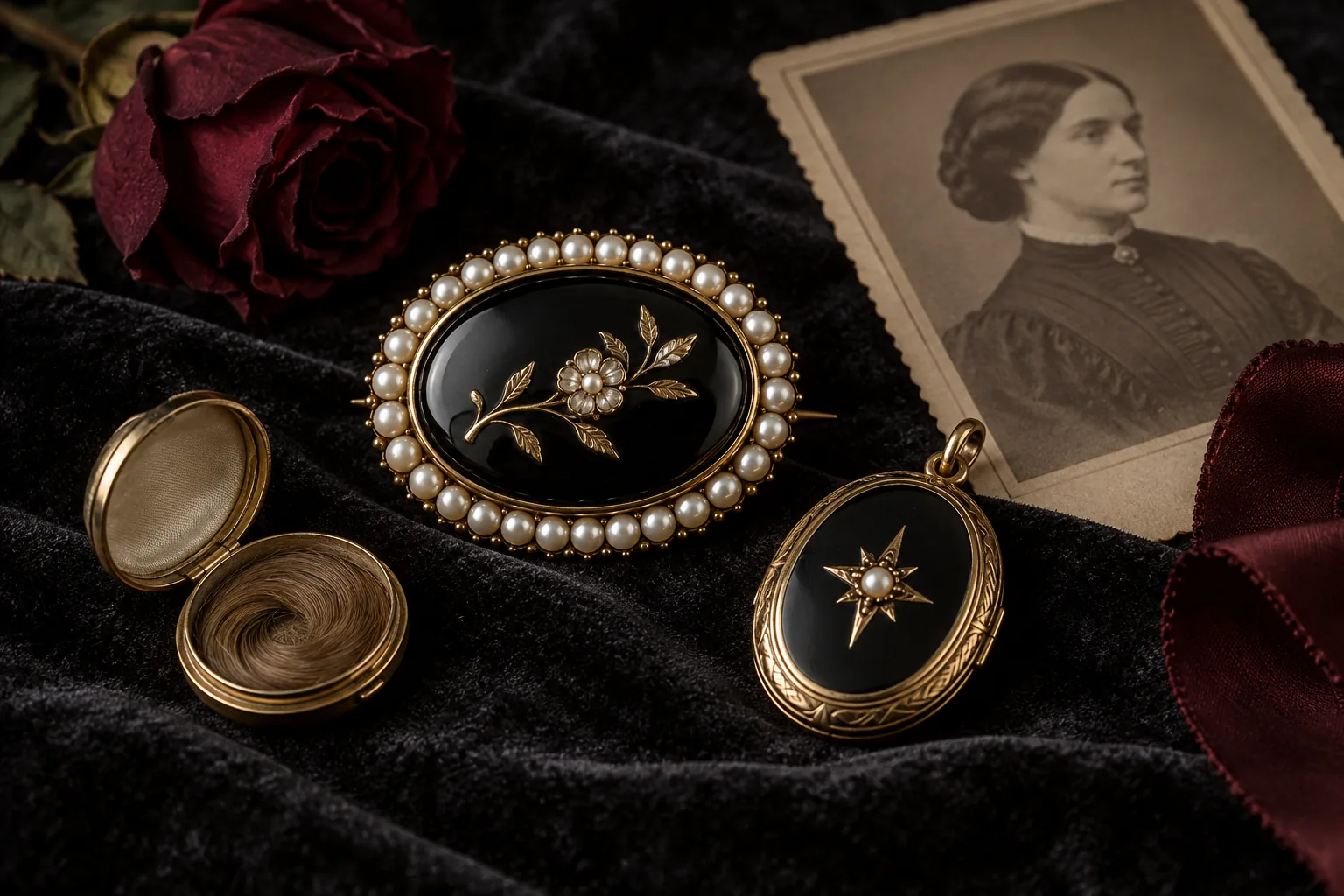
Mourning jewelry preserved memory through inscriptions, portrait miniatures, incorporated hair, dark enamel and black materials, and symbolic motifs; museum collections show these elements across 18th–19th‑century Europe and America, and surviving evidence also makes clear that hairwork was not always made for mourning.
What the surviving objects and museum records show
The Metropolitan Museum of Art’s collection and exhibition documentation make clear that mourning jewelry appears in many forms: brooches and lockets that contain painted portraits or miniatures, pieces set with human hair, rings and pins inscribed with names or dates, and jewels finished in dark enamel or black materials. The Met’s catalog entry for a Tiffany & Co. mourning brooch in its collection is an example of a museum-preserved object that combines materials and personal commemoration.
Museum exhibitions that survey national practices, such as The Metropolitan Museum of Art’s “Jewelry for America,” treat mourning jewels as part of broader social and material histories. Those exhibition materials show how manufacturers, makers, and consumers in the 18th and 19th centuries used specific techniques and materials to record loss, mark status, and express intimate memory in ways that were legible to contemporaries but can be read cautiously today.
The Victoria and Albert Museum’s A–Z of gemstones provides complementary evidence about materials: it catalogues the gemstones and organic materials used in jewelry and explains historical associations that influenced jewellers’ choices. Together, museum collections and reference works establish a material record rather than a single, universal meaning.
Cultures and periods: where and when mourning jewelry appears
Surviving examples and exhibitions emphasize the prominence of mourning jewelry in 18th‑ and 19th‑century Europe and North America. The Metropolitan Museum of Art’s holdings include examples tied to Western makers and consumers who adopted visible signs of mourning and private memorial objects.
Within that broad Western context there are distinct practices. For example, painted portrait miniatures mounted in lockets and brooches were common ways to keep an image close. Hairwork—braided or woven hair set under glass or worked into designs—appears in many objects in museum collections, but documentation in those collections also stresses that such hairwork served a range of sentimental purposes beyond bereavement.
Museum records do not treat these practices as global universals. Collections at Western museums primarily reflect the experiences of European and American makers and owners; other cultures used different materials and customs to mark loss or remembrance, and those practices deserve separate treatment using evidence specific to those places and times.
Documented historical meanings versus modern personal interpretations
Documented historical meanings rely on makers’ marks, inscriptions, contemporary etiquette manuals, and museum interpretation. The Metropolitan Museum of Art’s cataloging and exhibitions emphasize that many mourning pieces served as public or private markers of bereavement and social position; inscriptions and portrait miniatures are clear, contemporaneous evidence of commemorative intention.
Museum documentation also warns against overreading: when hair appears in a piece, the object record may note a funerary function, a keepsake relationship, or unclear provenance. The Museums’ descriptive notes make explicit that context matters, and that not every hairwork or dark‑finished piece was made strictly as a formal mourning jewel.
Modern personal interpretation is different in kind. Contemporary wearers and givers may treat antique mourning jewels as family heirlooms that embody continuity, as fashion statements, or as personal memorials reinterpreted for present needs. Those modern meanings are valid for present users but are not the same as the documented social signals or etiquettes of the original owners.
How motifs, gemstones, and traditions appear in jewelry
Motifs associated with mourning appear repeatedly in surviving pieces. Stylized symbols such as urns, willows, clasped hands, and laid‑down flowers show up in engravings and reliefs preserved in brooches, pendants, and rings. These motifs acted as visual shorthand for grief and remembrance in periods and communities that recognized them.
Gemstones and other materials were chosen for visual effect and symbolic resonance. The Victoria and Albert Museum’s A–Z of gemstones explains how jewelers selected stones and organic materials for color, durability, and cultural associations. Dark materials—black enamel, jet, and onyx among them—were often used because their sombre tones matched contemporary conventions for mourning dress and signaled solemnity.
Hairwork and portrait miniatures are uniquely intimate traditions. Hair could be braided into wearable forms or sealed beneath glass in lockets or brooches; painted miniatures allowed a face to be carried against the body. Museum catalog entries for items such as the Tiffany & Co. mourning brooch in The Metropolitan Museum of Art’s collection provide material evidence of these techniques and their use as personal keepsakes.
Practical and respectful guidance for selecting or gifting mourning jewelry
When selecting antique mourning jewelry for yourself or another, begin by acknowledging the object’s original function and the feelings it may evoke. If the piece contains human hair, treat it as a personal material: consider the family connections and the wishes of any relatives before displaying or altering it.
If you are buying new jewelry intended as a memorial, choose approaches that are consent‑based and respectful. Commissioning a locket with a discreet inscription, a miniature portrait, or a contemporary piece that uses non‑human‑hair materials preserves memory without appropriating practices that may feel intrusive to some recipients.
When gifting, be sensitive to timing and relationship. A mourning jewel given immediately after a death may be welcome in some families but burdensome in others. Explain the item’s provenance if it’s an antique, and offer context about what elements such as inscriptions or hair may mean historically. If you are unsure, a thoughtful alternative is a simple memorial pendant or a charitable donation in the person’s name paired with a small keepsake.
Conservation and ethical considerations
If you inherit or acquire mourning jewelry, conservation matters. Organic materials such as hair, ivory, or early plastics are fragile. Museums such as The Metropolitan Museum of Art document handling and storage practices in their catalog entries; when possible, seek professional conservation advice before attempting repairs or cleaning.
Ethically, museums remind owners and buyers that items with human material require particular sensitivity. Provenance research—tracing ownership and context—can clarify whether a piece was intended as a memorial, a sentimental keepsake, or a fashionable accessory, and it can inform responsible display and interpretation.
Frequently asked questions
What exactly is mourning jewelry?
Mourning jewelry is a category of personal adornment historically used to remember or mark a deceased person. Documented examples in museum collections often include portrait miniatures, pieces that contain hair, inscriptions of names or dates, and items finished in dark materials. Museum records emphasize that these features provide evidence of commemorative intent in many, though not all, surviving objects.
Was hair in jewelry always used for mourning?
No. While many museum examples show hair incorporated into memorial objects, museum documentation also notes that hairwork served broader sentimental purposes, such as keepsakes exchanged among the living. Collections at The Metropolitan Museum of Art and interpretative records make clear that hairwork is evidence of intimacy but not a definitive indicator of funerary use in every case.
Are certain gemstones or materials tied to mourning?
Historically, darker materials and stones were commonly associated with mourning dress and jewelry because of their sombre appearance. The Victoria and Albert Museum’s reference on gemstones explains how jewelers chose stones and organic materials for color, durability, and cultural associations. However, specific meanings varied by place and time, and museum sources caution against universal claims.
Is it appropriate to wear antique mourning jewelry today?
Many people wear antique mourning jewelry as family heirlooms, as expressions of personal memory, or as fashion. Consider the object's provenance and whether it contains human material such as hair. Respectful display and use—alongside an awareness of the piece’s original context—are recommended. If in doubt, consult conservators or museum guidance for handling and care.
How should I gift a memorial piece respectfully?
Choose timing and form carefully. A discreet locket or a contemporary memorial pendant with an inscription may be more appropriate than presenting an antique piece containing human hair. When an antique is involved, share provenance and be sensitive to the recipient’s emotional state and cultural norms.
Sources and further reading
- Tiffany & Co. mourning brooch — The Metropolitan Museum of Art
- An A–Z of gemstones — Victoria and Albert Museum
- Jewelry for America — The Metropolitan Museum of Art