Meaning at a glance
Men in Viking‑period societies wore practical and ornamental brooches, rings, and pendants, but neither wealth nor identity can reliably be inferred from a single object alone; archaeological context and broader assemblages matter.
Quick answer
Men in Viking‑period societies wore practical and ornamental brooches, rings, and pendants, yet wealth and identity cannot be read from a single object in isolation. This reflects the current consensus of museum researchers: individual finds have clear material and contextual value, but firm social meanings require careful interpretation of context and comparison across assemblages.
What the archaeological record and museums actually show
Archaeological finds and museum research provide the foundation for what we can say with confidence about Viking‑period men's jewelry. The National Museum of Denmark describes clothing and jewellery from the Viking Age as both functional and decorative and emphasizes that surviving objects come from specific burial and settlement contexts rather than from a single, universal dress code. The museum’s work focuses on finds from Scandinavian contexts and connected regions during the Viking Age.
The British Museum’s collection catalogues and educational materials document many of the specific object types recovered from Viking‑period sites, including penannular brooches and other fastenings, rings, and small metal pendants. The museum’s object records and gallery materials illustrate how researchers rely on typology, findspot, and manufacturing technique to place objects in time and culture, and they underline interpretive limits when trying to read social meaning from single items.
Common types: brooches, rings, and pendants
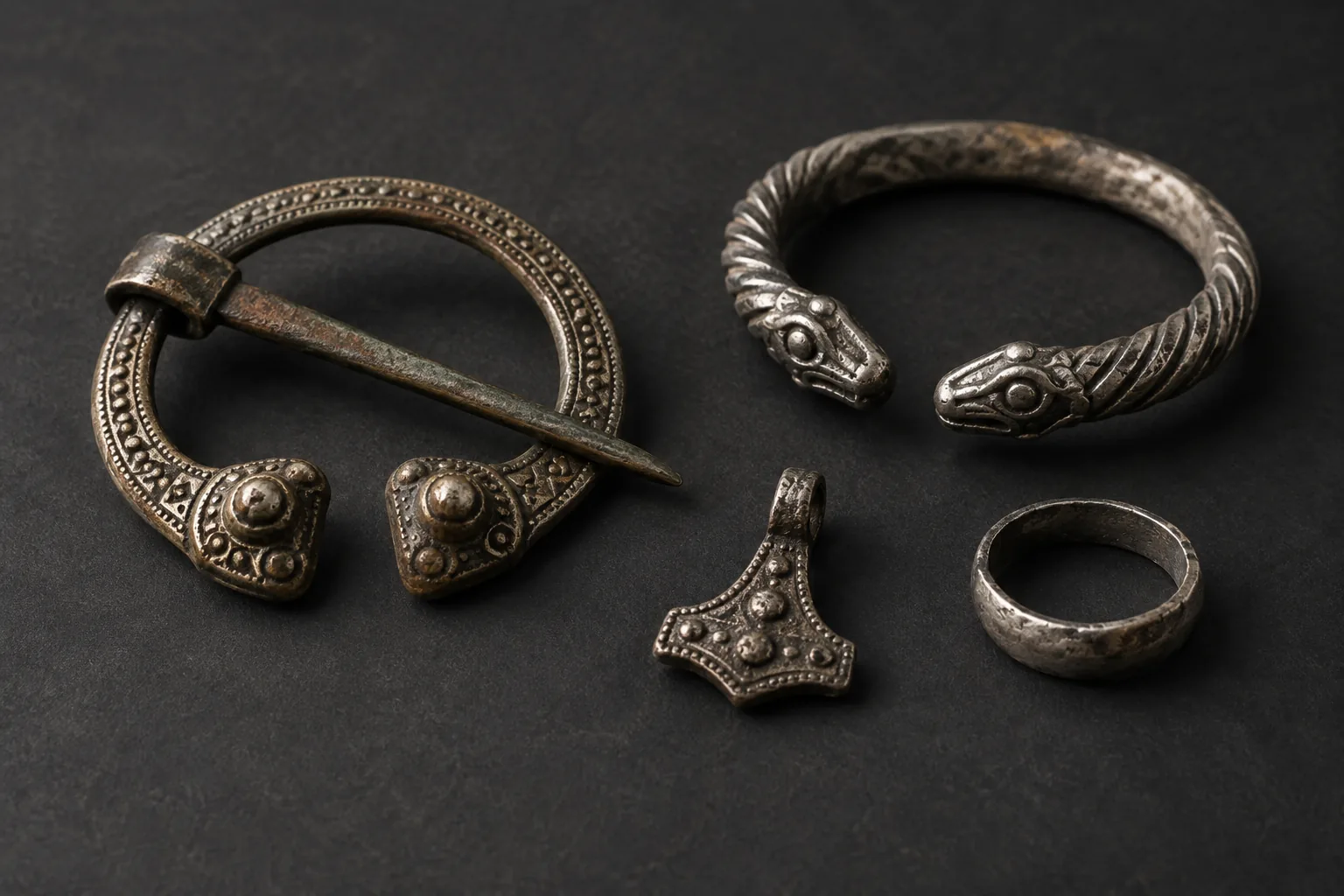
Brooches and pins appear frequently in Viking‑period contexts and often served the dual purpose of fastening clothing and signalling style or status. The British Museum documents penannular brooches as a recognizable form in the archaeological record; these are examples of objects that combine a clear practical function with decorative variation. Brooches appear in different sizes and materials and are found in both male and female contexts, so their presence alone does not define a wearer’s social role.
Rings and arm rings are also common finds. Rings could be simple metal bands used as personal adornment, tokens of exchange, or wearable wealth such as twisted arm rings made of silver or bronze. Museums treat such rings as part of an assemblage: when found in graves or hoards they can indicate wealth or connections to trade networks, but individual rings rarely provide a full social biography on their own.
Pendants range from small plain discs and functional mounts to decorated amulets and symbolic shapes. The British Museum’s exhibits and activities frequently present pendants as personal items that might have been worn for ornament, identification, or as an amulet, but their interpretation depends on context and comparison with other finds.
Documented meanings versus modern interpretations
Museum documentation emphasizes a cautious approach to meaning. The National Museum of Denmark and the British Museum both note that while archaeological context—such as burial position, associated grave goods, and settlement layers—can suggest aspects of identity, belief, or wealth, direct evidence for a single, definitive symbolic meaning is rarely available. An object’s function as clothing fastener or currency is often clearer than its social or religious meaning.
Modern interest in Viking imagery has produced many contemporary interpretations and personal uses of Viking‑style jewellery. These modern meanings—such as seeing a particular motif as a marker of ethnic identity or as expressing a specific spiritual belief—are legitimate personal or group expressions today but should be distinguished from documented uses in the Viking Age. Museums caution that modern symbolic attributions are modern reconstructions unless supported by contemporary written or pictorial sources or by strong archaeological patterns.
How motifs, materials, and traditions appear in Viking jewellery
Decorative motifs and manufacturing techniques are visible across museum collections and object records. The British Museum shows examples of metalwork with interlace, animal ornament, and geometric patterning on brooches and mounts. These decorative choices reflect regional styles and workshop traditions rather than a single, universal symbolism.
Materials recorded by museum collections include base metals such as bronze and more valuable metals such as silver and gold, together with organic or non‑metallic materials like amber and glass beads. The National Museum of Denmark highlights that different materials appear in different contexts and can reflect access to trade networks or regional preferences in dress and ornament. The presence of a valuable material may indicate access to wealth or trade, but where and how an item was found is essential to interpreting its social significance.
Gemstones and beads appear in some finds, usually as components in necklaces or as inlays. Museums present these as components of personal ornamentation and trade rather than as universally interpreted symbols; any specific symbolic meaning for a particular gemstone is an interpretive hypothesis unless supported by contextual evidence.
Practical and respectful selection or gifting guidance
If you are choosing or gifting Viking‑style jewellery today, decide first whether your priority is historical accuracy, contemporary design inspired by Viking motifs, or symbolic personal meaning. For historically informed pieces, prefer items that respect archaeological types and production techniques and come from reputable makers who document their methods. Museum resources and specialist makers often explain when a design is a careful reproduction versus a modern reinterpretation.
When gifting, be transparent about what the piece is intended to represent. If it’s a historically inspired brooch or a modern pendant using a Viking motif, explain that modern meanings are personal rather than archaeological certainties. Consider the recipient’s taste and cultural sensitivity: motifs that some people view as heritage symbols can mean different things to others, so respectful communication about intent matters.
Practical considerations include size and weight—many authentic brooches and arm rings are substantial—and durability of materials. If you want a piece that can be worn daily, choose robust metals and secure fastenings. If provenance and ethical sourcing are priorities, ask the maker or seller about material origins and whether the piece is a reproduction based on known archaeological types.
Conclusion
Archaeological evidence and museum research show that Viking‑period men wore a variety of brooches, rings, and pendants for both practical and ornamental reasons. Museums such as the National Museum of Denmark and the British Museum emphasize that interpreting social meaning requires context and caution. Today’s interest in Viking jewellery mixes historical inspiration with modern personal meanings; respecting that distinction is the best approach when wearing, selecting, or gifting these pieces.
Frequently asked questions
Did all Viking men wear jewelry?
Not necessarily. Archaeological evidence shows that many men in Viking‑period societies wore jewelry such as brooches, rings, or pendants, but the presence and type of jewelry varied by region, social role, and personal choice. Museums stress that surviving finds reflect particular burial and settlement contexts, not uniform practices.
Can a single brooch prove someone was wealthy or high status?
No. Museums including the National Museum of Denmark and the British Museum caution that a single object rarely proves social status on its own. Wealth and identity are best inferred from a combination of objects, the context they are found in, and other archaeological or historical evidence.
Were Viking pendants religious symbols?
Some pendants may have had religious or protective associations, but this cannot be assumed for every pendant. The British Museum presents pendants as personal items that could be ornamental, amuletic, or symbolic depending on context. Determining religious meaning requires strong contextual or textual support.
What materials did Viking‑period jewellery use?
Museum records show a range of materials, including base metals such as bronze and more valuable metals like silver and gold, as well as organic or non‑metallic materials such as amber and glass beads. Material choice can reflect regional preferences, trade connections, and the maker’s resources.
How should I buy or gift a Viking‑style piece respectfully?
Decide whether you want a historically informed reproduction or a modern interpretation and choose a reputable maker who documents their methods. Be transparent about the piece’s intended meaning and consider the recipient’s views on cultural symbols.
Where can I see authentic Viking jewellery?
Major museums with Viking collections, such as the National Museum of Denmark and the British Museum, display authentic finds and provide curatorial explanations about context, typology, and interpretation.
Sources and further reading
- Clothes and jewellery — National Museum of Denmark
- Viking penannular brooch — The British Museum
- Vikings gallery activities — The British Museum