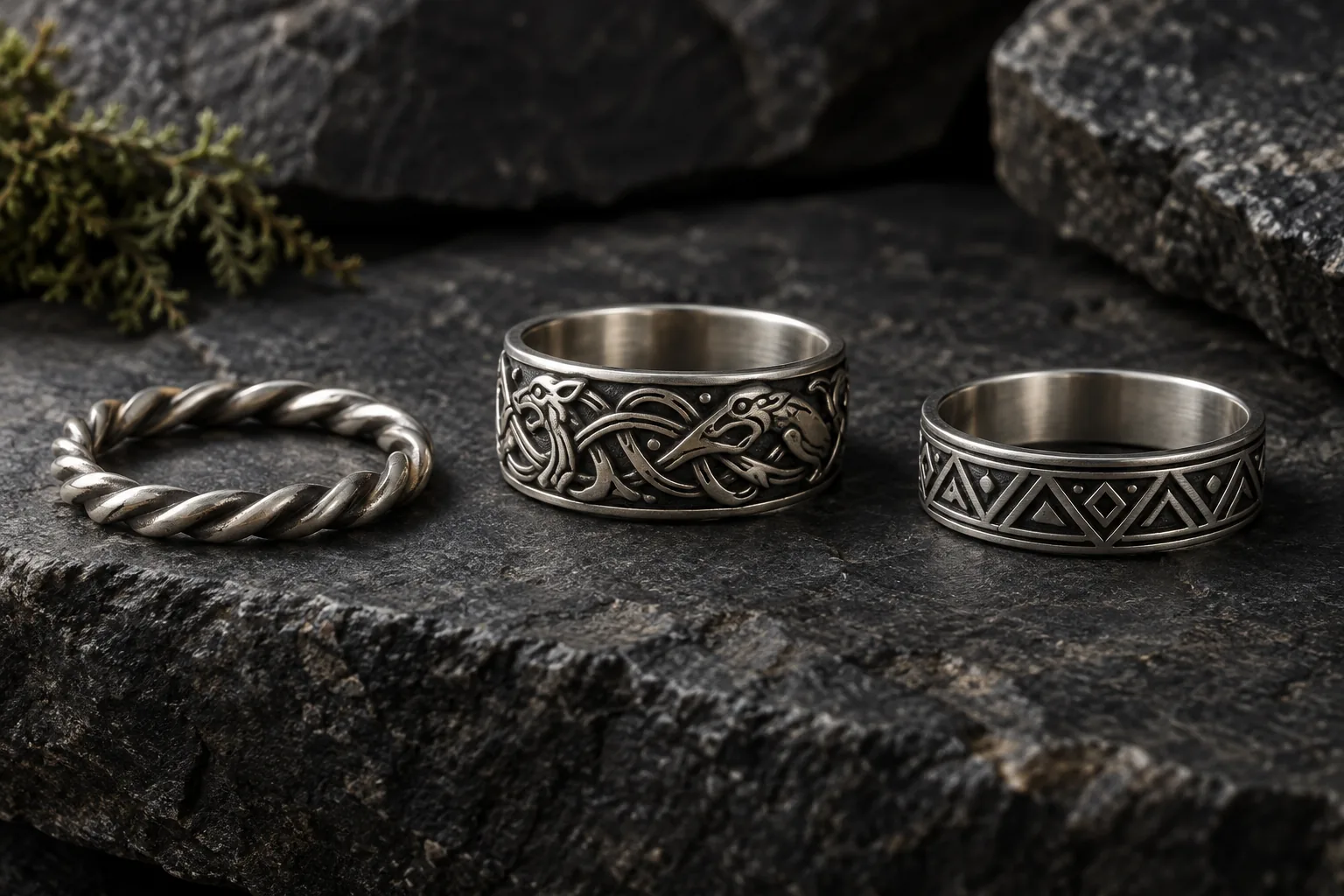
Meaning at a glance
A responsible Viking-style ring guide starts with construction, metal, motif provenance, fit, and seller disclosure rather than treating every knot or rune as historically authenticated.
What the archaeological evidence actually shows
Archaeological finds and museum collections provide the baseline for what we can say about Viking Age rings and jewelry. The National Museum of Denmark's summary of "Clothes and jewellery" presents material evidence that people in the Viking Age wore a range of metal ornaments and used metalwork as both dress and wealth. The British Museum's object record for a "Viking hacksilver arm-ring" and its educational materials in the Vikings gallery likewise show that rings and arm-rings appear as metal objects, sometimes used in payments or as portable wealth rather than solely as decorative or symbolic items.
From these museum records we can reliably identify the sorts of objects that survive in the archaeological record: solid metal rings and arm-rings, examples of twisted-wire and stamped decoration, cast metal pieces and broken fragments treated as hacksilver. Museums emphasize material evidence and also note interpretive limits: the presence of a motif or a rune on an object does not automatically prove a single, fixed symbolic meaning across time and place.
Which periods and cultures are represented by 'Viking' finds
When you read about "Viking" rings, the term usually refers to objects associated with Scandinavian cultural spheres during the Viking Age as represented in museum collections. Institutions like the National Museum of Denmark and the British Museum classify these finds by their archaeological context and typology rather than by a single cultural meaning. The surviving material is regionally varied across Scandinavia, the British Isles, and areas with Viking activity, so provenance details matter for interpretation.
Documented historical functions versus modern meanings
The historical record as represented in museum holdings supports a range of practical and status-related functions for rings: personal adornment, markers of wealth, and items that could be cut or melted for use as hack-silver. Museums that catalogue Viking material stress that many symbolic meanings attributed in modern popular accounts are interpretive or modern reconstructions rather than direct, documented facts.
Modern personal and spiritual meanings—such as assigning a specific rune or knot a universal protective power—are contemporary layers placed on the material. These modern interpretations can be meaningful to wearers today, but they should be distinguished from what is directly evidenced by archaeology and museum curation. The British Museum and the National Museum of Denmark both signal this distinction by documenting objects and cautioning against over-interpretation of motifs without context.
How common Viking motifs and features appear in jewelry
Motifs you will see in modern Viking-style rings—runes, interlace or knotwork, animal heads, and hammer shapes—appear in varying degrees in archaeological material, but their frequency and form depend on region and status. Museums show examples of stamped decoration, stylized animal forms and inscribed objects, and they document the metalworking techniques used to produce them. These museums present the objects and their contexts rather than asserting one-to-one symbolic meanings.
Gemstones and glass inlays are present in some high-status finds, but bulk archaeological evidence emphasizes metalwork—bronze, silver and sometimes gold—often fashioned into rings, arm-rings and other personal items. The technical appearance in jewelry can include cast terminals, twisted-wire bands, and stamped or punched ornament. Modern makers reproduce these techniques in contemporary materials, so paying attention to construction tells you whether a piece is a handcrafted reproduction, a mass-market copy, or an original-era object.
Practical buying criteria: construction, metal, provenance, fit, and disclosure
Construction: examine how a ring is made. Solid casting, lost-wax reproduction and hand-twisted wire are different techniques that affect durability and price. Museums document metalworking techniques and the kinds of wear visible on genuine archaeological items; look for honest descriptions of technique and photos of close detail when buying. For wearable everyday jewelry choose sound construction and verified metal content to avoid allergic reactions or rapid wear.
Metal and marks: ask sellers for metal composition and any hallmarks or assay information. Museum pieces show that bronze, silver and gold were used historically, and modern replicas may use contemporary alloys. Reputable sellers will disclose whether an item is sterling silver, bronze, gold-plated, or base metal with an antiqued finish. If authenticity is claimed, request provenance and documentation rather than relying on marketing language.
Motif provenance: when a ring is sold as "Viking" because it bears a knot, rune or hammer motif, request the basis for that claim. Museums and curators document specific finds and typologies; a motif reproduced from a named archaeological object or catalogue can be traced to that context. If a seller cannot tell you which find or region inspired a motif, treat the design as "Viking-inspired" rather than historically proven.
Fit and function: consider whether you want a finger ring or an arm-ring. The British Museum's hacksilver arm-ring records highlight that some rings in the archaeological record were designed as larger, heavier arm-rings used as wealth or currency. For wearable comfort, check the band width, interior finish and how a heavier historically accurate replica will feel in everyday wear. Get accurate finger sizing and ask about resizing options before purchase.
Seller disclosure and language: prefer listings that separate historical description from modern interpretation. Responsible listings will say if a motif is a modern interpretation or based on a specific archaeological example. Museums underline interpretive limits in their descriptions, and a trustworthy seller will do the same rather than promising universal or ancient powers linked to a motif.
Respectful selection and gifting guidance
Be mindful of language and cultural sensitivity when choosing or gifting a Viking-style ring. Avoid presenting a piece as a definitive cultural emblem unless it is accompanied by clear provenance and context. If a recipient has Norse heritage or practices a living tradition that uses these symbols, ask discreetly about preferences and significance. Museums remind us that objects can have multiple layers of meaning, and contemporary beliefs and personal identity matter as much as archaeological provenance.
When gifting, include information: a short note that explains whether the item is an inspired design or a reproduction of a documented find, and where possible cite the museum or typology that inspired the piece. This shows respect for historical complexity and gives the recipient the option to learn more.
Care, maintenance, and long-term value
Care depends on metal and finish. Sterling silver requires occasional cleaning to reduce tarnish; bronze can develop a patina that some wearers value. If the ring contains stones or inlay, follow the care instructions for those materials. Museums preserve original items in controlled environments; replicas meant for wear will withstand everyday use if constructed properly but will need routine care.
Consider documentation for long-term value: a reproduction copied from a named museum object with clear maker details and durable materials can retain aesthetic and educational value, but do not equate reproduction with archaeological provenance. If you are seeking an investment object, ask for certificates and provenance rather than symbolic claims.
Final takeaway
Use material evidence, builder transparency and respectful interpretation as your checklist: verify construction and metal, ask for the provenance of motifs, ensure correct sizing, and prefer sellers who distinguish documented archaeology from modern meanings. Museums such as the National Museum of Denmark and the British Museum provide the reference examples and cautionary context that should guide thoughtful buying and gifting of Viking-style rings.
Frequently asked questions
Are runes on rings historically common and do they have fixed meanings?
Runes appear on some archaeological objects, but museum records caution that there is not always a single fixed meaning that applied universally. Institutions such as the British Museum and the National Museum of Denmark document individual inscribed objects and emphasize interpretive limits, so modern attributions of universal meanings should be treated as contemporary interpretations unless tied to specific archaeological context.
What metals did Viking Age rings typically use?
Museum collections show that bronze, silver and occasionally gold were used in personal metalwork. The National Museum of Denmark and the British Museum document these materials in their catalogues and notes on clothing and jewellery. Modern replicas may use different alloys for durability and cost, so ask sellers for metal composition.
Were gemstones common in Viking rings?
Gemstones and glass inlays are present in some high-status finds, but the broader archaeological record emphasizes metalwork. Museums present examples where stones occur, but most everyday metal items found are plain metal or decorated by metalworking techniques rather than gem-set.
How should I size a historically inspired arm-ring or ring for wear?
Check the intended function: arm-rings in the archaeological record are larger and heavier and were sometimes used as portable wealth, while finger rings are sized for the hand. Measure the recipient's finger or wrist accurately and factor in band width and interior finish. If the seller permits, try on before final purchase or confirm resizing options.
If a seller calls a motif 'Viking', how can I verify that claim?
Ask the seller for the source: a museum catalogue number, a publication, or the specific archaeological find that inspired the design. Museums such as the National Museum of Denmark and the British Museum provide reference examples; if a seller cannot provide a traceable source, treat the item as "Viking-inspired" rather than historically authenticated.
Is it respectful to gift Viking-style jewelry to someone with Scandinavian heritage?
Gifting can be respectful if it is done with sensitivity. Include clear information about whether the piece is an inspired reproduction or linked to a specific archaeological object. If the recipient follows a living tradition or has strong cultural views, ask about preferences discreetly and avoid presenting modern interpretations as historical fact.
Sources and further reading
- Clothes and jewellery — National Museum of Denmark
- Viking hacksilver arm-ring — The British Museum
- Vikings gallery activities — The British Museum