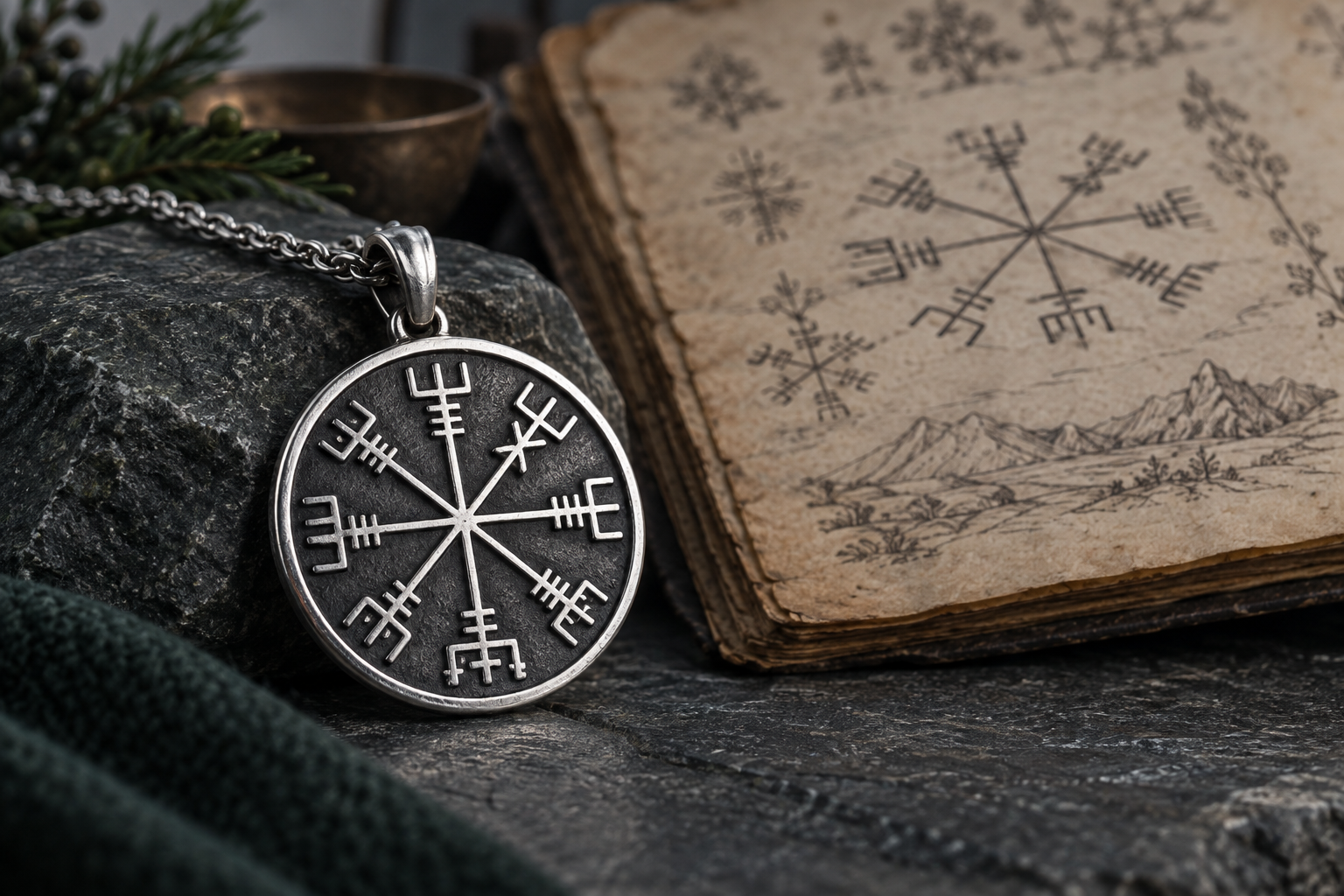
Meaning at a glance
Vegvisir is an Icelandic magical stave documented in later manuscript tradition rather than in securely attested Viking Age sources; contemporary jewelry uses the motif as a wayfinder symbol representing guidance, direction, and resilience.
Direct answer: what vegvisir means
Concise answer: Vegvisir is an Icelandic magical stave preserved in later manuscript tradition and is not securely attested as a Viking Age symbol. In modern use—especially in jewelry—the motif is commonly presented as a wayfinder or 'compass' symbol invoking guidance, direction, and resilience.
This short answer follows the scholarly assessment that the sign belongs to the corpus of Icelandic magical staves as transmitted in manuscript collections rather than to archaeology or Viking Age textual sources (De Gruyter). The familiar graphic that people call vegvisir today is preserved in post‑Viking manuscript tradition, for example in the Huld manuscript (Gelmir).
Historical evidence: what the sources actually show
The historical record for vegvisir comes from Icelandic manuscript collections of magical signs rather than from runic inscriptions, contemporary saga texts, or Viking Age archaeological contexts. Academic discussion places vegvisir within the Icelandic grimoire tradition as recorded in later manuscripts, and not as a motif demonstrably used in the Viking Age (De Gruyter).
The Huld manuscript preserves the familiar graphic that most people today recognize as vegvisir; the manuscript is part of the Icelandic manuscript tradition that handed down many such staves (Gelmir). These manuscripts collected magical diagrams and instructions as part of a learned Icelandic folkloric and magical practice: their presence in manuscripts indicates transmission through literary and scribal contexts rather than direct archaeological continuity from the Viking Age.
Because the evidence is manuscript‑based and arrives later in the textual record, scholars treat claims that vegvisir was a 'Viking compass' as modern interpretations rather than documented historical fact. In short, the motif is historically Icelandic in the manuscript tradition, but not securely attested as a symbol used in the Viking Age (De Gruyter).
Documented meanings versus modern interpretations
Documented historical meaning: the academic record shows vegvisir as one of several Icelandic magical staves preserved in manuscript sources. That is a descriptive claim about provenance and transmission rather than a single, unbroken meaning. The manuscripts present staves in contexts of folk magic, ritual instruction, or talismanic use, but they do not provide a single consistent 'translation' equivalent to a modern slogan (De Gruyter; Gelmir).
Modern personal and popular interpretations: over the last century vegvisir has been widely reinterpreted in popular culture and spiritual communities as a 'Viking compass' or an emblem of finding one's way. Contemporary users and jewelry makers commonly describe it as a wayfinder that represents guidance, safe travel, inner direction, perseverance, and resilience. These are contemporary meanings layered onto the historic stave and reflect modern needs for symbolic language rather than direct documentary continuity from the manuscripts.
It is important not to conflate the two. The manuscript provenance is a historical fact; the popular meaning as a personal or cultural symbol of guidance is a modern adoption and reinterpretation. Neither position is inherently wrong, but they answer different questions: one about historical evidence, the other about current symbolic use.
How the vegvisir motif appears in jewelry
In contemporary jewelry, vegvisir appears most often as a small round or starburst motif that echoes the design preserved in manuscripts. Jewelry makers reproduce the stave in pendants, rings, bracelets, earrings, and charms. The motif is commonly rendered as an engraved or cast design and may appear on flat discs, raised medallions, or as openwork patterns.
Materials vary widely. Sterling silver and stainless steel are frequent for pendants and rings because their contrast highlights the engraved lines, but vegvisir designs also appear in bronze‑finish pieces, wood carvings, leatherwork, and mixed‑media items. Some artisans inset the motif into bezel frames or combine it with enamel for color.
Gemstones and paired motifs are a modern interpretive choice rather than a historic prescription. Sellers and designers often pair vegvisir with stones that symbolize guidance or protection in contemporary metaphysical practice—examples include moonstone for intuition or labradorite for inner strength—but these pairings reflect present‑day symbolic systems rather than documented medieval Icelandic practice.
Design variations are common. Some pieces reproduce the manuscript form closely, while others simplify or stylize the lines so the motif reads as a compass rose, a sunburst, or a Nordic‑inspired emblem. Because vegvisir is now part of contemporary design vocabulary, you will see minimalist versions, ornate medieval‑style settings, and combined motifs such as the stave alongside runes or other symbolic images.
Choosing or gifting vegvisir jewelry with respect
If you are choosing vegvisir jewelry for yourself or as a gift, begin by being mindful of what you intend the symbol to represent. If you value the motif as a personal wayfinder—signifying guidance, resilience, or safe travel—state that intention when you give the piece. That helps the recipient understand that the gift is grounded in contemporary symbolism rather than a claim about historical appropriation.
If the recipient has Icelandic heritage or a particular interest in Norse history, be especially respectful about how you describe the symbol. Avoid asserting that vegvisir is an authentically Viking emblem if your aim is historical accuracy; instead say it is an Icelandic magical stave preserved in later manuscripts and now used as a modern symbol. This distinction honors both the manuscript tradition and the difference between academic evidence and popular meaning.
Practical selection tips: for everyday wear choose durable metals such as sterling silver or stainless steel and prefer solid‑construction pendants and secure clasps. For items intended as heirlooms, consider higher‑grade materials and simple, classic settings that allow the motif to remain legible over time. If you want to pair the symbol with a gemstone, select a stone whose modern symbolism aligns with your intended meaning, and ask the maker about stone setting and care.
Personalization and presentation: consider engraving a short personal message or date on the back of a pendant to tie the symbolic meaning to a specific life event. If gifting, include a brief note explaining why you chose the vegvisir motif and what it symbolizes for you; that context is often treasured more than the object alone.
Care, authenticity, and cultural sensitivity
Care: follow standard care instructions for the chosen metal and any stones. Clean sterling silver with appropriate cloths, avoid harsh chemicals on stones and finishes, and store pieces to limit scratching and tarnish.
Authenticity: no single official 'vegvisir' design exists beyond the manuscript tradition; many modern makers credit their interpretation or indicate that the design is inspired by Icelandic staves. If a historically faithful reproduction matters to you, look for makers who reference manuscript images or who document the design source.
Cultural sensitivity: wearing or gifting vegvisir is widely accepted in contemporary fashion and spiritual practice. Responsible use includes acknowledging the motif's Icelandic manuscript origins and avoiding marketing language that presents vegvisir as an unequivocal Viking or ethnic emblem if historical accuracy is claimed. Honest description respects both scholarship and personal meaning.
Frequently asked questions
Is vegvisir an authentic Viking symbol?
No. Scholarly sources indicate that vegvisir is an Icelandic magical stave preserved in later manuscript tradition and not securely attested as a Viking Age symbol (De Gruyter). The familiar graphic is transmitted in post‑Viking manuscripts such as the Huld manuscript (Gelmir).
What does vegvisir mean?
Historically, vegvisir is the name given to a type of Icelandic magical stave in manuscript collections. In modern usage, particularly in jewelry, it is commonly interpreted as a wayfinder symbol representing guidance, direction, and resilience.
Can vegvisir protect sailors or travelers?
The manuscripts that preserve vegvisir are part of Icelandic magical tradition and include talismanic material, but modern claims that it will literally protect sailors reflect contemporary spiritual interpretation rather than proven historical practice. Treat such protective claims as modern belief rather than established historical fact (De Gruyter).
Is it appropriate to wear vegvisir if I'm not Icelandic?
Yes, many people wear vegvisir as a personal symbol of guidance. It is respectful to acknowledge the motif's Icelandic manuscript origins and avoid presenting it as an unequivocal Viking or ethnic emblem if claiming historical authenticity.
How do I choose vegvisir jewelry for a gift?
Choose durable materials for everyday wear, prefer clear and well‑executed motifs so the stave remains legible, and include a note explaining the meaning you intend. If historical accuracy matters to the recipient, select makers who cite manuscript sources or produce faithful reproductions.
Where does the commonly seen vegvisir design come from?
The familiar design is preserved in the Icelandic manuscript tradition; the Huld manuscript is one of the places where the motif appears in the form many people recognize today (Gelmir).
Sources and further reading
- Guidance from ancient symbols: Vegvísir, Ægishjálmur and other galdramyndir — De Gruyter
- Huld manuscript — Gelmir