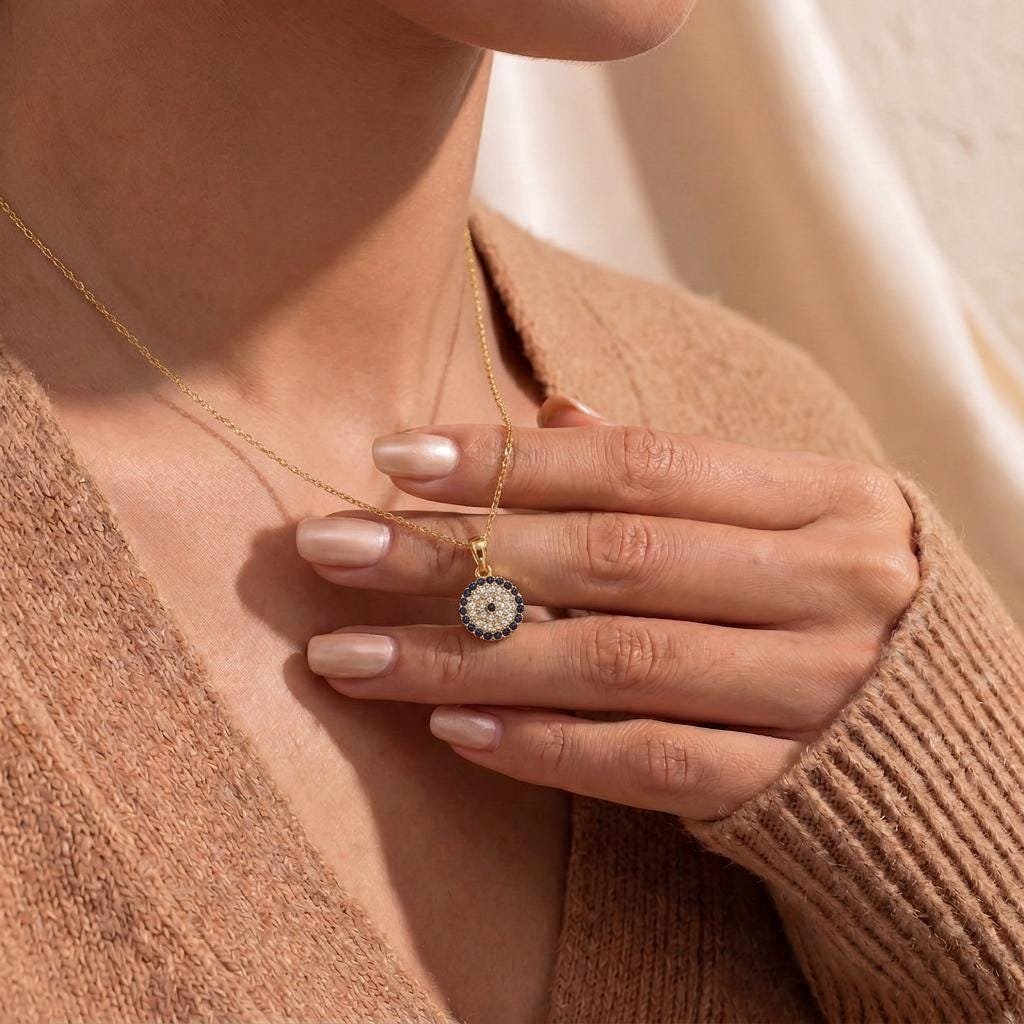
Meaning at a glance
Evil eye jewelry is generally worn as an apotropaic amulet intended to turn away an envious or harmful gaze, but its forms, names, and religious or cultural associations vary across regions and periods.
Direct answer
Evil eye jewelry meaning: historically and today, such pieces are most often intended as apotropaic objects—amulets worn to avert or deflect an envious, harmful, or malevolent gaze. The exact symbolism, name and religious associations differ by culture and historical period.
Historical evidence by culture and period
Ancient Egypt: Museum scholarship shows Egyptians used eye-shaped amulets with protective and restorative associations, often placed on the body or included in burials. The Metropolitan Museum of Art describes a wide range of Egyptian amulets worn on the body for protection, healing and other apotropaic purposes (The Metropolitan Museum of Art). The Egyptian wedjat (Eye of Horus) appears in the Met’s collection as a distinct protective/healing symbol rather than the same thing as later ‘‘evil eye’’ amulets (The Metropolitan Museum of Art).
Byzantium (Eastern Roman Empire): Byzantine wearable art includes objects explicitly designed to protect the wearer. Smarthistory’s survey of Byzantine wearable art notes the continued use of personal protective jewelry in the region and period, showing continuity of amulet use into late antiquity and the medieval era (Smarthistory).
Middle East and North Africa: Museum objects and cataloguing link personal amulets and pendants with protective functions across Jewish and Muslim contexts in the Middle East and North Africa. The British Museum’s recorded objects (for example, pendant Amulet; pendant (As1966,01.440)) document amulets that have been used in Jewish and Muslim communities and connect particular motifs—such as the khamsa/hand motif—to those regional practices (The British Museum).
Documented historical meanings vs. modern personal interpretations
Documented historical meanings: Museum descriptions and object records consistently treat these items as protective amulets—objects worn or carried on the body to avert danger, illness or evil influences. The Metropolitan Museum of Art and Smarthistory frame many of these artifacts in functional terms: amulets with apotropaic purposes, sometimes tied to healing or regeneration in the case of specific Egyptian motifs such as the wedjat (The Metropolitan Museum of Art; Smarthistory). The British Museum’s object records show similar protective functions recorded for amulets in Middle Eastern contexts and note association with Jewish and Muslim users (The British Museum).
Modern personal interpretations: Contemporary wearers and designers often layer meanings—spiritual protection, fashion statement, cultural identity, or personal reminder. These modern associations are subjective and not universally shared: while museums document historical protective intentions, modern interpretations can be devotional, secular, political, aesthetic, or simply sentimental. Distinguish clear archaeological and curatorial descriptions in museum records from the range of modern personal meanings people ascribe to similar motifs today.
How the motif and tradition appear in jewelry
Forms: Across time and regions, protective eye motifs and related amulets appear as pendants, pendants sewn into clothing, beads on strings or necklaces, and small objects intended to be carried or worn (The Metropolitan Museum of Art; Smarthistory; The British Museum). Museum records indicate these items were commonly integrated into everyday wearable forms.
Materials and techniques: Museum collections document a variety of materials—faience, glass, metal, and other materials used to make small amulets and inlaid eyes—crafted to be wearable. The Metropolitan Museum of Art’s essays and object records, and the British Museum’s catalogue entries, describe amulets made from durable materials designed for body wear (The Metropolitan Museum of Art; The British Museum).
Motifs and names: The same broad idea—an object intended to ward off harm—shows up under different names and motifs. For example, the Egyptian wedjat-eye (Eye of Horus) is historically associated with healing and regeneration and is treated as a distinct symbol in museum scholarship; it is not necessarily identical in meaning or form to later Middle Eastern ‘‘evil eye’’ amulets (The Metropolitan Museum of Art). The British Museum identifies other regional motifs, such as the khamsa (hand motif) recorded in Middle Eastern and North African contexts, linked to protective use in Jewish and Muslim communities (The British Museum).
Practical and respectful selection or gifting guidance
Understand the recipient’s context: Ask or consider whether the recipient identifies with the cultural, religious or symbolic meanings attached to such amulets. Because names, forms and associations vary by community, a respectful gift reflects the recipient’s background and preferences.
Prefer provenance and maker transparency: Choose a piece from a maker or source that lists materials and origin. Museum records show these symbols have long and varied histories; selecting jewelry with clear provenance respects that complexity.
Choose the right material for wear and care: Select materials appropriate to the recipient’s skin (hypoallergenic metals if needed) and lifestyle. Museum examples show amulets made of metal, faience, glass and other durable materials—each has different cleaning and care needs (The Metropolitan Museum of Art; The British Museum).
Avoid assuming universal protective power: Some wearers treat these items as spiritual protection; others wear them for cultural identity or style. Phrase a gift thoughtfully—e.g., “I thought you might like this symbol as a meaningful piece” rather than making universal claims about its power.
Be culturally sensitive: If a design is associated with a religious community, consider whether an alternative that nods to the motif without appropriating sacred elements would be better. If uncertain, ask a trusted person from the relevant community for guidance.
Explain the object if appropriate: A short note that mentions the motif’s historical use as a protective amulet (and cites that museums document this use) can provide respectful context and show your awareness of the symbol’s history.
Frequently asked questions
What does evil eye jewelry mean?
Historically, museum records describe these items as apotropaic amulets—objects worn or carried to avert harm, jealousy or ill intent. Modern wearers may also attach personal, aesthetic or cultural meanings that vary by individual.
Is the Eye of Horus the same as the evil eye?
No. Museum scholarship treats the Egyptian wedjat (Eye of Horus) as a distinct symbol with associations of protection and healing; it is not identical to later ‘‘evil eye’’ amulets that appear in other regions (The Metropolitan Museum of Art).
Can anyone wear evil eye jewelry?
Yes—objects in museum collections show protective amulets were worn by many different people across cultures. Still, be mindful of cultural and religious associations and the recipient’s preferences when gifting or wearing such symbols.
How do I pick a respectful gift of this kind?
Consider the recipient’s cultural and religious background, choose a piece with clear provenance and materials suited to wear, and include a short note explaining the motif’s historical use as a protective amulet rather than asserting universal power.
Where can I learn more about historical amulets?
Museum essays and object records are a good starting point. The Metropolitan Museum of Art and the British Museum maintain essays and catalog entries on amulets and protective objects; academic resources such as Smarthistory offer context about wearable art in specific periods.
Sources and further reading
- Ancient Egyptian Amulets — The Metropolitan Museum of Art
- Amulet; pendant (As1966,01.440) — The British Museum
- Wearable Art in Byzantium — Smarthistory
- Wedjat Eye Amulet — The Metropolitan Museum of Art